---
author:
- contributor_roles: []
family: Edmunds
given: Scott
url: https://orcid.org/0000-0001-6444-1436
blog:
authors: null
community_id: 52db0518-e228-4260-8c54-c4e323b2569d
created: 1675555200
current_feed_url: null
description: Data driven blogging from the GigaScience editors
doi: https://doi.org/10.59350/gigablog
favicon: https://rogue-scholar.org/api/communities/52db0518-e228-4260-8c54-c4e323b2569d/logo
feed_format: application/atom+xml
feed_url: http://gigasciencejournal.com/blog/feed/atom/
filter: null
generator: Other
home_page_url: https://gigasciencejournal.com/blog
issn: null
language: eng
license: https://creativecommons.org/licenses/by/4.0/legalcode
prefix: '10.59350'
relative_url: null
secure: false
slug: gigablog
status: archived
subfield: '1311'
title: GigaBlog
updated: null
use_api: null
container: GigaBlog
date: '2018-08-31T00:00:00+00:00'
date_updated: '2025-12-06T10:25:19+00:00'
guid: http://gigasciencejournal.com/blog/?p=2469
identifier: https://doi.org/10.59350/zvk4r-9ba55
image: http://gigasciencejournal.com/blog/wp-content/uploads/2018/08/macaque-265x300.jpg
images:
- alt: Monkey microbiome
height: '119'
sizes: '(max-width: 132px) 100vw, 132px'
src: http://gigasciencejournal.com/blog/wp-content/uploads/2018/08/monkey_microbiome-300x270.png
srcset: http://gigasciencejournal.com/blog/wp-content/uploads/2018/08/monkey_microbiome-300x270.png,
http://gigasciencejournal.com/blog/wp-content/uploads/2018/08/monkey_microbiome.png
width: '132'
- alt: Monkey microbiome
height: '200'
src: http://gigasciencejournal.com/blog/wp-content/uploads/2018/08/100064_GutMicrobiota.jpg
width: '184'
- height: '300'
sizes: '(max-width: 265px) 100vw, 265px'
src: http://gigasciencejournal.com/blog/wp-content/uploads/2018/08/macaque-265x300.jpg
srcset: http://gigasciencejournal.com/blog/wp-content/uploads/2018/08/macaque-265x300.jpg,
http://gigasciencejournal.com/blog/wp-content/uploads/2018/08/macaque-768x870.jpg,
http://gigasciencejournal.com/blog/wp-content/uploads/2018/08/macaque-904x1024.jpg,
http://gigasciencejournal.com/blog/wp-content/uploads/2018/08/macaque.jpg
width: '265'
issn: null
keywords:
- Biology
- BGI
- Genome
- GigaDB
- Metagenomics
lang: en
license: https://creativecommons.org/licenses/by/4.0/legalcode
rid: kayea-g1f89
rights: https://creativecommons.org/licenses/by/4.0/legalcode
summary: Monkey Microbiome Business Research just
out in GigaScience introduces the macaque monkey to the microbial gene catalogue
club, joining other important model organisms including the (also recently published
in GigaScience) Rat, Mouse, Pig and Cow.
title: Of Mice and Men (and Monkey) Microbiomes.
url: https://wayback.archive-it.org/22098/2025-05-01T17:13:42Z/http://gigasciencejournal.com/blog/monkey-microbiome
version: v1
---
***Monkey Microbiome Business***
*{.alignleft
.wp-image-2470 loading="lazy" decoding="async"
srcset="http://gigasciencejournal.com/blog/wp-content/uploads/2018/08/monkey_microbiome-300x270.png 300w, http://gigasciencejournal.com/blog/wp-content/uploads/2018/08/monkey_microbiome.png 700w"
sizes="(max-width: 132px) 100vw, 132px" width="132"
height="119"}Research just [out in
GigaScience](https://doi.org/10.1093/gigascience/giy100) introduces the
macaque monkey to the microbial gene catalogue club, joining other
important model organisms including the (also [recently
published](https://doi.org/10.1093/gigascience/giy055) in GigaScience)
Rat, Mouse, Pig and Cow. To explain more, in this posting we give some
insight into what this data shows, and how this growing library of gut
microbial genes can be used to better understand human health.*
{.alignright
.size-full .wp-image-2474 loading="lazy" decoding="async" width="184"
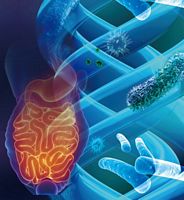
height="200"}While the famous quote that there are [10 times as many
microbial cells cells in the human body as there are human cells
]{.ILfuVd .yZ8quc}has [been scaled back a
bit](https://www.nature.com/news/scientists-bust-myth-that-our-bodies-have-more-bacteria-than-human-cells-1.19136),
there is no doubt that in terms of numbers of genes we are massively out
numbered by genes in our \"other genome\", [the
microbiome](https://en.wikipedia.org/wiki/Microbiota). In 2014 our
colleagues at BGI [published](https://www.nature.com/articles/nbt.2942)
an integrated catalogue of reference genes in the human gut microbiome;
combining 6.4TB whole-genome shotgun sequencing data from the
[MetaHIT](http://dx.doi.org/10.1038/nature08821) consortium, the Human
Microbiome Project ([HMP](http://www.hmpdacc.org/HMASM/)) and a
[diabetes study on Chinese adults.](http://dx.doi.org/10.5524/100036)
The final high-quality reference catalogue contained 9,879,896
non-redundant genes, and to aid the sharing of this massive dataset we
hosted it openly [in our GigaDB
repository](http://dx.doi.org/10.5524/100064). With the aim of
facilitating quantitative characterization of multi-omics data from the
gut microbiome to understand its variation across populations in human
health and disease, this data has been the most downloaded and popular
dataset in our GigaDB repository. The tens of thousands of downloads
hopefully demonstrating the utility and use of this dataset.
Following this approach research groups from the Institute of
Metagenomics of BGI Research have continued this work in other model
organisms, [publishing](https://doi.org/10.1038/nbt.3353) and [releasing
via GigaDB](http://dx.doi.org/10.5524/100114) the microbial gene
[catalogue of the mouse](http://dx.doi.org/10.5524/100114) in 2015, the
[pig microbial catalogue](http://dx.doi.org/10.5524/100187) in 2016, and
just recently published the gene
[catalogue](http://dx.doi.org/10.5524/100440) of the [Sprague-Dawley rat
gut metagenome in
*GigaScience*](https://doi.org/10.1093/gigascience/giy055). Our
microbiome may seem complicated, but the 9.9M genes in the human gut
microbiomes are outnumbered by the 13.8M genes in a the cow rumen, with
data [out in GigaDB](http://dx.doi.org/10.5524/100391) earlier this year
and a [preprint describing this](https://doi.org/10.1101/272690) also
out.
**Monkey News**\
Latest to join this microbiome club is the monkey, with a [publication
just out](https://doi.org/10.1093/gigascience/giy100) in *GigaScience*
describing the construction of the first *Macaca fascicularis* gut
microbiome gene catalogue, and data again [out in
GigaDB](http://dx.doi.org/10.5524/100470). *Macaca fascicularis*, or
the [cynomolgus or [crab-eating]{.st}
macaque](https://en.wikipedia.org/wiki/Crab-eating_macaque), is a
primate whose genetics and physiology are close to humans, making it an
important model in biomedical research and drug development. However,
detailed information of cynomolgus macaque gut microbiota had not been
well developed.
In order to construct the cynomolgus macaque gut microbial gene
catalogue and explore differences of cynomolgus macaque gut microbiome
under different diet conditions, 20 cynomolgus macaques were selected
and separated into two groups fed high-fat/low fibre or low-fat/high
fibre diets. After three months of feeding, fecal samples were collected
and sequenced using metagenomic shotgun sequencing technology. In total,
140Gb of sequencing data were generated. The researchers then
constructed the first non-redundant *Macaca fascicularis* gene catalogue
comprising 1,991,169 genes. By aligning against the NCBI-NR database,
65.68% of the macaque gut genes have taxonomic annotation information,
and 53.65% of the macaque gut genes could be annotated to the phylum
level. At the functional level, 53.09% of the macaque gut genes can be
assigned to KEGG orthologs (KOs).
**Pigs and Mice and Monkey Microbiomes, Oh My!**
{.alignleft
.size-medium .wp-image-2475 loading="lazy" decoding="async"
srcset="http://gigasciencejournal.com/blog/wp-content/uploads/2018/08/macaque-265x300.jpg 265w, http://gigasciencejournal.com/blog/wp-content/uploads/2018/08/macaque-768x870.jpg 768w, http://gigasciencejournal.com/blog/wp-content/uploads/2018/08/macaque-904x1024.jpg 904w, http://gigasciencejournal.com/blog/wp-content/uploads/2018/08/macaque.jpg 1178w"
sizes="(max-width: 265px) 100vw, 265px" width="265" height="300"}In
order to explore the feasibility of cynomolgus macaque as an animal
model for human gut microbiome research, the team compared macaque the
gut bacterial gene catalogue with the human, pig and mouse catalogues
that we are currently hosting in GigaDB. The results showed that 39.49%
of the cynomolgus macaque gut bacterial genes were included in the human
gut bacterial gene catalogue, and 25.45% of the genes were presented in
the pig gut bacterial gene catalogue, whereas only 0.6% of the genes
were found in the mouse gut gene catalogue. Additionally, high quality
reads from each 20 faecal samples of cynomolgus macaque, pig and mouse
were also mapped with the 9.9M human gut bacterial gene catalogue. More
reads of cynomolgus macaque gut microbiome (39.23%) could be mapped to
the human gut bacterial gene catalog compared to reads from the pig
(26.98%) and mouse (16.01%). These new findings indeed show that
cynomolgus macaque could become a promising model for human gut
microbiome research due to its greater similarity compared with other
mammals.
When we asked Xiaoping Li, head of this project at the Institute of
Metagenomics, BGI-Research about why they set up these efforts in
cataloguing the microbial world she said: \"The established animal gut
microbial gene catalogues (GMGCs) can increase our knowledge in the
animal gut microbial composition and functionality. GMGCs could also
serve a valuable reference and resource for researchers wishing to work
with rat and monkey models in the biomedical field, as well as those in
poultry industry who are interested in pigs and cows.\"
With this menagerie of microbiomes already completed of where this area
of research is going next, Xiaoing says: \"The gut microbial gene
catalogues of human will be further updated by including metagenomic
data from different ethnic groups and also bacteria isolates from faecal
samples. The GMGC of chicken, one of the most commonly consumed
high-protein foods, is also in our plans.\"
It feels appropriate seeing this pioneering microbiome data coming from
macaques, as the genome of this species was amongst the first batch of
genomes [released in GigaDB](http://dx.doi.org/10.5524/100003), and was
the first of our DOI\'s to get cited in a [scientific
article](https://www.nature.com/articles/nbt.1992) in October 2011 (and
[covered in one of our first postings in
GigaBlog](http://gigasciencejournal.com/blog/gigadata-news-macaque-dois-published-in-nature-biotechnology/)
then).
**A catalogue of microbiome gene catalogues:**
Al-Aama et al. (2014): Supporting data for the paper: \"An integrated
catalog of reference genes in the human gut microbiome\". GigaScience
Database.
Backhed et al. (2015): A Catalogue of the Mouse Gut Metagenome.
GigaScience Database.
Chatelier et al. (2016): A catalogue of the pig gut microbiome
GigaScience Database.
Li et al. (2018): Supporting data for \"A catalog of microbial genes
from the bovine rumen reveals the determinants of herbivory\"
GigaScience Database.
Pan et al. (2018): A gene catalogue of the Sprague-Dawley rat gut
metagenome. GigaScience Database.
Li et al. (2018): Supporting data for \"Establishment of a *Macaca
fascicularis* gut microbiome gene catalog and comparison with the human,
pig and mouse gut microbiomes\". GigaScience Database.
\*\*Further Reading\
**[1.](https://www.nature.com/articles/nbt.2942) Li J, Jia H, Cai X,
Zhong H, Feng Q, Sunagawa S, Arumugam M, Kultima JR, Prifti E, Nielsen
T, Juncker AS, Manichanh C, Chen B, Zhang W, Levenez F, Wang J, Xu X,
Xiao L, Liang S, Zhang D, Zhang Z, Chen W, Zhao H, Al-Aama JY, Edris S,
Yang H, Wang J, Hansen T, Nielsen HB, Brunak S, Kristiansen K, Guarner
F, Pedersen O, Doré J, Ehrlich SD; MetaHIT Consortium, Bork P, Wang J;
MetaHIT Consortium. An integrated catalog of reference genes in the
human gut microbiome. Nat Biotechnol. 2014 Aug;32(8):834-41. doi:
[10.1038/nbt.2942](https://www.nature.com/articles/nbt.2942).**\
\*\*[2.](https://doi.org/10.1093/gigascience/giy055) Pan H, Guo R, Zhu
J, Wang Q, Ju Y, Xie Y, Zheng Y, Wang Z, Li T, Liu Z, Lu L, Li F, Tong
B, Xiao L, Xu X, Li R, Yuan Z, Yang H, Wang J, Kristiansen K, Jia H, Liu
L. A gene catalogue of the Sprague-Dawley rat gut metagenome.
Gigascience. 2018 May 1;7(5). doi:
[10.1093/gigascience/giy055](https://doi.org/10.1093/gigascience/giy055).\
[3.](https://doi.org/10.1093/gigascience/giy100) Li X, Liang S, Xia Z,
Qu J, Liu H, Liu C, Yang H, Wang J, Madsen L, Hou Y, Li J, Jia H,
Kristiansen K, Xiao L. Establishment of a Macaca fascicularis gut
microbiome gene catalog and comparison with the human, pig and mouse gut
microbiomes. *Gigascience*. 2018 Aug 18. doi:
[10.1093/gigascience/giy100](https://doi.org/10.1093/gigascience/giy100).
The post [Of Mice and Men (and Monkey)
Microbiomes.](http://gigasciencejournal.com/blog/monkey-microbiome/){rel="nofollow"}
appeared first on
[GigaBlog](http://gigasciencejournal.com/blog){rel="nofollow"}.