---
author:
- contributor_roles: []
family: Edmunds
given: Scott
url: https://orcid.org/0000-0001-6444-1436
blog:
authors: null
community_id: 52db0518-e228-4260-8c54-c4e323b2569d
created: 1675555200
current_feed_url: null
description: Data driven blogging from the GigaScience editors
doi: https://doi.org/10.59350/gigablog
favicon: https://rogue-scholar.org/api/communities/52db0518-e228-4260-8c54-c4e323b2569d/logo
feed_format: application/atom+xml
feed_url: http://gigasciencejournal.com/blog/feed/atom/
filter: null
generator: Other
home_page_url: https://gigasciencejournal.com/blog
issn: null
language: eng
license: https://creativecommons.org/licenses/by/4.0/legalcode
prefix: '10.59350'
relative_url: null
secure: false
slug: gigablog
status: archived
subfield: '1311'
title: GigaBlog
updated: null
use_api: null
container: GigaBlog
date: '2014-02-06T00:00:00+00:00'
date_updated: '2025-12-06T10:42:33+00:00'
guid: http://finaloriginalblogs.dev/gigablog/?p=971
identifier: https://doi.org/10.59350/w8kyr-0e629
image: http://gigasciencejournal.com/blog/wp-content/uploads/2014/02/bgi-galaxy-21-300x257.png
images:
- height: '257'
sizes: '(max-width: 300px) 100vw, 300px'
src: http://gigasciencejournal.com/blog/wp-content/uploads/2014/02/bgi-galaxy-21-300x257.png
srcset: http://gigasciencejournal.com/blog/wp-content/uploads/2014/02/bgi-galaxy-21-300x257.png,
http://gigasciencejournal.com/blog/wp-content/uploads/2014/02/bgi-galaxy-21-768x658.png,
http://gigasciencejournal.com/blog/wp-content/uploads/2014/02/bgi-galaxy-21.png
width: '300'
- height: '588'
sizes: '(max-width: 744px) 100vw, 744px'
src: http://gigasciencejournal.com/blog/wp-content/uploads/2014/02/Screen-shot-2014-02-05-at-4.31.52-PM.png
srcset: http://gigasciencejournal.com/blog/wp-content/uploads/2014/02/Screen-shot-2014-02-05-at-4.31.52-PM.png,
http://gigasciencejournal.com/blog/wp-content/uploads/2014/02/Screen-shot-2014-02-05-at-4.31.52-PM-300x237.png
width: '744'
- src: http://gigasciencejournal.com/blog/wp-content/uploads/2014/02/bgi-galaxy-21.png
- src: http://gigasciencejournal.com/blog/wp-content/uploads/2014/02/Screen-shot-2014-02-05-at-4.31.52-PM.png
issn: null
keywords:
- Publishing
- Technology
- Usegalaxy
- Conferences
- Galaxy
lang: en
license: https://creativecommons.org/licenses/by/4.0/legalcode
reference:
- id: https://doi.org/10.1186/2047-217x-2-17
unstructured: Bedoya-Reina, O. C., Ratan, A., Burhans, R., Kim, H. L., Giardine,
B., Riemer, C., Li, Q., Olson, T. L., Loughran, T. P., vonHoldt, B. M., Perry,
G. H., Schuster, S. C., & Miller, W. (2013). Galaxy tools to study genome
diversity. Gigascience, 2(1).
- id: https://doi.org/10.1186/2047-217x-3-1
unstructured: 'Hiltemann, S., Mei, H., de Hollander, M., Palli, I., van der Spek,
P., Jenster, G., & Stubbs, A. (2014). CGtag: complete genomics toolkit and
annotation in a cloud-based Galaxy. GigaScience, 3(1).'
- id: https://doi.org/10.5524/100069
unstructured: Bedoya-Reina, O. C., Ratan, A., Burhans, R., Kim, K. L., Giardine,
B., Riemer, C., Li, Q., Olson, T. L., Loughran, T. P. J., vonHoldt, B. M., Perry,
G. H., Schuster, S. C., & Miller, W. (2013). GigaGalaxy workflows and histories
from "Galaxy tools to study genome diversity" [Data set]. GigaScience Database.
- id: http://www.gigasciencejournal.com/series/galaxy
unstructured: Unknown title
- id: http://gigasciencejournal.com/blog/rewarding-reproducibility-first-papers-in-our-galaxy-series-utilizing-our-gigagalaxy-platform/
unstructured: Unknown title
- id: http://gigasciencejournal.com/blog
unstructured: Unknown title
rid: s4kwq-jfb94
rights: https://creativecommons.org/licenses/by/4.0/legalcode
summary: Push the button! GigaScience moves toward more interactive
articles Research articles are being published with increasingly large
and complicated supporting datasets, together with the software code used in analyses
of the data.
title: 'Rewarding Reproducibility: First Papers in our Galaxy Series utilizing our
GigaGalaxy platform'
url: https://wayback.archive-it.org/22098/2025-05-01T17:13:42Z/http://gigasciencejournal.com/blog/rewarding-reproducibility-first-papers-in-our-galaxy-series-utilizing-our-gigagalaxy-platform
version: v1
---
**Push the button! *GigaScience* moves toward more interactive
articles**\
[{.alignleft
.size-medium .wp-image-987 loading="lazy" decoding="async"
srcset="http://gigasciencejournal.com/blog/wp-content/uploads/2014/02/bgi-galaxy-21-300x257.png 300w, http://gigasciencejournal.com/blog/wp-content/uploads/2014/02/bgi-galaxy-21-768x658.png 768w, http://gigasciencejournal.com/blog/wp-content/uploads/2014/02/bgi-galaxy-21.png 783w"
sizes="(max-width: 300px) 100vw, 300px" width="300"
height="257"}](http://gigasciencejournal.com/blog/wp-content/uploads/2014/02/bgi-galaxy-21.png)\
Research articles are being published with increasingly large and
complicated supporting datasets, together with the software code used in
analyses of the data. However, there is a
[growing](http://www.plosmedicine.org/article/info:doi/10.1371/journal.pmed.0020124){target="_blank"
rel="noopener"}
[number](http://www.nature.com/ng/journal/v41/n2/full/ng.295.html "Ioannidis microarray paper"){target="_blank"
rel="noopener"} of studies reporting the inability to reproduce
previously published findings which may, at least in part, be
responsible for the increasing rate of retractions that [Bjorn Brembs
has
calculated](http://bjoern.brembs.net/2013/07/the-looming-crisis-in-science/ "B Brembs blog on retractions"){target="_blank"
rel="noopener"} will overtake the number of papers published some time
in the mid-2040s. Furthermore, there is an awareness of the
\"reproducibility gap\" within the scientific community, with Francis
Collins of the NIH [just
publishing](http://www.nature.com/news/policy-nih-plans-to-enhance-reproducibility-1.14586 "Collins NIH reproducibility drive"){target="_blank"
rel="noopener"} a statement expressing concern about this issue. Whilst
this has provoked
[some](http://news.cell.com/cellreports/cell-reports/in-defense-of-science "Cell: reproducibility isn't a problem piece"){target="_blank"
rel="noopener"} [to
deny](http://www.nature.com/news/reproducibility-the-risks-of-the-replication-drive-1.14184 "Nature: reproducibility isn't a problem article"){target="_blank"
rel="noopener"} this is a serious issue (ironically in journals with the
[highest retraction
rates](http://iai.asm.org/content/79/10/3855.abstract "Retraction Index paper"){target="_blank"
rel="noopener"}),
*[GigaScience](http://www.gigasciencejournal.com/ "GigaScience"){target="_blank"
rel="noopener"}* has joined initiatives such as [Sage Bionetworks
Synapse](https://www.synapse.org/ "SAGE synapse homepage"){target="_blank"
rel="noopener"} and [Science
Exchange](https://www.scienceexchange.com/ "Science Exchange website"){target="_blank"
rel="noopener"} [reproducibility
initiative](http://reproducibilityinitiative.org/ "Reproducibility initiative"){target="_blank"
rel="noopener"} in attempting to do something about this through
building platforms and procedures to assist and reward authors who are
keen on their work being reproducible and actually used. The [Galaxy
community](http://usegalaxy.org/ "Galaxy homepage"){target="_blank"
rel="noopener"} is one that shares similar goals, with a computational
platform which allows users to share workflows, histories and wrapped
tools in an easy-to-use and open source interface that even people
without coding experience can use. On top of our [GigaDB
repository](gigadb.org/ "GigaDB homepage"){target="_blank"
rel="noopener"} to host large scale datasets, we have also set up our
own Galaxy server called
[GigaGalaxy](http://galaxy.cbiit.cuhk.edu.hk/ "GigaGalaxy server page"){target="_blank"
rel="noopener"} to similarly present and host the computational outputs
and methods of studies published in *GigaScience*.
Attending the [Galaxy Community Conference in
Oslo](https://wiki.galaxyproject.org/Events/GCC2013 "GCC2013 homepage"){target="_blank"
rel="noopener"} last summer (see the write-up
[here](http://blogs.biomedcentral.com/gigablog/2013/07/09/usegalaxy-lights-up-northern-skies/ "#usegalaxy conference write-up"){target="_blank"
rel="noopener"}), we and the conference committee announced a [call for
papers](http://blogs.biomedcentral.com/gigablog/2013/04/05/call-for-papers-for-a-special-gcc2013-galaxy-series/ "Galaxy CfP blog"){target="_blank"
rel="noopener"} for a special thematic focused series on studies
utilizing large-scale datasets and workflows. The initial results of
this are now available, with the first two papers just out and available
from the [new series
page](http://www.gigasciencejournal.com/series/Galaxy "Galaxy Series Page"){target="_blank"
rel="noopener"}. Whilst the series considers best practice papers,
discussion, as well as novel uses of Galaxy, these first papers are
examples of Galaxy toolkits, with a [genome diversity tool
collection](http://dx.doi.org/10.1186/2047-217X-2-17 "Galaxy Pop Genomics paper"){target="_blank"
rel="noopener"} presented from the Webb Miller lab at Pennsylvania
State, and a [set of analytical and visualisation tools for Complete
Genomics sequencing
data](http://dx.doi.org/10.1186/2047-217X-3-1 "CGtag paper"){target="_blank"
rel="noopener"} from the Stubbs lab at Erasmus Medical College. What
differentiates this series from other traditional journals are doing is
the focus on reproducibility, and the use of permanent DOIs and our own
Galaxy server that can archive and present wrapped tools and workflows
and histories from the papers.
**DOIs for workflows**\
Following on from our experiences allocating
[DOIs](http://en.wikipedia.org/wiki/Digital_object_identifier "Digital Object Identifier (wikipedia page)"){target="_blank"
rel="noopener"} to software from papers, we helped lobby
[DataCite](http://www.datacite.org/ "DataCite schema"){target="_blank"
rel="noopener"} to include \"workflow\" as a similar resource type, and
they have now [included
this](http://schema.datacite.org/meta/kernel-3/example/datacite-example-workflow-v3.0.xml "Workflow metadata example"){target="_blank"
rel="noopener"} in the release of their latest [metadata
schema](http://schema.datacite.org/ "DataCite schema"){target="_blank"
rel="noopener"}. We have been testing our GigaGalaxy platform by
[implementing
workflows](galaxy.cbiit.cuhk.edu.hk/galaxy/u/peter/p/soapdenovo2-tutorial-1 "SOAPdenovo2 workflows"){target="_blank"
rel="noopener"} from our [SOAPdenovo2
publication](http://www.gigasciencejournal.com/content/1/1/18 "SOAPdenovo2 paper"){target="_blank"
rel="noopener"}, and we presented much of this work at our \"[What
Bioinformaticians need to know Beyond the
PDF](http://blogs.biomedcentral.com/gigablog/2013/08/09/more-on-our-ismb-workshop-what-bioinformaticians-need-to-know-about-digital-publishing-beyond-the-pdf/ "WBN2NBtPDF2 blog post"){target="_blank"
rel="noopener"}\" workshop at ISMB (which incidentally will be
[continued
again](http://www.researchobject.org/news/ "News on WBN2NBtPDF2"){target="_blank"
rel="noopener"} at the 2014 meeting). The genome diversity toolkit is
our first example of a DOI that resolves purely to a workflow. From the
landing page in GigaDB, you can download the Galaxy XML files, or click
the link to appropriate part in the [\"Papers\" section of our
GigaGalaxy
server](http://galaxy.cbiit.cuhk.edu.hk/paper/list_published "GigaScience papers in GigaGalaxy"){target="_blank"
rel="noopener"} to [browse and run the workflows discussed in the
paper](http://galaxy.cbiit.cuhk.edu.hk/u/gigascience/g/obedoyareina2013 "Galaxy Pop Genomics paper workflows"){target="_blank"
rel="noopener"}. Presenting a handy toolkit covering a number of popular
population genetics tools, the paper provides diverse examples of their
application on the genetics of Lemurs, and Canines and Cave Bears (oh
my!). Seven of these examples are viewable on our [GigaGalaxy
page](http://galaxy.cbiit.cuhk.edu.hk/u/gigascience/g/obedoyareina2013 "Galaxy Pop Genomics paper workflows"){target="_blank"
rel="noopener"}. Whilst the latest versions of the tools and further
examples are available from the [main Galaxy
server](http://usegalaxy.org/ "Galaxy homepage"){target="_blank"
rel="noopener"} and the authors website, the *GigaScience* Galaxy server
provides access to static versions of the tools used within the examples
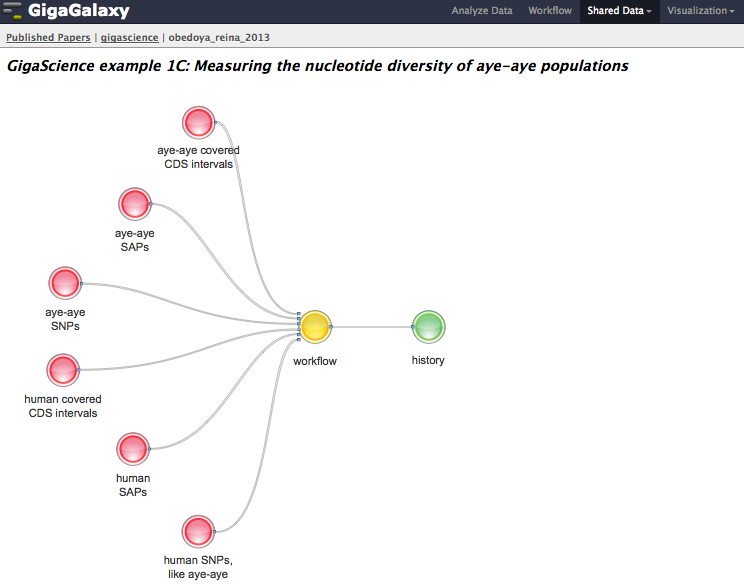
of the paper. To make it a little more interactive and understandable
for users, we have produced SVG graphs to help visualize how input
datasets, workflows and histories are related to each example analysis.
[{.aligncenter
.size-full .wp-image-972 loading="lazy" decoding="async"
srcset="http://gigasciencejournal.com/blog/wp-content/uploads/2014/02/Screen-shot-2014-02-05-at-4.31.52-PM.png 744w, http://gigasciencejournal.com/blog/wp-content/uploads/2014/02/Screen-shot-2014-02-05-at-4.31.52-PM-300x237.png 300w"
sizes="(max-width: 744px) 100vw, 744px" width="744"
height="588"}](http://gigasciencejournal.com/blog/wp-content/uploads/2014/02/Screen-shot-2014-02-05-at-4.31.52-PM.png)
As a step on the road to executable papers, this is aiming to be a more
interactive and two-way experience than traditional publication models
still rooted in the print era, so please feedback to us at
editorial@gigasciencejournal.com on on any bugs or features you would
like to see. We would like to thank our collaborators at [CBIIT (the
CUHK-BGI Innovation Institute of
Trans-omics)](http://www.cuhk.edu.hk/cbiit/research.html "CBIIT research page"){target="_blank"
rel="noopener"} who helped us set up our Galaxy server, [BioMed
Central](http://www.biomedcentral.com/ "BMC homepage"){target="_blank"
rel="noopener"},
[DataCite](http://www.datacite.org/ "DataCite homepage"){target="_blank"
rel="noopener"}, as well as the authors and reviewers for working with
us to get these examples out and online. The
[series](http://www.gigasciencejournal.com/series/Galaxy "Galaxy Series Page"){target="_blank"
rel="noopener"} is still open and we are continuing to take and review
submissions, so watch the series page for future additions. Please
contact us if you are interested in submitting your work or submit
through our submission system
[here](http://www.gigasciencejournal.com/manuscript "Submit page"){target="_blank"
rel="noopener"}. Thanks to support from the
[BGI](http://www.genomics.cn/en/index "BGI homepage"){target="_blank"
rel="noopener"} our article processing charges are still currently free
and, as we are again silver sponsors of the [2014 Galaxy Community
Conference](https://wiki.galaxyproject.org/Events/GCC2014 "GCC2014 homepage"){target="_blank"
rel="noopener"}, we hope to meet many of you there.
### **References**
[1.](http://dx.doi.org/10.1186/2047-217X-2-17 "Galaxy Pop Genomics paper"){target="_blank"
rel="noopener"} Bedoya-Reina et al.: Galaxy tools to study genome
diversity. GigaScience 2:17
[http://dx.doi.org/10.1186/2047-217X-2-17](http://dx.doi.org/10.1186/2047-217X-2-17 "Galaxy Pop Genomics paper"){target="_blank"
rel="noopener"}
[2.](http://dx.doi.org/10.1186/2047-217X-3-1 "CGtag paper"){target="_blank"
rel="noopener"} Hiltemann et al.: CGtag: complete genomics toolkit and
annotation in a cloud-based Galaxy. GigaScience 2014 3:1
[http://dx.doi.org/10.1186/2047-217X-3-1](http://dx.doi.org/10.1186/2047-217X-3-1 "CGtag paper"){target="_blank"
rel="noopener"}
[3.](http://dx.doi.org/10.5524/100069 "Galaxy Pop Genomics paper workflow DOI"){target="_blank"
rel="noopener"} Bedoya-Reina, OC; Ratan, A; Burhans, R; Kim, HL;
Giardine, B; Riemer, C; Li, Q; Olson, TL; Loughran Jr, TP; vonHoldt, BM;
Perry, GH; Schuster, SC; Miller, W (2013): GigaGalaxy workflows and
histories from \"Galaxy tools to study genome diversity\" GigaScience
Database.
[http://dx.doi.org/10.5524/100069](http://dx.doi.org/10.5524/100069 "Galaxy Pop Genomics paper workflow DOI"){target="_blank"
rel="noopener"}
[4.](http://www.gigasciencejournal.com/series/Galaxy "Galaxy Series Page"){target="_blank"
rel="noopener"} GigaScience Galaxy Series Page
https://academic.oup.com/gigascience/pages/galaxy_series_data_intensive_reproducible_research
The post [Rewarding Reproducibility: First Papers in our Galaxy Series
utilizing our GigaGalaxy
platform](http://gigasciencejournal.com/blog/rewarding-reproducibility-first-papers-in-our-galaxy-series-utilizing-our-gigagalaxy-platform/){rel="nofollow"}
appeared first on
[GigaBlog](http://gigasciencejournal.com/blog){rel="nofollow"}.