---
author:
- contributor_roles: []
family: Edmunds
given: Scott
url: https://orcid.org/0000-0001-6444-1436
blog:
authors: null
community_id: 52db0518-e228-4260-8c54-c4e323b2569d
created: 1675555200
current_feed_url: null
description: Data driven blogging from the GigaScience editors
doi: https://doi.org/10.59350/gigablog
favicon: https://rogue-scholar.org/api/communities/52db0518-e228-4260-8c54-c4e323b2569d/logo
feed_format: application/atom+xml
feed_url: http://gigasciencejournal.com/blog/feed/atom/
filter: null
generator: Other
home_page_url: https://gigasciencejournal.com/blog
issn: null
language: eng
license: https://creativecommons.org/licenses/by/4.0/legalcode
prefix: '10.59350'
relative_url: null
secure: false
slug: gigablog
status: archived
subfield: '1311'
title: GigaBlog
updated: null
use_api: null
container: GigaBlog
date: '2016-06-03T00:00:00+00:00'
date_updated: '2025-12-06T10:34:03+00:00'
guid: http://blogs.biomedcentral.com/gigablog/?p=1740
identifier: https://doi.org/10.59350/vhpgg-ec668
image: http://gigasciencejournal.com/blog/wp-content/uploads/2016/06/IncreaseReproducibility.jpg
images:
- alt: IncreaseReproducibility
height: '208'
src: http://gigasciencejournal.com/blog/wp-content/uploads/2016/06/IncreaseReproducibility.jpg
width: '280'
- alt: Slide1
height: '191'
sizes: '(max-width: 300px) 100vw, 300px'
src: http://gigasciencejournal.com/blog/wp-content/uploads/2016/06/Slide1-300x191.jpg
srcset: http://gigasciencejournal.com/blog/wp-content/uploads/2016/06/Slide1-300x191.jpg,
http://gigasciencejournal.com/blog/wp-content/uploads/2016/06/Slide1.jpg
width: '300'
issn: null
keywords:
- Open Access
- Publishing
- Technology
- Genomics
- Metagenomics
lang: en
license: https://creativecommons.org/licenses/by/4.0/legalcode
reference:
- id: https://doi.org/10.1186/s13742-016-0129-2
unstructured: Mofiz, E., Deborah, C., Seemann, T., Currie, B. J., Fischer, K., &
Papenfuss, A. T. (2016). Genomic resources and draft assemblies of the human and
porcine varieties of scabies mites, Sarcoptes scabiei var. hominis
and var. suis. Gigascience, 5(1).
- id: https://doi.org/10.17504/protocols.io.exwbfpe
unstructured: Mofiz, E. (2016). Draft genome assembly using parasitic mite population
NGS DNA sample from mites extracted from host wound environment v1. Springer
Science and Business Media LLC.
- id: https://doi.org/10.1186/s13742-016-0128-3
unstructured: Hébert, F. O., Grambauer, S., Barber, I., Landry, C. R., & Aubin-Horth,
N. (2016). Transcriptome sequences spanning key developmental states as a resource
for the study of the cestode Schistocephalus solidus , a threespine stickleback
parasite. Gigascience, 5(1).
- id: https://doi.org/10.17504/protocols.io.ew9bfh6
unstructured: F.O., H., Grambauer S., . not . provided ., Barber I., . not . provided
., Landry C.R., . not . provided ., & Aubin-Horth N., . not . provided . (2016).
Reference transcriptome sequence resource for the study of the Cestode Schistocephalus
solidus, a threespine stickleback parasite. v1. Springer Science and Business
Media LLC.
- id: http://gigasciencejournal.com/blog/reproducible-research-resources-researching-parasites/
unstructured: Unknown title
- id: http://gigasciencejournal.com/blog
unstructured: Unknown title
rid: s8ya8-acb86
rights: https://creativecommons.org/licenses/by/4.0/legalcode
summary: '** GigaScience has Tapeworms and Scabies! And Reproducible Research.
**While there has been recent controversy (and hashtags in response) from some of
the more conservative sections of the medical community calling those who use or
build on previous data "research parasites", as data publishers we strongly disagree
with this.'
title: Reproducible Research Resources for Research(ing) Parasites
url: https://wayback.archive-it.org/22098/2025-05-01T17:13:42Z/http://gigasciencejournal.com/blog/reproducible-research-resources-researching-parasites
version: v1
---
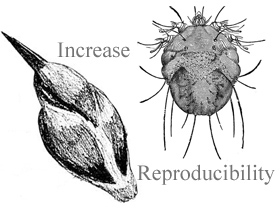
\*\**GigaScience* has Tapeworms and Scabies! And Reproducible Research.\
{.alignright
.size-full .wp-image-1746 loading="lazy" decoding="async" width="280"
height="208"}\*\*While there has been [recent controversy (and hashtags
in response](http://science.sciencemag.org/content/351/6277/1005)) from
some of the more conservative sections of the medical community calling
those who use or build on previous data \"research parasites\", as data
publishers we strongly disagree with this. And also feel it is unfair to
drag parasites into this when they can teach us a thing or two about
good research practice. Parasitology remains a complex field given the
often extreme differences between parasites, which all fall under the
umbrella definition of an organism that lives in or on another organism
(host) and derives nutrients at the host\'s expense. Published today in
*GigaScience* are articles on two parasitic organisms,
[scabies](http://dx.doi.org/10.1186/s13742-016-0129-2) and on the
[tapeworm *Schistocephalus
solidus*](http://dx.doi.org/10.1186/s13742-016-0128-3). Not only are
both papers in parasitology, but the way in which these studies are
presented showcase a new collaboration with
[protocols.io](http://protocols.io) that provides a unique means for
reporting the Methods that serves to improve reproducibility. Here the
authors take advantage of their open access repository of scientific
methods and a collaborative protocol-centered platform, and we for the
first time have integrated this into our submission, review and
publication process. We now also have a [groups
page](https://www.protocols.io/groups/gigascience-journal) on the portal
where our methods can be stored.
Currently, the most common way of presenting methods in articles is in
extremely brief paragraphs as supplemental downloadable PDF files. The
result is often incomplete or non-discoverable methodology, which is key
for scientists to properly build on scientific discovery. The
parasitology articles published today are the first two studies to
showcase the seamless integration into the manuscript submission and
publication process of clear, detailed, and complete methodology
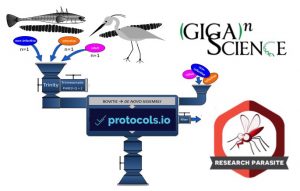
descriptions. The [protocols.io](http://protocols.io) platform enables
researchers to submit their methods in a standard format, with no space
limitations, that can be directly linked to any article simply through a
citable DOIs. These can also be searched online, and best yet, can be
versioned allowing for adaptations for future work. Not only does this
allow the research community easy access to detailed methods, it also
means authors don\'t have to continually rewrite methods for every paper
that uses them. Being [big promoters of data
citation](http://blogs.biomedcentral.com/gigablog/2014/02/28/having-a-finger-on-the-pulse-of-data-citation/),
in a similar manner this incentives good practice and method sharing as
users can simply cite and credit the \'recipe\' in protocols.io. See
[their video](https://www.youtube.com/watch?v=r9eBZgTzRNA) for more on
how this works.\
https://www.youtube.com/watch?v=r9eBZgTzRNA
**Itching to solve the reproducible research problem\
A**fter the research parasites debate it seems fitting that the
complexity of making scientific reporting reproducible is demonstrated
in papers that capture the complexity of parasitic organisms, and, in
these cases, parasites that require many different complicated
experimental steps and unusual computational pipelines to study them.
In [the first study](http://dx.doi.org/10.1186/s13742-016-0129-2),
researchers from the National Health and Medical Research Council in
Australia studied the genome of the human scabies parasite collected
from remote disadvantaged and indigenous communities in Northern
Australia, where up to 25% of adults and 50% of children acquire scabies
infections each year. Scabies infections are linked to bacterial skin
infections and rheumatic fever. As a consequence of this children with
scabies do less well, and this is a contributing factor to indigenous
Australians having significantly reduced life expectancy and amongst the
highest rates of rheumatic heart disease in the world.
Until now studying this species has been challenging. Being fractions of
a millimeter in size, the researchers needed to collect, per sample,
about 1000 mites to obtain enough DNA for next generation sequencing. In
addition to the complications of collecting and pooling the mites, their
tiny size also meant they had to deal with contamination from the
mite\'s gut contents. All of these variables can create difficulty in
clearly describing how conclusions are derived and how the research can
be built on. The lead author Anthony Papenfuss, discussing the
challenges of communicating this work has been, stated: \"Writing clear
and accurate descriptions of the wet lab and bioinformatics methods is a
challenge at the best of times. It is especially hard when the design is
complex and iterative exploratory analysis using multiple tools is
required. It requires great care and time consuming refinement of the
text. I think documenting the methods using
[protocols.io](http://protocols.io) will make this much easier.\". As
with all out papers, supporting genomics data is [available from
GigaDB](http://dx.doi.org/10.5524/100198) and the SRA.
{.alignleft
.size-medium .wp-image-1747 loading="lazy" decoding="async"
srcset="http://gigasciencejournal.com/blog/wp-content/uploads/2016/06/Slide1-300x191.jpg 300w, http://gigasciencejournal.com/blog/wp-content/uploads/2016/06/Slide1.jpg 685w"
sizes="(max-width: 300px) 100vw, 300px" width="300" height="191"}In our
[second paper](http://dx.doi.org/10.1186/s13742-016-0128-3), researchers
from Quebec studied the molecular biology of the parasitic tapeworm
*Schistocephalus solidus*. Despite *S. solidus* serving as an emblematic
study system in parasitology with [two centuries of
research](http://www.sciencedirect.com/science/article/pii/0169475890901798);
however, it has an extremely complicated life-cycle with multiple
developmental states and host species (parasitizing crustaceans, fish
and birds). As a consequence, while there is much known about its
morphology and physiology, identifying which genes are used at each
stage of infection, has been comparatively lacking.
The work here includes recreating the different host conditions and
collecting living worms from the different life cycles to collect RNA
and produce a transcriptome gene catalogue. First author
François-Olivier Hébert stated \"Describing such a long process of field
sampling, experimental infections in the lab using multiple hosts and,
of course, the complementary bioinformatic analyses was one of the
greatest challenges in this paper.\". With the new integrated data and
method publishing pipeline aiding this, the authors added \"We were able
to achieve that by making all of our homemade scripts, programs and
datasets freely available to the public through *GigaScience*, GigaDB
and [protocols.io](http://protocols.io). They represent essential
complementary platforms that allowed us to respect our vision of a
reproducible science\". The extensive supporting data is again
[available from our GigaDB
repository](http://dx.doi.org/10.5524/100197).
We at *GigaScience* are excited to announce this collaboration with
concrete examples to show, and with protocols.io having been highlighted
in our instructions for authors, as well as integrated into our data
submission pipelines these are the first of what will be an increasingly
common part of our our published papers. Keep checking the
[*GigaScience* groups page on
protocols.io](https://www.protocols.io/groups/gigascience-journal) to
see as and when these get published.
Update 3/6/16: BMC have been late to publish the *Schistocephalus
solidus* publication, but a provisional version can be seen here:
https://goo.gl/VtpxSp. Apologies, and are chasing them to fix this as
soon as possible.\
Update 7/6.16: The *Schistocephalus solidus* paper came out the
following day and is working fine now. protocols.io have also published
a [blog
post](https://www.protocols.io/groups/protocolsio/news/weve-been-itching-to-share-this-integration-of-gigascience)
on the integration.
### **References**
Mofiz E. et al., Genomic resources and draft reference assemblies of the
human and porcine scabies mites, Sarcoptes scabiei var. hominis and var.
suis. *GigaScience*. **5**:23. 2016.
DOI:[10.1186/s13742-016-0129-2](http://dx.doi.org/10.1186/s13742-016-0129-2)
Mofiz, E; Holt, D; Seemann, T; Currie, B, J; Fischer, K; Papenfuss, A, T
(2016): Draft genome assembly using parasitic mite population NGS DNA
sample from mites extracted from host wound environment. Protocols.io.
Hebert FO. et al., Reference transcriptome for the parasite
Schistocephalus solidus: insights into the molecular evolution of
parasitism. *GigaScience*. **5**:24. 2016.
DOI:[10.1186/s13742-016-0128-3](http://dx.doi.org/10.1186/s13742-016-0128-3)
Herbert, F.O.; Grambauer, S.; Barber, I.; Landry, C.R., Aubin-Horth, N.
(2016): Protocols for \"Reference transcriptome sequence resource for
the study of the Cestode Schistocephalus solidus, a threespine
stickleback parasite.\". Protocols.io.
The post [Reproducible Research Resources for Research(ing)
Parasites](http://gigasciencejournal.com/blog/reproducible-research-resources-researching-parasites/){rel="nofollow"}
appeared first on
[GigaBlog](http://gigasciencejournal.com/blog){rel="nofollow"}.