---
author:
- contributor_roles: []
family: Edmunds
given: Scott
url: https://orcid.org/0000-0001-6444-1436
blog:
authors: null
community_id: 52db0518-e228-4260-8c54-c4e323b2569d
created: 1675555200
current_feed_url: null
description: Data driven blogging from the GigaScience editors
doi: https://doi.org/10.59350/gigablog
favicon: https://rogue-scholar.org/api/communities/52db0518-e228-4260-8c54-c4e323b2569d/logo
feed_format: application/atom+xml
feed_url: http://gigasciencejournal.com/blog/feed/atom/
filter: null
generator: Other
home_page_url: https://gigasciencejournal.com/blog
issn: null
language: eng
license: https://creativecommons.org/licenses/by/4.0/legalcode
prefix: '10.59350'
relative_url: null
secure: false
slug: gigablog
status: archived
subfield: '1311'
title: GigaBlog
updated: null
use_api: null
container: GigaBlog
date: '2022-11-28T00:00:00+00:00'
date_updated: '2026-01-25T05:10:28+00:00'
guid: http://gigasciencejournal.com/blog/?p=4664
identifier: https://doi.org/10.59350/v4emk-5r363
image: http://gigasciencejournal.com/blog/wp-content/uploads/2022/11/nick-fewings-BAZejJdZ57w-unsplash2.jpg
images:
- height: '320'
sizes: '(max-width: 700px) 100vw, 700px'
src: http://gigasciencejournal.com/blog/wp-content/uploads/2022/11/nick-fewings-BAZejJdZ57w-unsplash2.jpg
srcset: http://gigasciencejournal.com/blog/wp-content/uploads/2022/11/nick-fewings-BAZejJdZ57w-unsplash2.jpg,
http://gigasciencejournal.com/blog/wp-content/uploads/2022/11/nick-fewings-BAZejJdZ57w-unsplash2-300x137.jpg
width: '700'
- alt: Multilingual articles example
height: '338'
src: http://gigasciencejournal.com/blog/wp-content/uploads/2022/11/GigaByte_multilingual.gif
width: '600'
- alt: Multilingual articles
height: '396'
sizes: '(max-width: 768px) 100vw, 768px'
src: http://gigasciencejournal.com/blog/wp-content/uploads/2022/11/Chinese-PMC-view-1024x528.png
srcset: http://gigasciencejournal.com/blog/wp-content/uploads/2022/11/Chinese-PMC-view-1024x528.png,
http://gigasciencejournal.com/blog/wp-content/uploads/2022/11/Chinese-PMC-view-300x155.png,
http://gigasciencejournal.com/blog/wp-content/uploads/2022/11/Chinese-PMC-view-768x396.png,
http://gigasciencejournal.com/blog/wp-content/uploads/2022/11/Chinese-PMC-view-1536x792.png,
http://gigasciencejournal.com/blog/wp-content/uploads/2022/11/Chinese-PMC-view-2048x1056.png
width: '768'
- src: http://gigasciencejournal.com/blog/wp-content/uploads/2022/11/nick-fewings-BAZejJdZ57w-unsplash2.jpg
- src: http://gigasciencejournal.com/blog/wp-content/uploads/2022/11/GigaByte_multilingual.gif
- alt: 'Viewing the English and Chinese versions of our launch
Editorial in PubMed Central'
src: http://gigasciencejournal.com/blog/wp-content/uploads/2022/11/Chinese-PMC-view-1024x528.png
issn: null
keywords:
- Publishing
- Accessibility
- GigaByte
- Open Access
- Open Science
lang: en
license: https://creativecommons.org/licenses/by/4.0/legalcode
rid: wq8fy-r2719
rights: https://creativecommons.org/licenses/by/4.0/legalcode
summary: In another first for the novel GigaByte publication platform developed
by River Valley Technologies, this week marks the first time multilingual articles
have been simultaneously published in English, Spanish and Ukrainian Open
Science has gained momentum over the past decade, and embracing that, GigaScience
Press has aimed at pushing scientific publishing beyond just making articles open
access toward making the entire process open
title: The first English-Spanish-Ukrainian Publication. How to publish multilingual
articles with GigaByte
url: https://wayback.archive-it.org/22098/2025-05-01T17:13:42Z/http://gigasciencejournal.com/blog/how-to-publish-multilingual-articles
version: v1
---
*In another first for the novel GigaByte publication platform developed
by River Valley Technologies, this week marks the first time
multilingual articles have been simultaneously published in English,
Spanish and Ukrainian*
Open Science has gained momentum over the past decade, and embracing
that, GigaScience Press has aimed at pushing scientific publishing
beyond just making articles open access toward making the entire process
open and accessible to the research community and public (see [our
recent Editorial](https://doi.org/10.1093/gigascience/giac067)). In
November 2021 UNESCO ratified and published their [Recommendation on
Open Science](https://unesdoc.unesco.org/ark:/48223/pf0000379949),
defining the core values of open science including the collective
benefit as a global public good. Stating open science should benefit
humanity as a whole, and that scientific knowledge should be openly
available and its benefits universally shared. The practice of science
should be inclusive, sustainable and equitable.
One of the many areas of action highlighted here is encouraging
multilingualism in the practice of science, as most international
scientific communication is carried out in English, which for the
majority of the world and a large proportion of scholars is not their
primary language. By allowing multiple views, the novel *GigaByte*
publishing platform developed by our partners at [River Valley
Technologies](https://rivervalley.io/) has addressed the accessibility
issue by showcasing dual versions of our publications in Chinese,
Spanish and Portuguese. We\'ve also made sure to promote and use
AfricArXiv and SciELO preprints, and link them to relevant *GigaByte*
papers published by authors in Africa and Latin America. This novel,
more accessible way of presenting our research has already been utilised
by the many Latin-American authors of our [vectors of human disease
series](http://gigasciencejournal.com/blog/vector-borne-diseases-series/),
but this is the first time we have showcased more than one additional
language, as well as the first time we have published papers in a
Cyrillic script. This multilingual articles functionality was one of the
main features we presented to the judges when *GigaByte* [won the 2022
ALPSP
Award](http://gigasciencejournal.com/blog/gigabyte-alpsp-innovation-award/)
for Innovation in Publishing.
**Glory to Ukrainian and Puerto Rican Science**\
This week we are showcasing our first example of a trilingual
publication; authors from the University of Puerto Rico at Mayagüez,
Oakland University in the US, ITMO University in Russia and Uzhhorod
National University in Ukraine publishing the mitochondrial genome of
the long-spined black sea urchin simultaneously in English, Spanish and
Ukrainian. Greatly increasing the accessibility of the work to readers
where the species is endemic (and currently [undergoing a worrying
die-off](https://www.agrra.org/sea-urchin-die-off/)) in Latin America
and the Caribbean. As well as the Ukrainian research community [spread
around the
world](https://www.genomeweb.com/genetic-research/russias-war-ukraine-continues-genomics-research-may-become-another-casualty#.Y4BmdYJBxQI)
as their institutes, homes, and infrastructure are being destroyed in
the current Russian invasion of Ukraine. To further increase the
discoverability to Spanish speakers the preprint of the paper is also
[available in SciELO
preprints](https://doi.org/10.1590/SciELOPreprints.5055).
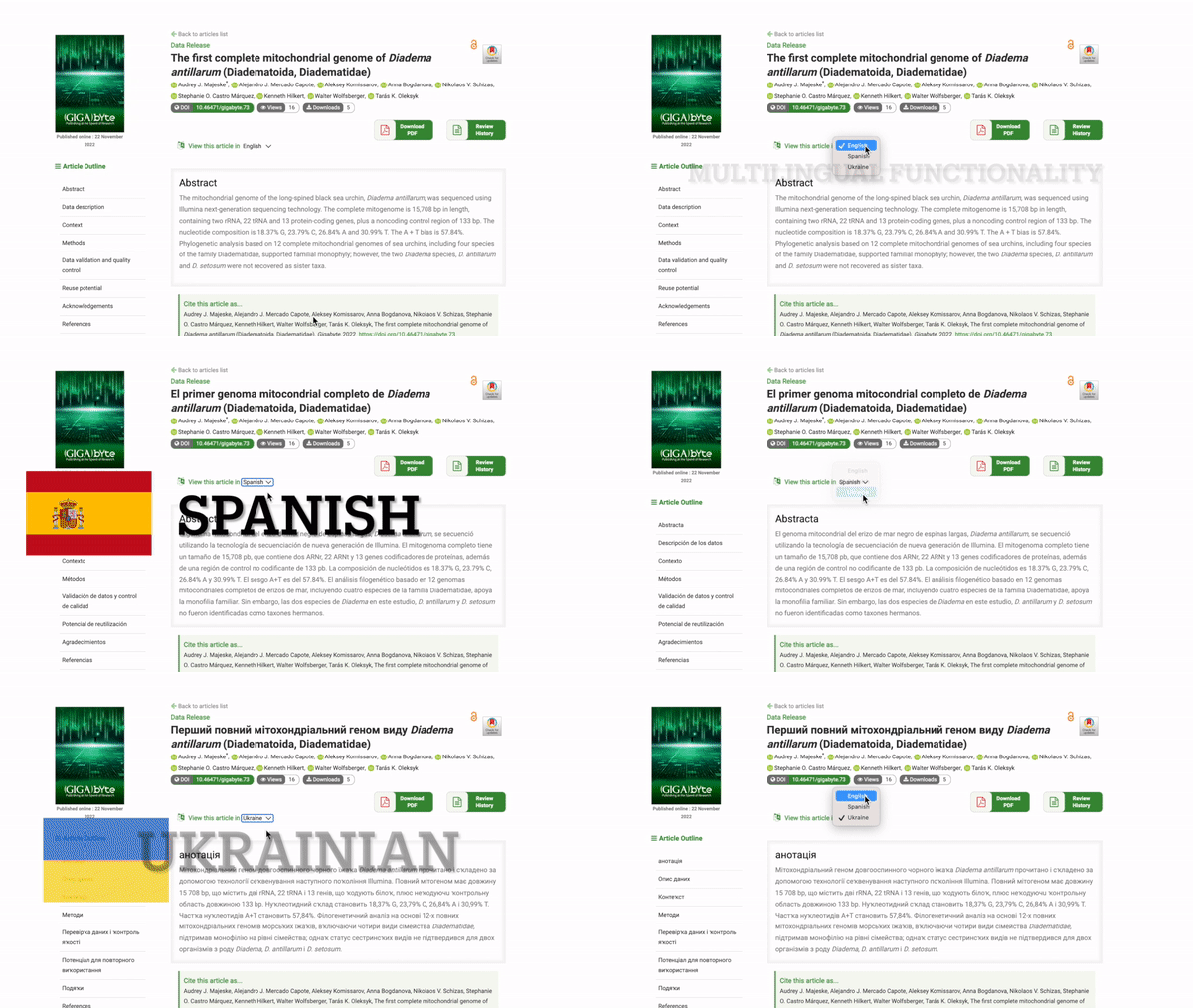
To toggle between the different languages you can select and switch them
using \"View this article in...\" link situated just above the abstract
on the full-text version of the paper. If there are any problems viewing
this just reset the browser cache and try again. English is the
\"version of record\" used to create the PDF version, but the
multilingual versions are included in the XML so they are machine
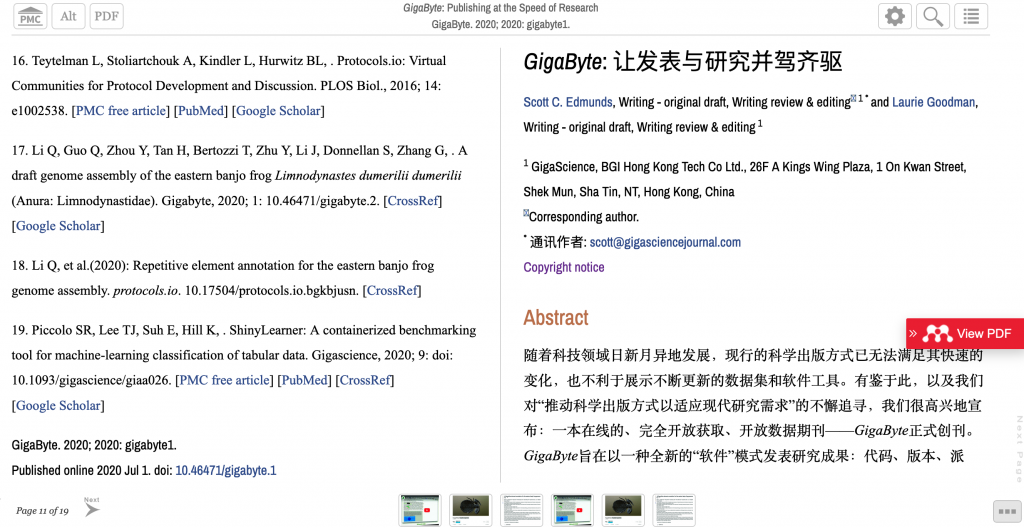
readable, and the multilingual versions are all included in the version
shared with PubMed Central, and can be read from the PMC versions of our
papers now they are being ingested there.
Viewing the English and Chinese versions of our launch
Editorial in PubMed Central
**How to Utilise *GigaByte*\'s Multilingual Functionality**\
Using the [newly published paper](https://doi.org/10.46471/gigabyte.73)
as an example we can talk through the process of submitting and
publishing a multilingual version of your article with *GigaByte*.
English is the primary version of the manuscript we peer review, but if
you have versions of your work translated into any other language we are
happy to publish these alongside the primary \"version of record\". Due
to the current unreliability of automatic translations we want the
author to provide manually translated and carefully checked versions of
the work, and these should be included as supplemental files submitted
through our publication system alongside the primary English language
version. With details in the covering letter and the files labelled to
explain which language they are.
Authors from countries where English is not their first language often
write the paper first in their native tongue and then translate it into
English, and this approach of publishing both versions means that
original effort is not wasted. To ensure there are no inconsistencies
between versions, after peer-review the Editors will share the final
copy-edited version of the paper with the authors, and they should make
sure they update and add any of these final changes the multilingual
versions. The *GigaByte* Editors will then formally accept the paper and
send the one or more multilingual versions through to our Editorial
Production team, who will then work from the English version in the
proofing process, and create parallel versions in the different
additional languages. The unique XML-first publishing workflow from
[River Valley Technologies](https://rivervalley.io/), that through
automation can carry out proofing in less than a day, enables these
additional versions to be created in not much additional time.
As all *GigaByte* papers are linked to preprints, we recommend that
Spanish and Portuguese language papers are submitted to the [SciELO
preprint server](https://preprints.scielo.org/index.php/scielo) to
increase discoverability there. And there are a number of other preprint
servers have a geographical and language focus (e.g.
[AfricArXiv](https://info.africarxiv.org/),
[ChinaXiv](https://chinaxiv.org/home.htm?locale=en),
[Jxiv](https://jxiv.jst.go.jp/index.php/jxiv), etc.) that can also help
assist and promote readership to non-English speaking communities.
Please contact the *GigaByte* Editors at
if you have any questions or multilingual articles to submit.
\*\*Further Reading:\
\*\*Audrey J. Majeske, Alejandro J. Mercado Capote, Aleksey Komissarov,
Anna Bogdanova, Nikolaos V. Schizas, Stephanie O. Castro Márquez,
Kenneth Hilkert, Walter Wolfsberger, Tarás K. Oleksyk, The first
complete mitochondrial genome of *Diadema antillarum* (Diadematoida,
Diadematidae), *Gigabyte*, 2022
The post [The first English-Spanish-Ukrainian Publication. How to
publish multilingual articles with
GigaByte](http://gigasciencejournal.com/blog/how-to-publish-multilingual-articles/){rel="nofollow"}
appeared first on
[GigaBlog](http://gigasciencejournal.com/blog){rel="nofollow"}.