---
author:
- contributor_roles: []
family: Edmunds
given: Scott
url: https://orcid.org/0000-0001-6444-1436
blog:
authors: null
community_id: 52db0518-e228-4260-8c54-c4e323b2569d
created: 1675555200
current_feed_url: null
description: Data driven blogging from the GigaScience editors
doi: https://doi.org/10.59350/gigablog
favicon: https://rogue-scholar.org/api/communities/52db0518-e228-4260-8c54-c4e323b2569d/logo
feed_format: application/atom+xml
feed_url: http://gigasciencejournal.com/blog/feed/atom/
filter: null
generator: Other
home_page_url: https://gigasciencejournal.com/blog
issn: null
language: eng
license: https://creativecommons.org/licenses/by/4.0/legalcode
prefix: '10.59350'
relative_url: null
secure: false
slug: gigablog
status: archived
subfield: '1311'
title: GigaBlog
updated: null
use_api: null
container: GigaBlog
date: '2023-07-18T00:00:00+00:00'
date_updated: '2025-12-06T10:10:48+00:00'
guid: http://gigasciencejournal.com/blog/?p=5041
identifier: https://doi.org/10.59350/r7gfh-zhf62
image: http://gigasciencejournal.com/blog/wp-content/uploads/2023/07/Bonne-Wepster2.jpg
images:
- alt: Bonne-Wepster collection
height: '348'
sizes: '(max-width: 576px) 100vw, 576px'
src: http://gigasciencejournal.com/blog/wp-content/uploads/2023/07/Bonne-Wepster2.jpg
srcset: http://gigasciencejournal.com/blog/wp-content/uploads/2023/07/Bonne-Wepster2.jpg,
http://gigasciencejournal.com/blog/wp-content/uploads/2023/07/Bonne-Wepster2-300x181.jpg
width: '576'
- alt: Johanna Bonne-Wepster
height: '768'
sizes: '(max-width: 768px) 100vw, 768px'
src: http://gigasciencejournal.com/blog/wp-content/uploads/2023/07/Drie_erepromoties_te_Amsterdam._Eredoctoraten_voor_mevr._J._Bonne-Wepster_genee_Bestanddeelnr_904-7681-1024x1024.jpg
srcset: http://gigasciencejournal.com/blog/wp-content/uploads/2023/07/Drie_erepromoties_te_Amsterdam._Eredoctoraten_voor_mevr._J._Bonne-Wepster_genee_Bestanddeelnr_904-7681-1024x1024.jpg,
http://gigasciencejournal.com/blog/wp-content/uploads/2023/07/Drie_erepromoties_te_Amsterdam._Eredoctoraten_voor_mevr._J._Bonne-Wepster_genee_Bestanddeelnr_904-7681-300x300.jpg,
http://gigasciencejournal.com/blog/wp-content/uploads/2023/07/Drie_erepromoties_te_Amsterdam._Eredoctoraten_voor_mevr._J._Bonne-Wepster_genee_Bestanddeelnr_904-7681-150x150.jpg,
http://gigasciencejournal.com/blog/wp-content/uploads/2023/07/Drie_erepromoties_te_Amsterdam._Eredoctoraten_voor_mevr._J._Bonne-Wepster_genee_Bestanddeelnr_904-7681-768x768.jpg,
http://gigasciencejournal.com/blog/wp-content/uploads/2023/07/Drie_erepromoties_te_Amsterdam._Eredoctoraten_voor_mevr._J._Bonne-Wepster_genee_Bestanddeelnr_904-7681-1536x1536.jpg,
http://gigasciencejournal.com/blog/wp-content/uploads/2023/07/Drie_erepromoties_te_Amsterdam._Eredoctoraten_voor_mevr._J._Bonne-Wepster_genee_Bestanddeelnr_904-7681-2048x2048.jpg
width: '768'
- alt: Johanna Bonne-Wepster notebooks
height: '559'
sizes: '(max-width: 840px) 100vw, 840px'
src: http://gigasciencejournal.com/blog/wp-content/uploads/2023/07/Bonne-WepsterNotebook.jpg
srcset: http://gigasciencejournal.com/blog/wp-content/uploads/2023/07/Bonne-WepsterNotebook.jpg,
http://gigasciencejournal.com/blog/wp-content/uploads/2023/07/Bonne-WepsterNotebook-300x200.jpg,
http://gigasciencejournal.com/blog/wp-content/uploads/2023/07/Bonne-WepsterNotebook-768x511.jpg
width: '840'
- src: http://gigasciencejournal.com/blog/wp-content/uploads/2023/07/Bonne-Wepster2.jpg
- alt: 'Johanna Bonne-Wepster receiving her honorary Doctorate from
the University of Amsterdam. CC0.'
src: http://gigasciencejournal.com/blog/wp-content/uploads/2023/07/Drie_erepromoties_te_Amsterdam._Eredoctoraten_voor_mevr._J._Bonne-Wepster_genee_Bestanddeelnr_904-7681-1024x1024.jpg
- src: http://gigasciencejournal.com/blog/wp-content/uploads/2023/07/Bonne-WepsterNotebook.jpg
issn: null
keywords:
- Health
- Biodiversity
- Disease Vector
- Ecology
- GigaByte
lang: en
license: https://creativecommons.org/licenses/by/4.0/legalcode
reference:
- id: https://doi.org/10.46471/gigabyte.84
unstructured: Patel, S., Harris, Z. N., Londo, J. P., Miller, A., & Fennell,
A. (2023). Genome assembly of the hybrid grapevine Vitis 'Chambourcin'. Gigabyte,
2023, 1–18.
- id: https://doi.org/10.46471/gigabyte.83
unstructured: Taconet, P., Zogo, B., Soma, D. D., Ahoua Alou, L. P., Mouline, K.,
Dabiré, R. K., Amanan Koffi, A., Pennetier, C., & Moiroux, N. (2023). Anopheles
sampling collections in the health districts of Korhogo (Côte d'Ivoire) and Diébougou
(Burkina Faso) between 2016 and 2018. Gigabyte, 2023, 1–10.
- id: https://doi.org/10.1093/gigascience/giac114
unstructured: Unknown title
- id: https://doi.org/10.46471/gigabyte_series_0002
unstructured: Unknown title
rid: jd43h-jvn57
rights: https://creativecommons.org/licenses/by/4.0/legalcode
summary: Field notes of early-20th century entomologist Johanna Bonne-Wepster
have been turned into crucial new public health data through digitization, filling
data gaps and continuing her legacy in forming Dutch tropical medicine research.
Natural history collections contain huge amounts of information on diversity,
distribution and ecology of a variety of species; however, much of this valuable
information is effectively lost
title: Converting the Field Records of Early-20th Century Public Health Pioneer to
Data
url: https://wayback.archive-it.org/22098/2025-05-01T17:13:42Z/http://gigasciencejournal.com/blog/field-records-of-johanna-bonne-wepster
version: v1
---
*Field notes of early-20th century entomologist Johanna Bonne-Wepster
have been turned into crucial new public health data through
digitization, filling data gaps and continuing her legacy in forming
Dutch tropical medicine research.*
::: {.wp-block-image}
:::
Natural history collections contain huge amounts of information on
diversity, distribution and ecology of a variety of species; however,
much of this valuable information is effectively lost to researchers
due to historical and practical constraints: most of these data are only
available on non-digitised labels and journal notes. The absence of such
extensive data is particularly unfortunate because some of those records
include information on vector-borne disease species, including a variety
of mosquito species, which are responsible for more than 17% of
infectious diseases worldwide. Moreover, as climate change alters
temperatures and weather patterns around the world, invasive species are
spreading into new areas, with the expectation that the risk of
vector-borne diseases will further increase. [It is
estimated](https://doi.org/10.1371/journal.pntd.0007213) that by 2050,
disease-carrying mosquitoes will ultimately reach 500 million more
people than they do today. To address this critical data loss, a team of
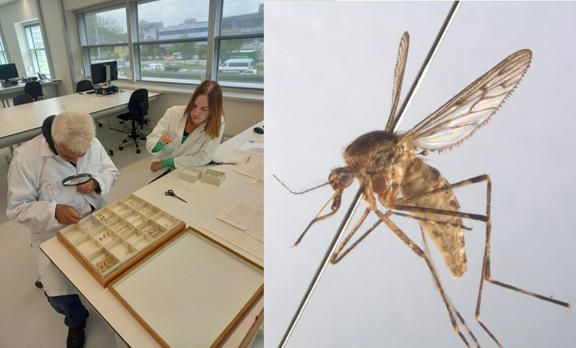
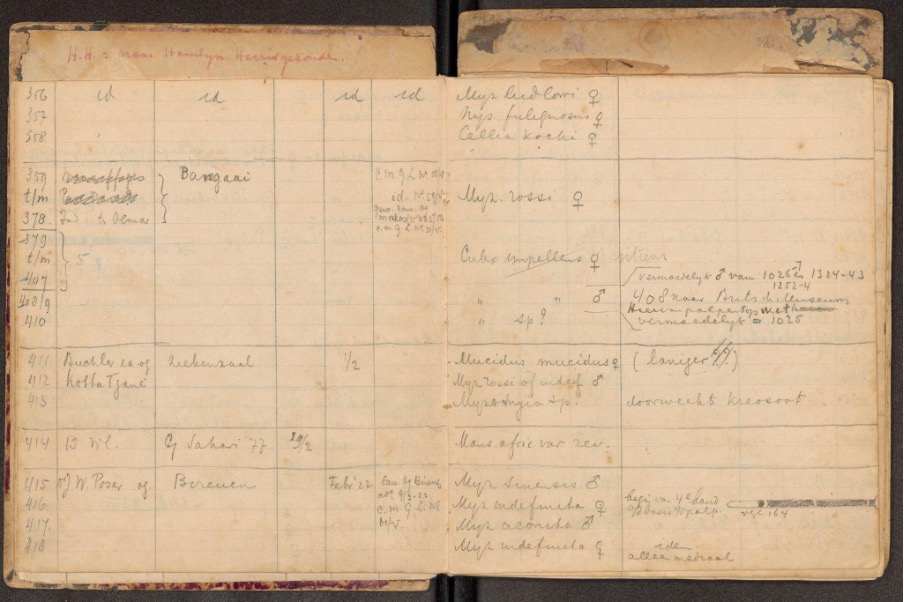
researchers at the Naturalis Biodiversity Center have painstakingly
organised and digitised information from the handwritten notebooks of
the Dutch entomologist Johanna Bonne-Wepster (1892-1978), unlocking
formerly inaccessible information and making it readily available to
researchers and citizen scientists worldwide. The article is [published
today](https://doi.org/10.46471/gigabyte.85) as latest paper in the
[*GigaByte* Vectors of human disease
series](http://gigasciencejournal.com/blog/second-call-vector-papers/).
[Bonne-Wepste](https://en.wikipedia.org/wiki/Johanna_Bonne-Wepster)r
played a particularly important role in Dutch tropical medicine. Her
career spanned from 1917 to 1961, during which time she and her husband
carried out research in the former Dutch colonies of Indonesia and
Suriname. Bonne-Wepster, one of many historical, non-formally trained
women who, like these data, are lost to history, collected tens of
thousands of mosquitos, and trained herself to identify their species.
Her thorough investigations, which provide detailed physical
descriptions of this blood-sucking family of insects, was aimed at
giving non-taxonomists the means to recognize different vector species.
Bibiche Berkholst from Naturalis comments on the collection:
\"*Bonne-Wepster collected and documented a huge amount of mosquitoes in
her lifetime. We were able to digitise over 10,000 of those, which took
us many months. Each mosquito had to be checked against the
Bonne-Wepster\'s field books, and many specimens were missing locality
and/or species labels, which needed to be added as well. It feels very
satisfying that this important collection has been digitised, and I hope
that the remarkable history of Bonne-Wepster will inspire many female
amateur entomologists like myself.*\"
During the twenties and thirties Bonne-Wepster collected the bulk of her
legacy collections. After her return to The Netherlands in 1948,
Bonne-Wepster continued researching mosquitoes primarily at the
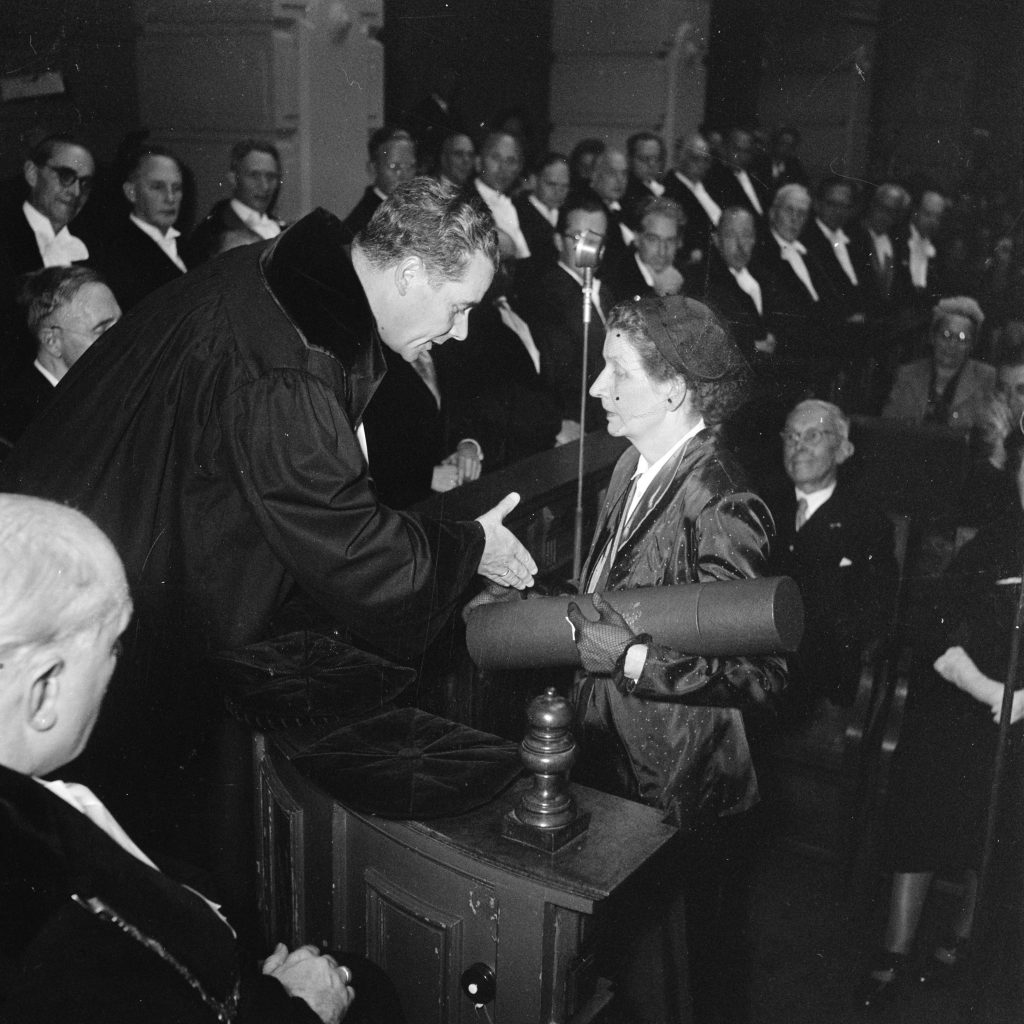
University of Amsterdam. Even though she was not academically trained,
her enormous contribution to the field of mosquito taxonomy ultimately
did not go unnoticed as she was given an honorary doctorate from that
university in 1951. In the 1970s, her collection was transferred to
Rijksmuseum van Natuurlijke Historie (RMNH) in Leiden, now known as
Naturalis. Initially, the museum obtained only the sampled specimens,
not the field books with elaborate fieldnotes. The field books were
thought to have been lost until a curator of the RMNH made a visit to
the elderly Mrs. Bonne-Wepster and was able to retrieve them.
Johanna Bonne-Wepster receiving her honorary Doctorate from
the University of Amsterdam. CC0.
Efforts are being taken to digitise these original field books,
mobilising data contained in them, and corroborating this with the
associated specimens. For the first time, these archival texts and
52,102 of her records of mosquitoes are being released into the public
domain via the [Naturalis](https://hdl.handle.net/21.12107/402003304)
and [GBIF (Global Biodiversity Information Facility)
repositories](https://doi.org/10.15468/cl6p3l), making them fully
available to both researchers and citizen scientists worldwide. In
addition to previously inaccessible Bonne-Wepster data, the researchers
have also digitised detailed information from the smaller amounts of
data from collections available at the Zoölogisch Museum Amsterdam
Nederland (1,216 mosquitoes) and the former RMNH (another 2,388
mosquitoes).
The data made available through this project is particularly valuable
because it describes historical and recent records of mosquitoes, and
can be used in different areas of research, including estimates of
spatial distribution, modelling of current and future distributions
through Ecological Niche Modeling, and for developing much-needed vector
control programs. It further highlights the importance of finding,
digitally extracting, and organising data from the vast number of
unavailable and extremely valuable historical documents so they can add
to the currently available information, form historic baselines, and
substantially extend the study of trends in the spread of vectors of
human and animal disease. This type of work can have a huge impact on
current public health issues as well as be of historical
interest.\*\* \*\*
First author Pasquale Ciliberti says of the data\*: \"I would really
like it if the data we unlocked could contribute, even in a minimal
form, to the understanding of the ecology of mosquitoes. To me, as a
collection manager, it would have been a nightmare if the information
stored in the field books would have been lost. I am very glad that this
information is online and available to researchers. Also I am pleased
that we are valuing the work of a [woman in
Science](http://gigasciencejournal.com/blog/tag/women-in-science/). She
was officially an \"amateur\". She shows that with passion and
commitment you can achieve a lot.\"\*
This paper is part of the second phase of s[ubmissions of vectors of
human disease data papers](http://org/10.46471/GIGABYTE_SERIES_0002)
supported by the Special Programme for Research and Training in Tropical
Diseases, hosted at the World Health Organization (WHO). After the
[publication of our first disease vector data from Africa (Burkina Faso
and Ivory Coast)](https://doi.org/10.46471/gigabyte.83) last month, this
paper includes our first major data collection from Asia.
## References {#references .wp-block-heading}
Ciliberti P et al., Digitizing the Culicidae collection of Naturalis
Biodiversity Center, with a special focus on the former Bonne-Wepster
subcollection. *GigaByte. 2023.*
[https://doi.org/10.46471/gigabyte.85](https://doi.org/10.46471/gigabyte.84)
Taconet P et al., Anopheles sampling collections in the health districts
of Korhogo (Côte d\'Ivoire) and Diébougou (Burkina Faso) between 2016
and 2018, *GigaByte*, 2023
Edmunds et al., Publishing data to support the fight against human
vector-borne diseases, *GigaScience*, Volume 11, 2022, giac114,
You can see all the papers in the Vector-Borne Disease series here:
Update 22/8/2023: The authors have produced a great video
that we can now include here.
The post [Converting the Field Records of Early-20th Century Public
Health Pioneer to
Data](http://gigasciencejournal.com/blog/field-records-of-johanna-bonne-wepster/){rel="nofollow"}
appeared first on
[GigaBlog](http://gigasciencejournal.com/blog){rel="nofollow"}.