---
author:
- contributor_roles: []
family: Edmunds
given: Scott
url: https://orcid.org/0000-0001-6444-1436
blog:
authors: null
community_id: 52db0518-e228-4260-8c54-c4e323b2569d
created: 1675555200
current_feed_url: null
description: Data driven blogging from the GigaScience editors
doi: https://doi.org/10.59350/gigablog
favicon: https://rogue-scholar.org/api/communities/52db0518-e228-4260-8c54-c4e323b2569d/logo
feed_format: application/atom+xml
feed_url: http://gigasciencejournal.com/blog/feed/atom/
filter: null
generator: Other
home_page_url: https://gigasciencejournal.com/blog
issn: null
language: eng
license: https://creativecommons.org/licenses/by/4.0/legalcode
prefix: '10.59350'
relative_url: null
secure: false
slug: gigablog
status: archived
subfield: '1311'
title: GigaBlog
updated: null
use_api: null
container: GigaBlog
date: '2021-11-17T00:00:00+00:00'
date_updated: '2025-12-06T10:12:44+00:00'
guid: http://gigasciencejournal.com/blog/?p=4227
identifier: https://doi.org/10.59350/hky5j-61m70
image: http://gigasciencejournal.com/blog/wp-content/uploads/2021/11/mozzie-copy-1024x687.jpg
images:
- alt: vectors of human diseases
height: '515'
sizes: '(max-width: 768px) 100vw, 768px'
src: http://gigasciencejournal.com/blog/wp-content/uploads/2021/11/mozzie-copy-1024x687.jpg
srcset: http://gigasciencejournal.com/blog/wp-content/uploads/2021/11/mozzie-copy-1024x687.jpg,
http://gigasciencejournal.com/blog/wp-content/uploads/2021/11/mozzie-copy-300x201.jpg,
http://gigasciencejournal.com/blog/wp-content/uploads/2021/11/mozzie-copy-768x515.jpg,
http://gigasciencejournal.com/blog/wp-content/uploads/2021/11/mozzie-copy-1536x1031.jpg,
http://gigasciencejournal.com/blog/wp-content/uploads/2021/11/mozzie-copy.jpg
width: '768'
- alt: 'Credit: Asian tiger mosquito (Aedes albopictus),
observed in Republic of Korea. Photo 2021 Jake David MacLennan via iNaturalist
Research-grade Observations,
CC BY-NC 4.0.'
src: http://gigasciencejournal.com/blog/wp-content/uploads/2021/11/mozzie-copy-1024x687.jpg
issn: null
keywords:
- Medicine
- Biodiversity
- Diseases
- GigaByte
- Open Data
lang: en
license: https://creativecommons.org/licenses/by/4.0/legalcode
rid: j2sj9-b0t13
rights: https://creativecommons.org/licenses/by/4.0/legalcode
summary: ' UPDATE: Deadline extended until 30 March 2022 or until maximum of 15
accepted manuscripts is reached—only a few slots remain! GigaScience
Press partnering with GBIF are supported by TDR, the Special Programme for Research
and Training in Tropical Diseases, hosted at the World Health Organization, to release
a special issue for publication of new datasets presenting biodiversity data for
research on vectors of human diseases. '
title: GigaByte call for data papers describing datasets on vectors of human diseases
url: https://wayback.archive-it.org/22098/2025-05-01T17:13:42Z/http://gigasciencejournal.com/blog/vectors-of-human-diseases-series
version: v1
---
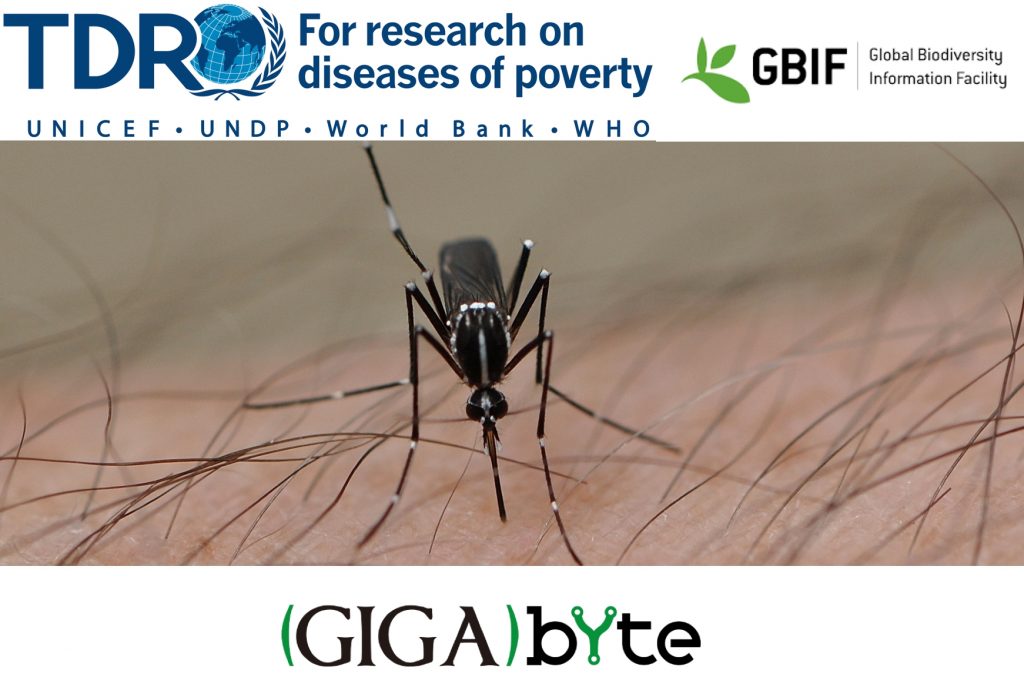
Credit: Asian tiger mosquito (Aedes albopictus),
observed in Republic of Korea. Photo 2021 Jake David MacLennan via iNaturalist Research-grade Observations,
CC BY-NC 4.0.
*UPDATE: Deadline extended until 30 March 2022 or until maximum of 15
accepted manuscripts is reached---only a few slots remain!*
*GigaScience Press partnering with GBIF are supported by TDR, the
Special Programme for Research and Training in Tropical Diseases, hosted
at the World Health Organization, to release a special issue for
publication of new datasets presenting biodiversity data for research on
vectors of human diseases.*
[TDR, the Special Programme for Research and Training in Tropical
Diseases](https://tdr.who.int/); the [Global Biodiversity Information
Facility (GBIF)](https://www.gbif.org/); and GigaScience Press are
announcing a new call for authors to submit and publish [Data Release
papers](https://gigabytejournal.com/data-release-description) on vectors
of human disease in a thematic series in [*GigaByte*
Journal](https://gigabytejournal.com/).
Vector-borne diseases account for about one quarter of all infectious
diseases. Although there has been significant progress for malaria, with
a recent decrease in malaria morbidity and mortality rates, this
progress is currently halting. Other diseases, such as those caused by
arboviruses like dengue, chikungunya, yellow fever and more recently
Zika, are expanding, with an increased number of cases and fatalities.
The necessity to develop new vector control strategies, approaches and
tools was recognized through the Global Vector Control Response
[approved by the World Health Assembly in
2017](https://www.who.int/publications/i/item/9789241512978). Among the
mutually agreed objectives between GBIF and TDR is to work on a
repository of data related to vectors and support design and
identification of sources and contacts for data mobilization campaigns
to improve data coverage to help research on vector-borne diseases and
human health. Within the framework of this collaboration, a special
issue on data papers on vectors will be supported with *GigaByte*.
The data papers submitted should describe datasets with the following
criteria:
- Data has clear relevance for research on [vectors of human
vector-borne
diseases](https://www.who.int/news-room/fact-sheets/detail/vector-borne-diseases)
- Dataset contains more than 5,000 records that are new to GBIF.org in
2021/22 with high-quality data and metadata
- Data is dedicated to the public domain under an open
[](https://www.gbif.org/news/HdDwtyv9jjrvG99OSHsP6/call-for-data-papers-describing-datasets-from-russia-deadline-extended#geography)
CC0 designation
The call for manuscripts will be open until **28 February 2022.**
The article processing fee (normally \$350) will be waived for 15
papers, provided that the publications are accepted and meet the above
criteria.
**Instructions for Authors**
The manuscript must be prepared in English and submitted in accordance
with \*GigaByte\'\*s [instructions to
authors](https://gigabytejournal.com/data-release-description) by 28
February 2021.
Authors may contribute to more than one manuscript, and Data Releases
can support and be published alongside traditional analysis
publications, but the work and data release described needs to
stand-alone and justify itself by *adding value*.
*GigaByte* will publish a special issue including the selected papers by
the first half of 2022. As a newly launched journal we are working to
index our papers as widely as possible, and the journal is currently
indexed in the [Directory of Open Access Journals
(DOAJ)](https://www.doaj.org/toc/2709-4715), CNKI and
[JGate](https://jgateplus.com/home/). The authors contributing to the
series will also be acknowledged and invited as contributing authors to
an accompanying series announcement article in *GigaByte*\'s well
established sister journal
[*GigaScience*](http://gigasciencejournal.com/), which is indexed by
MEDLINE, PubMed, the Science Citation Index Expanded, CAS, CNKI, EMBASE
and Scopus.
Manuscripts and datasets will go through an open and transparent
peer-review process, including data auditing and curation from the
GigaScience Press data team. To find out more about data publishing see
the [GBIF.org explainer on data
papers](https://www.gbif.org/data-papers), [Quick guide to publishing
data through GBIF.org](https://www.gbif.org/publishing-data), and the
[*GigaByte* submission
instructions](https://gigabytejournal.com/information-for-authors).
*GigaByte* Data Release articles have a simple [easy-to-write
format](https://gigabytejournal.com/data-release-description), and can
be [submitted
here](https://gigabyte-review.rivervalleytechnologies.com/) as Microsoft
word (DOC, DOCX), PDF and TeX/LaTeX files (see [Overleaf
template](https://www.overleaf.com/latex/templates/template-for-gigabyte-journal-data-report-submissions/swdqpvktksvf)).
We recommend that authors start by preparing the dataset and publishing
it through GBIF.org before turning to manuscript writing and editing.
*GigaByte*\'s novel, end-to-end XML publishing platform, means
publication can be done in a quicker and more cost-effective manner
better designed for these more granular research objects that don\'t
require such a labour intensive and detailed vehicle for sharing. It
also allows additional interactivity and we can work with the authors to
embed maps, video and imaging data plugins and other relevant tools for
visualizing data and results in the final publications. Please discuss
with the editors if you have any dynamic content you would like to
highlight.
For questions please contact the Chief Editor of the thematic series at
*GigaByte* [Scott Edmunds](mailto:editorial@gigasciencejournal.com) and
GBIF Scientific officer [Dmitry Schigel](mailto:dschigel@gbif.org).
#### ***Definition of terms*** {#definition-of-terms .wp-block-heading}
**Datasets with relevance for research on vectors of human vector-borne
diseases**
This sponsored call for data papers has a thematic focus on [vectors of
human vector-borne
diseases](https://www.who.int/news-room/fact-sheets/detail/vector-borne-diseases).
Authors can prepare data papers that describe checklist, occurrence or
sampling-event [datasets](https://www.gbif.org/dataset-classes); [this
blog post](https://data-blog.gbif.org/post/choose-dataset-type/)) will
help authors determine which class of dataset is most suitable. Data on
pathogens (viruses, bacteria and parasites) can be published as
attributes of vector data in the
[associatedOccurrences](http://rs.tdwg.org/dwc/terms/associatedOccurrences)
field of occurrence and sampling-event datasets, No human data can be
included in the datasets. See examples of existing
[checklist](https://www.gbif.org/dataset/39f36f10-559b-427f-8c86-2d28afff68ca),
[occurrence](https://www.gbif.org/dataset/fc8a216d-4467-449f-b0c6-84cd905deb6e),
and
[sampling-event](https://www.gbif.org/dataset/bbf97678-fe2a-4d74-9cf8-ed48ddeaf64f)
datasets in GBIF.
**Datasets with more than 5,000 records that are new to GBIF.org**
The 5,000 [occurrence](https://www.gbif.org/dataset-classes#occurrences)
records minimum threshold is merely a guiding number, not the target to
publish a dataset which is cut to be just over the limit to pass.
[Checklist](https://www.gbif.org/dataset-classes#checklists) and
[sampling-event](https://www.gbif.org/dataset-classes#samplingevents)
datasets below the threshold will be considered eligible on the basis of
exceptional value and handled case by case by the editor. Minimum
publishable units, [salami
publishing](https://doi.org/10.11613/BM.2013.030), and dataset version
papers are discouraged: datasets should be published in their original,
untrimmed size. Data must be new to GBIF.org in 2021/22, providing
high-quality data and metadata. Many datasets are, by nature, dynamic,
so while a data paper promotes and describes the dataset at the time of
submission, the dataset link can and often will resolve to the evolving
online resource. Therefore, a data paper should ideally be written in a
way that it serves as a bibliographic citation, a showcase and a lasting
\"home\" for the dataset. Any datasets with additional supporting data
not suitable for GBIF will be curated and hosted in the GigaScience
Press [GigaDB repository](http://gigadb.org/site/guide) or other
domain-specific repositories.
**Datasets with high-quality data and metadata**
Authors should start by publishing a dataset comprising data and
metadata that meets GBIF\'s [data-quality
requirements](https://www.gbif.org/data-quality-requirements). This
effort will involve work on an installation of the GBIF [Integrated
Publishing Toolkit](https://www.gbif.org/ipt). If the Darwin Core
archive is constructed elsewhere, the use of the GBIF [Data
Validator](https://www.gbif.org/tools/data-validator) is recommended
before the publication.
The post [GigaByte call for data papers describing datasets on vectors
of human
diseases](http://gigasciencejournal.com/blog/vectors-of-human-diseases-series/){rel="nofollow"}
appeared first on
[GigaBlog](http://gigasciencejournal.com/blog){rel="nofollow"}.