---
author:
- affiliation:
- id: https://ror.org/027bh9e22
name: Leiden University
contributor_roles: []
family: Waltman
given: Ludo
url: https://orcid.org/0000-0001-8249-1752
- contributor_roles: []
family: Rzayeva
given: Narmin
url: https://orcid.org/0000-0003-0397-5412
- contributor_roles: []
family: Pinfield
given: Stephen
blog:
authors:
- name: Leiden Madtrics
community_id: d8304840-75c2-4164-bc37-ec879c4f065b
created: 1780876800
current_feed_url: null
description: Leiden Madtrics
doi: https://doi.org/10.59350/leidenmadtrics
favicon: https://rogue-scholar.org/api/communities/d8304840-75c2-4164-bc37-ec879c4f065b/logo
feed_format: application/atom+xml
feed_url: https://www.leidenmadtrics.nl/atom/
filter: null
generator: Other
home_page_url: https://www.leidenmadtrics.nl/
issn: null
language: eng
license: https://creativecommons.org/licenses/by/4.0/legalcode
prefix: '10.59350'
relative_url: null
secure: null
slug: leidenmadtrics
status: active
subfield: '1804'
title: Leiden Madtrics
updated: 1784193807
use_api: null
container: Leiden Madtrics
date: '2025-05-22T00:00:00+00:00'
date_updated: '2025-12-05T08:24:16+00:00'
guid: https://www.leidenmadtrics.nl/articles/the-state-of-preprinting-in-europe-and-the-netherlands
identifier: https://doi.org/10.59350/h5cx3-7yn67
images:
- alt: Figure 1 Preprint adoption in Europe
src: https://www.leidenmadtrics.nl/images/uploads/Figure-1-Preprint-adoption-in-Europe.png
- alt: Figure 2 Preprint adoption in the Netherlands
src: https://www.leidenmadtrics.nl/images/uploads/Figure-2-Preprint-adoption-in-the-Netherlands.png
- alt: Figure 2 Preprint adoption in the Netherlands
src: https://www.leidenmadtrics.nl/images/uploads/Figure-2-Preprint-adoption-in-the-Netherlands.png
- alt: 'Figure 1: Percentage of preprinted outputs for different disciplines and different
countries in Europe (2021-2022). Statistics are shown only if a country has at
least 50 peer-reviewed outputs in a discipline.'
src: https://www.leidenmadtrics.nl/images/uploads/Figure-1-Preprint-adoption-in-Europe.png
- alt: Figure 2. Percentage of preprinted outputs for different disciplines and different
universities in the Netherlands (2021-2022). Statistics are shown only if a university
has at least 50 peer-reviewed outputs in a discipline.
src: https://www.leidenmadtrics.nl/images/uploads/Figure-2-Preprint-adoption-in-the-Netherlands.png
issn: null
lang: en
license: https://creativecommons.org/licenses/by/4.0/legalcode
rid: 2ra5r-yz724
rights: https://creativecommons.org/licenses/by/4.0/legalcode
summary: A preprint is a research article that is made openly available on a preprint
server, typically before submission to a peer-reviewed journal. Preprinting enables
new scientific knowledge to be shared in a timely and open way. It often takes many
months or even years for an article to pass through the peer review process of a
journal.
title: The state of preprinting in Europe and the Netherlands
url: https://www.leidenmadtrics.nl/articles/the-state-of-preprinting-in-europe-and-the-netherlands
version: v1
---
A preprint is a research article that is made openly available on a
preprint server, typically before submission to a peer-reviewed journal.
Preprinting enables new scientific knowledge to be shared in a timely
and open way. It often takes many months or even years for an article to
pass through the peer review process of a journal. By preprinting their
work, authors can prevent lengthy delays in the dissemination of their
research, thereby contributing to speeding up progress in science.
In a [paper published recently on the SocArXiv preprint
server](https://doi.org/10.31235/osf.io/xdwc4_v2){target="_blank"}, we
analysed the global adoption of preprinting, including variations by
discipline and region. Based on bibliographic data on many millions of
research outputs, we estimated the percentage of peer-reviewed outputs
(published in scientific journals, books, and conference proceedings)
that have been posted as a preprint. The data we used, obtained from the
[Dimensions](https://www.dimensions.ai/){target="_blank"},
[OpenAlex](https://openalex.org/){target="_blank"}, and
[Crossref](https://doi.org/10.64000/dpcc9-k4564){target="_blank"}
databases, has several limitations, making it hard to determine the
percentage of preprinted outputs in a fully accurate way. Nevertheless,
even though providing a comprehensive picture of the adoption of
preprinting is challenging, our statistics do offer crucial insights
into preprint adoption, and in particular into disciplinary and regional
differences.
[Our paper](https://doi.org/10.31235/osf.io/xdwc4_v2){target="_blank"}
analyses differences in the adoption of preprinting at a global level.
It shows, for instance, that in many disciplines preprint adoption is
much higher in North America and Western and Northern Europe than in
Africa and Asia. The downside of a global analysis is that more local
differences in preprint adoption can easily get obscured. In this post,
we therefore use the data collected in our study to zoom in on the
adoption of preprinting in Europe and more specifically in the
Netherlands.
### Preprint adoption in Europe
To analyse the adoption of preprinting in Europe, we consider the 15
European countries (excluding Turkey and Russia) with the largest number
of peer-reviewed outputs in the Dimensions database in 2021 and 2022.
For each of these countries and each of the 22 high-level disciplines in
the [Dimensions Fields of Research
classification](https://dimensions.freshdesk.com/support/solutions/articles/23000018826-what-is-the-background-behind-the-fields-of-research-for-classification-system-){target="_blank"},
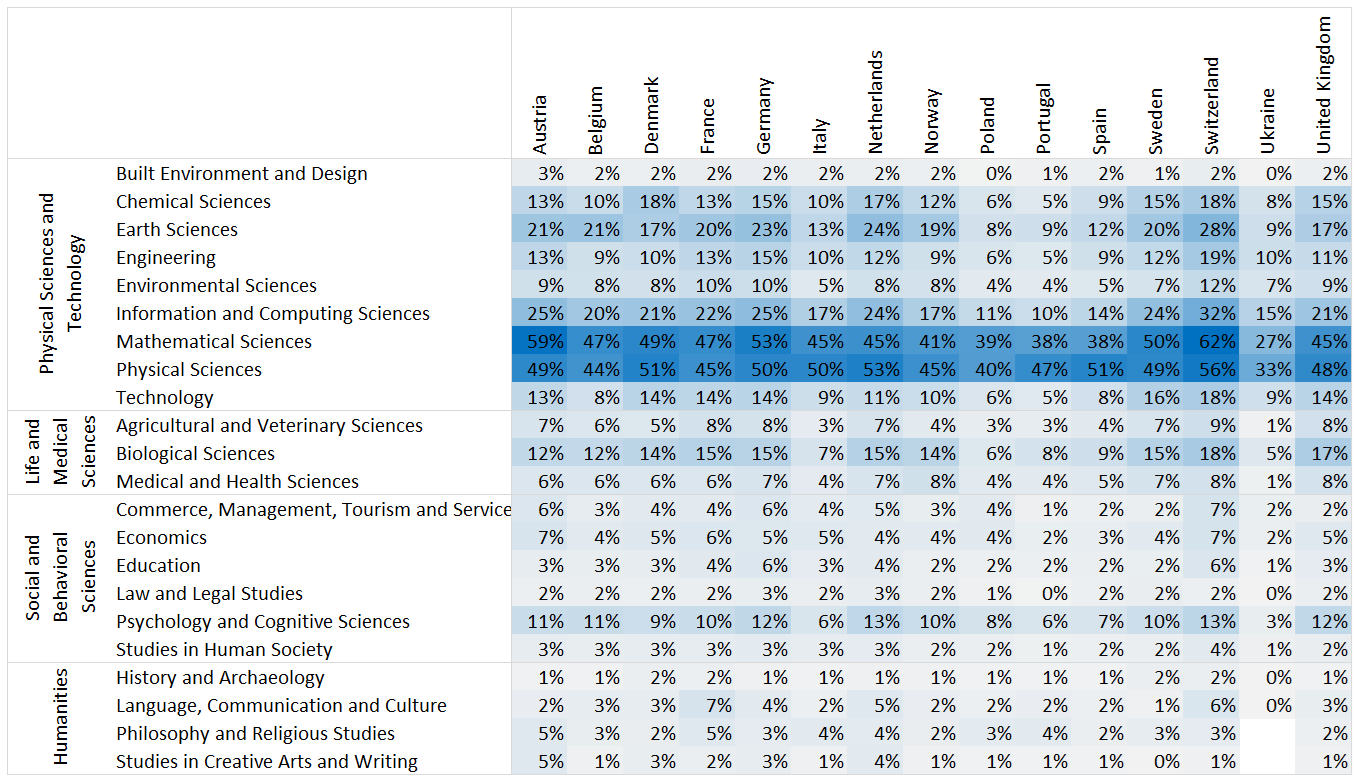
Figure 1 shows the percentage of peer-reviewed outputs published in 2021
and 2022 that have also been posted as a preprint. We focus on 2021 and
2022 because these are the most recent years for which we have
reasonably complete data.
Figure 1: Percentage of preprinted outputs for different
disciplines and different countries in Europe (2021-2022). Statistics
are shown only if a country has at least 50 peer-reviewed outputs in a
discipline.
In terms of disciplinary differences in preprint adoption, the patterns
for Europe shown in Figure 1 are broadly similar to the global patterns
presented in [our
paper](https://doi.org/10.31235/osf.io/xdwc4_v2){target="_blank"}. The
highest adoption of preprinting can be found in physics and mathematics.
In many European countries, about half of the peer-reviewed outputs in
these disciplines have been posted as a preprint. In the information and
computing sciences and the earth sciences, many European countries have
about 20% preprinted outputs. These disciplines are followed by
chemistry, engineering, technology, biology, and psychology, where many
European countries have between 10 and 15% preprinted outputs. In the
remaining disciplines, typically less than 10% of the peer-reviewed
outputs have been preprinted, although we should emphasize that in some
disciplines, in particular economics, our statistics underestimate the
actual adoption of preprinting (e.g., working papers in economics are
not included in our statistics).
There are substantial differences in preprint adoption between European
countries. The adoption of preprinting is relatively low in countries in
Southern Europe (Italy, Portugal, and Spain) and Eastern Europe (Poland
and Ukraine). Especially Ukraine is lagging behind in preprint adoption.
The adoption of preprinting is higher in Western and Northern European
countries. Switzerland stands out as the country with the highest
preprint adoption in many disciplines.
### Preprint adoption in the Netherlands
As shown in Figure 1, the Netherlands is one of the European countries
with a relatively high adoption of preprinting. To get a better
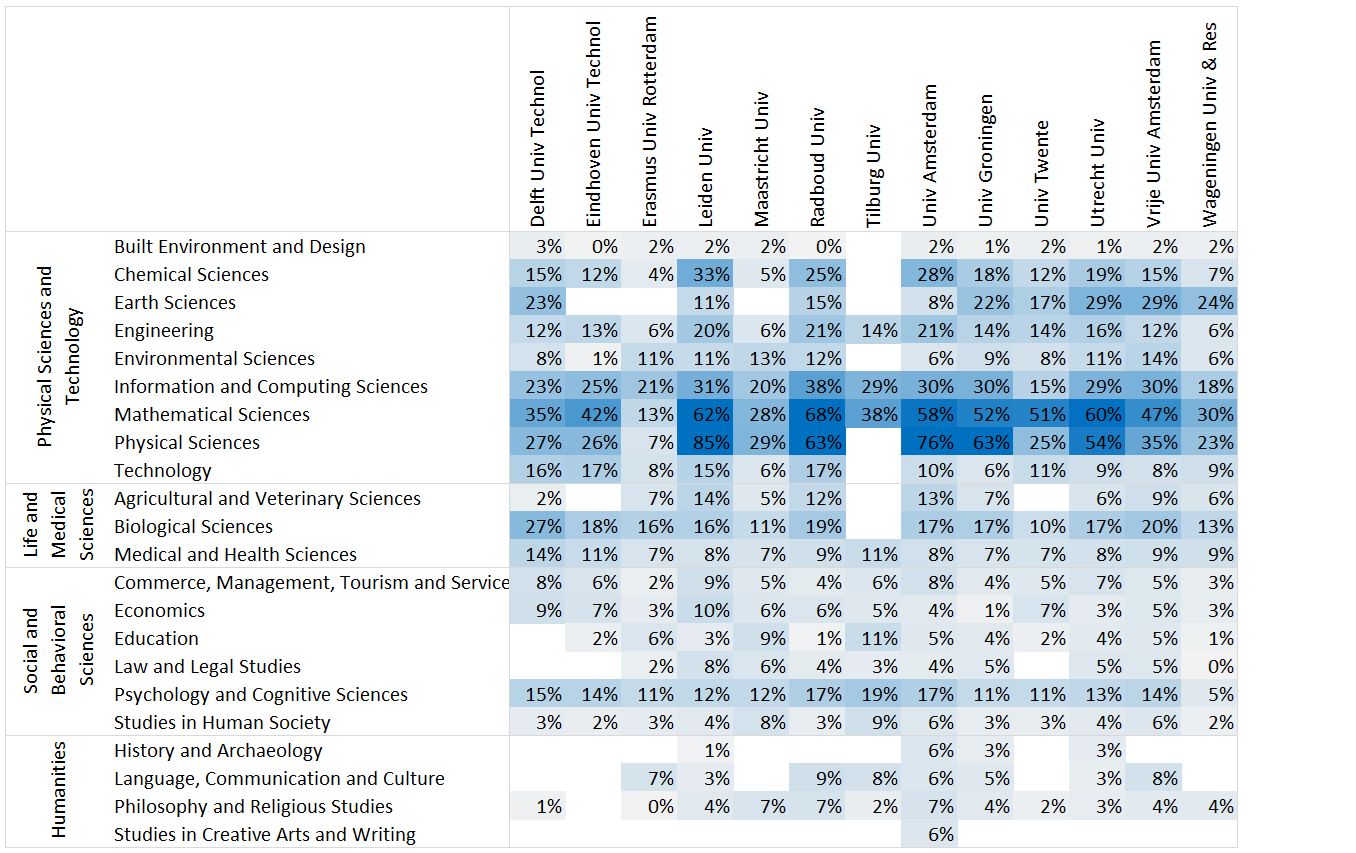
understanding of preprint adoption in the Netherlands, Figure 2 presents
statistics for the 13 large universities in the country. Research
outputs were assigned to a university using the approach taken in the
[CWTS Leiden Ranking Open
Edition](https://open.leidenranking.com/){target="_blank"}.
Figure 2. Percentage of preprinted outputs for different
disciplines and different universities in the Netherlands (2021-2022).
Statistics are shown only if a university has at least 50 peer-reviewed
outputs in a discipline.
For each university, Figure 2 shows disciplines in which the university
performs relatively well in terms of preprint adoption and disciplines
in which preprint adoption is less satisfactory or even almost
completely non-existent. Universities may use this information to make
targeted efforts to improve preprint adoption, focused on disciplines in
which adoption is lagging behind.
Interestingly, even within a discipline, there can be large differences
between universities in the adoption of preprinting. For instance, in
physics, mathematics, and chemistry, Leiden University has 85%, 62%, and
33% preprinted outputs, respectively, while only 7%, 13%, and 4% of the
outputs of Erasmus University Rotterdam in these disciplines have been
preprinted. These statistics indicate there is a lot of room for
improvement in preprint adoption at Erasmus University Rotterdam.
However, the broad scope of the disciplines also hides important
information. In the physics discipline, for example, a majority of the
outputs of Leiden University deal with astronomy research. In contrast,
most of the physics outputs of Erasmus University Rotterdam are
interdisciplinary studies at the interface between physics and medicine,
authored by researchers from Erasmus MC, the medical centre of the
university. Statistics at the global level show that preprinting is
widely practiced in astronomy, while it is still relatively uncommon in
medicine. The difference between Leiden University and Erasmus
University Rotterdam in preprint adoption in the physics discipline is
in line with these global patterns.
### Promoting preprinting
As shown in [our
paper](https://doi.org/10.31235/osf.io/xdwc4_v2){target="_blank"}, the
adoption of preprinting has grown substantially in recent years.
Nevertheless, preprint adoption is still quite low in many disciplines,
even in Western and Northern European countries, which are ahead of many
other countries in terms of preprint adoption. Low preprint adoption
delays the dissemination of scientific knowledge and therefore harms
progress in science.
How can preprinting be promoted? In a [recent survey of
researchers](https://doi.org/10.1002/asi.24880){target="_blank"},
integrating preprinting in journal workflows was identified as the most
important way to promote preprinting, followed by providing recognition
to researchers for preprinting their work. Other ways to promote
preprinting, considered somewhat less important by the surveyed
researchers, include encouraging or mandating preprinting by research
funders, research institutions, and journals as well as offering
preprint training to researchers.
The survey findings indicate actions that can be taken at the national
and institutional level to improve the adoption of preprinting.
Integration of preprinting in journal workflows requires coordination
between scientific publishers, preprint servers, and other providers of
publishing infrastructures. Pushing for this may be challenging for
national and institutional stakeholders. However, encouraging
preprinting, providing recognition for preprinting, and offering
preprint training are actions that should be within reach for
stakeholders at the national and institutional level. Given the low
preprint adoption in many disciplines, these actions need to get more
priority. Further efforts also need to be made to better understand the
cultures and practices in different disciplinary communities that
promote or discourage preprinting. Achieving greater awareness of the
value of preprinting, and of the drivers and barriers within specific
disciplines, is essential.
In Europe, Western and Northern European countries seem more successful
in promoting preprinting than their Southern and Eastern European
neighbours, suggesting there may be opportunities for the latter
countries to benefit from the experiences of the former ones. In the
Netherlands, favourable conditions for preprinting are being created by
national initiatives such as the [\'recognition and rewards\'
program](https://recognitionrewards.nl/){target="_blank"}, the
allocation of funding for [recognising and rewarding open
science](https://www.openscience.nl/en/researchprogrammes/recognising-en-rewarding-open-science){target="_blank"},
and the development of a [\'practical guide to
preprints\'](https://doi.org/10.5281/zenodo.5600534){target="_blank"}.
However, the actual adoption of preprinting needs to take place within
universities and other research institutions. Differences in the local
implementation of national initiatives are likely to lead to differences
between institutions in preprint adoption, in line with the statistics
shown in Figure 2. Sharing of best practices between institutions seems
crucial.
### Preprint adoption elsewhere in the world
Are you interested in the adoption of preprinting elsewhere in the
world, outside the Netherlands or outside Europe? The [data set we have
made available along with our
paper](https://doi.org/10.5281/zenodo.15301958){target="_blank"}
provides statistics like those in Figure 1 for all countries in the
world. The data set also includes the DOIs of the more than two million
peer-reviewed outputs for which a corresponding preprint has been
identified. In addition, we have made available a [separate data
set](https://doi.org/10.5281/zenodo.15459986){target="_blank"} in which
statistics like those in Figure 2 are provided for all 1506 universities
in the most recent release of the CWTS Leiden Ranking Open Edition.
Hopefully these data sets will be helpful to develop a more in-depth
understanding of the adoption of preprinting in different parts of the
world. Ultimately, we hope this will contribute to making preprinting
the norm in scientific publishing worldwide!
[DOI: 10.59350/h5cx3-7yn67 ([export/download/cite this blog
post](https://rogue-scholar.org/records/2ra5r-yz724){target="_blank"})]{.caption}
[**Note:** an earlier version of this blog post did not feature the
elaboration following the sentence that begins: \"In the remaining
disciplines, typically less than 10% of the peer-reviewed outputs have
been preprinted\".]{.caption}