


---
author:
- contributor_roles: []
  family: van den Boomen
  given: Bram
- affiliation:
  - id: https://ror.org/027bh9e22
    name: Leiden University
  contributor_roles: []
  family: van Eck
  given: Nees Jan
  url: https://orcid.org/0000-0001-8448-4521
- affiliation:
  - id: https://ror.org/027bh9e22
    name: Leiden University
  contributor_roles: []
  family: Waltman
  given: Ludo
  url: https://orcid.org/0000-0001-8249-1752
- contributor_roles: []
  family: Ross-Hellauer
  given: Tony
- contributor_roles: []
  family: Horbach
  given: Serge
blog:
  authors:
  - name: Leiden Madtrics
  community_id: d8304840-75c2-4164-bc37-ec879c4f065b
  created: 1780876800
  current_feed_url: null
  description: Leiden Madtrics
  doi: https://doi.org/10.59350/leidenmadtrics
  favicon: https://rogue-scholar.org/api/communities/d8304840-75c2-4164-bc37-ec879c4f065b/logo
  feed_format: application/atom+xml
  feed_url: https://www.leidenmadtrics.nl/atom/
  filter: null
  generator: Other
  home_page_url: https://www.leidenmadtrics.nl/
  issn: null
  language: eng
  license: https://creativecommons.org/licenses/by/4.0/legalcode
  prefix: '10.59350'
  relative_url: null
  secure: null
  slug: leidenmadtrics
  status: active
  subfield: '1804'
  title: Leiden Madtrics
  updated: 1784193807
  use_api: null
container: Leiden Madtrics
date: '2023-05-01T00:00:00+00:00'
date_updated: '2025-12-05T08:30:22+00:00'
guid: https://www.leidenmadtrics.nl/articles/the-journal-observatory-connecting-information-on-scholarly-communication
identifier: https://doi.org/10.59350/gpq75-3hh53
images:
- src: https://www.leidenmadtrics.nl/images/community/job_researchers.png
- src: https://www.leidenmadtrics.nl/images/community/job_publishers.png
- src: https://www.leidenmadtrics.nl/images/community/job_funders.png
- src: https://www.leidenmadtrics.nl/images/community/job_stakeholders.png
- alt: The Journal Observatory
  src: https://www.leidenmadtrics.nl/images/community/The-Journal-Observatory.png
- src: https://www.leidenmadtrics.nl/images/community/The-Journal-Observatory.png
issn: null
lang: en
license: https://creativecommons.org/licenses/by/4.0/legalcode
rid: qcvfn-7aa26
rights: https://creativecommons.org/licenses/by/4.0/legalcode
summary: The scientific community is moving towards a more transparent way of conducting
  and reporting research. Scientific publications are becoming more and more openly
  accessible but openness should also extend to peer review, preprinting, preregistration,
  data sharing, metadata availability, and related issues.Research funders and other
  stakeholders are putting a significant effort into promoting open science practices
  in scholarly communication.
title: The Journal Observatory - Connecting information on scholarly communication
url: https://www.leidenmadtrics.nl/articles/the-journal-observatory-connecting-information-on-scholarly-communication
version: v1
---

The scientific community is moving towards a more transparent way of
conducting and reporting research. Scientific publications are becoming
more and more openly accessible but openness should also extend to peer
review, preprinting, preregistration, data sharing, metadata
availability, and related issues.

Research funders and other stakeholders are putting a significant effort
into promoting open science practices in scholarly communication. But
there is a lack of high-quality infrastructure that provides information
on the openness, policies and procedures of scholarly journals and other
publication outlets. Consequently, it can be challenging to answer
questions like: how do journals organize quality assurance and peer
review? How do journals support open access publishing? How do journals
or preprint servers support preregistration, preprinting, and data
sharing? How diverse are the editorial teams of journals?

This information can be crucial to multiple stakeholders:\

<table>
<colgroup>
<col style="width: 25%" />
</colgroup>
<tbody>
<tr>
<td style="width: 25%; border: 0"><div
style="border-bottom: 2px solid orange;">
<img
src="https://www.leidenmadtrics.nl/images/community/job_researchers.png"
data-image="33400" />
</div></td>
<td style="width: 25%; border: 0"><div
style="border-bottom: 2px solid orange;">
<img
src="https://www.leidenmadtrics.nl/images/community/job_publishers.png"
data-image="33401" />
</div></td>
<td style="width: 25%; border: 0"><div
style="border-bottom: 2px solid orange;">
<img
src="https://www.leidenmadtrics.nl/images/community/job_funders.png"
data-image="33402" />
</div></td>
<td style="width: 25%; border: 0"><div
style="border-bottom: 2px solid orange;">
<img
src="https://www.leidenmadtrics.nl/images/community/job_stakeholders.png"
data-image="33403" />
</div></td>
</tr>
<tr>
<td style="vertical-align: top; border: 0"><h3 id="researchers"
style="margin: 0;">Researchers</h3></td>
<td style="vertical-align: top; border: 0"><h3 id="publishers"
style="margin: 0;">Publishers</h3></td>
<td style="vertical-align: top; border: 0"><h3
id="funders-research-institutions-and-libraries"
style="margin: 0;">Funders, research institutions and
libraries</h3></td>
<td style="vertical-align: top; border: 0"><h3 id="all-stakeholders"
style="margin: 0;">All stakeholders</h3></td>
</tr>
<tr>
<td style="vertical-align: top; border: 0"><p>need this information to
decide which journals to engage with as reader, author, reviewer, or
editor.</p></td>
<td class="focus-visible" data-focus-visible-added=""
style="vertical-align: top; border: 0">need this information to
advertise the distinctive features of their journals, to demonstrate the
investments they make in their journals, and to attract readers,
authors, reviewers, and editors.</td>
<td style="vertical-align: top; border: 0"><p>need this information to
inform negotiations with publishers, to support the development of
publication policies, and to assess and reward the compliance with these
policies.</p></td>
<td style="vertical-align: top; border: 0"><p>will benefit from high-
quality information to explore, assess and develop novel publication and
review models.</p></td>
</tr>
</tbody>
</table>

The [Journal Observatory
project](http://www.journalobservatory.org){target="_blank"} aims to
contribute to making available the information needed by these
stakeholders.\

### The current landscape, and its shortcomings

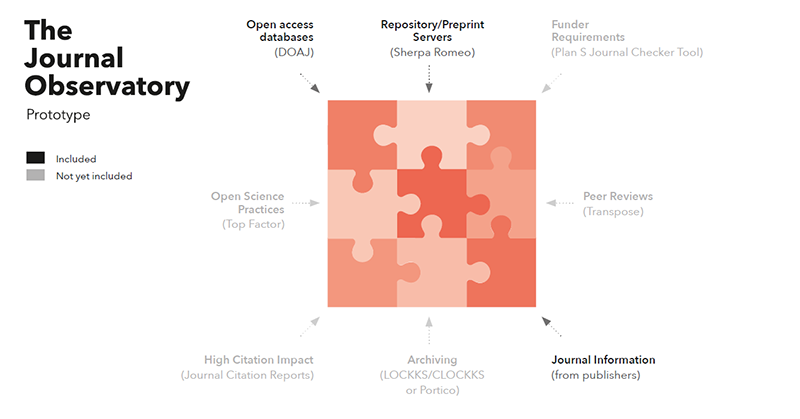
There are numerous initiatives and platforms providing some part of the
puzzle, but information is scattered, incomplete, and difficult to
compare. For example, tools and databases are available that help
researchers understand how to make their research openly accessible
(DOAJ), whether their work can be posted in a repository or on a
preprint server (Sherpa Romeo), how to ensure compliance with funder
requirements (Plan S Journal Checker Tool), and how to pick a
publication platform that offers particular peer review approaches
(Transpose), open science practices (TOP factor), or that is considered
to have a sufficiently high citation impact (Journal Citation Reports).

Given this complexity, it seems unrealistic to expect stakeholders to
know which tools or databases to use to obtain specific information.

As new models of publishing such as Publish-Review-Curate, publication
as you go, preprint review and others emerge, distinct publishing
functions like dissemination and evaluation are increasingly decoupled.
This creates the need for different platforms to interact and at least
to be aware of each other\'s policies and requirements. At present,
there are minimal standards to enable the systematic interoperability of
these platforms. At the research output level, standards like
[DocMaps](https://docmaps.knowledgefutures.org/){target="_blank"} and
the [COAR
Notify](https://www.coar-repositories.org/notify/){target="_blank"}
protocol are under development. However, to empower further innovation
in scholarly communication, a shared way to describe these different
platforms and their possibilities of interaction is required.\

### The Journal Observatory project: aims and approach

To address this challenge, our project aims to:\

1.  define an extensible, machine-readable and traceable way to describe
    the policies and practices of the various platforms involved in
    disseminating and evaluating scholarly works: the **Scholarly
    Communication Platform Framework\**

2.  demonstrate the value of this new framework by building a
    demonstration prototype called the **Journal Observatory**, a
    resource which combines data on journals and other publication
    platforms from various sources to clarify policy information for
    authors, reviewers and others.

#### **1. Scholarly Communication Platform Framework** {#scholarly-communication-platform-framework}

[The Scholarly Communication Platform
Framework](https://www.journalobservatory.org/framework/){target="_blank"}
is a new, high-level, structured language that enables the exchange of
information about platforms for scholarly communication. To date, we
have focused on enabling description of platforms for the dissemination
and/or evaluation of research articles, such as scientific journals,
preprint servers, and peer review platforms. However, the Framework can
fairly easily be extended in the future to describe platforms performing
other scholarly communication functions (e.g., archiving via platforms
like LOCKKS/CLOCKKS or Portico), or to describe dissemination/evaluation
of other types of scholarly outputs (books, datasets, software, code,
methods, materials). The detailed inner-workings and rationale of the
Framework are described in our [technical
report](https://doi.org/10.5281/zenodo.7860610){target="_blank"}.
Documentation and source code can be found on the [project\'s
webpage](https://www.journalobservatory.org/framework/){target="_blank"}.\

#### **2. Journal Observatory prototype** {#journal-observatory-prototype}

The Journal Observatory prototype is a proof-of-concept demonstrator
which integrates journal information from diverse open data sources
including DOAJ, Sherpa Romeo and others, as well as directly from
publishers. It shows the power of combining information from these
different sources to support three primary use-case areas: open access
publishing, preprinting and peer review procedures. By making this
information available, we support researchers, publishers, funders and
research institutions to make informed decisions and monitor compliance.
The prototype comes both with interfaces for machines and with a
user-friendly web interface for humans. There are two interfaces for
machines: a [SPARQL
endpoint](https://sparql.journalobservatory.org/sparql){target="_blank"}
and a [REST API](https://api.journalobservatory.org/){target="_blank"}.
The web interface for humans is provided by the [Journal Observatory
Browser](https://app.journalobservatory.org/){target="_blank"}. More
information about the prototype, including documentation and source
code, can be found on the [project\'s
webpage](https://www.journalobservatory.org/prototype/){target="_blank"}.\

<figure>
<img
src="https://www.leidenmadtrics.nl/images/community/The-Journal-Observatory.png"
data-image="33680" alt="The Journal Observatory" />
</figure>

### **Next steps**

The Journal Observatory project has achieved much within a limited
timeframe and with limited resources. We see our project and its outputs
as the start or continuation, not the end, of a much larger
conversation. We hope our work will provide a base for a more ambitious
long-term agenda, co-shaped with the wider scholarly community, and
aimed at working toward open and interoperable infrastructure for
providing systematic and reliable information on scholarly journals and
other scholarly communication platforms.\

### **The community event**

To mark the end of the project and to launch the project\'s results, we
organized an [online community
event](https://www.journalobservatory.org/event/){target="_blank"} on
April 25. During the event, we presented our work, including a live demo
of the Journal Observatory Browser to show how the tool can support
users in efficiently finding answers to questions like: what journals in
my field (e.g. sustainability research) provide options for Diamond Open
Access publishing? How do the preprinting policies of two journals
compare? What journals in my field adhere to Open Peer Review, in the
sense of publishing review reports?\

The demonstration was followed by Lucy Ofiesh\'s (Director of Finance &
Operations at Crossref) talk on the Principles of Open Scholarly
Infrastructure (POSI). Lucy described how these principles, developed as
a community resource to help guide organizations, can support the
resilience and sustainability of open infrastructure that serves the
scholarly communications ecosystem.

The event was concluded by a panel discussion in which three of the
project\'s stakeholder advisory board members discussed their
perspective on the need and future of interoperable,
systematically-collected information on scholarly communication
platforms. Johan Rooryck (Executive Director of cOAlition S), Catriona
MacCallum (Director of Open Science at Hindawi Publishing) and Gabe
Stein (Head of Operations and Product at the Knowledge Futures Group)
shared their view from the perspective of a research agency coalition,
publisher and infrastructure provider, respectively. They agreed that
there is a dire need for the kind of service provided by initiatives
like the Journal Observatory project, but also identified several
challenges on the road towards sustainability of such initiatives.

The recording of the event can be watched
[here](https://www.journalobservatory.org/event/){target="_blank"}.\

### **Get involved!**

We call upon all within the scholarly communications community to work
collaboratively to advance these aims. If you are interested to discuss
potential collaboration with us or have ideas about how to take this
forward, please contact us via [Ludo
Waltman](mailto:waltmanlr@cwts.leidenuniv.nl){target="_blank"}, Journal
Observatory project lead.\

### **Acknowledgement**

The Journal Observatory project was supported by the Open Science Fund
of the Dutch Research Council (NWO).\

We thank Melanie Imming and Mathijs van Woerkum (im-studio) for their
contributions to the illustrations in this blogpost and all members of
our stakeholder advisory board for their valuable input to our project.\