---
author:
- contributor_roles: []
family: Edmunds
given: Scott
url: https://orcid.org/0000-0001-6444-1436
blog:
authors: null
community_id: 52db0518-e228-4260-8c54-c4e323b2569d
created: 1675555200
current_feed_url: null
description: Data driven blogging from the GigaScience editors
doi: https://doi.org/10.59350/gigablog
favicon: https://rogue-scholar.org/api/communities/52db0518-e228-4260-8c54-c4e323b2569d/logo
feed_format: application/atom+xml
feed_url: http://gigasciencejournal.com/blog/feed/atom/
filter: null
generator: Other
home_page_url: https://gigasciencejournal.com/blog
issn: null
language: eng
license: https://creativecommons.org/licenses/by/4.0/legalcode
prefix: '10.59350'
relative_url: null
secure: false
slug: gigablog
status: archived
subfield: '1311'
title: GigaBlog
updated: null
use_api: null
container: GigaBlog
date: '2022-06-14T00:00:00+00:00'
date_updated: '2025-12-06T10:12:13+00:00'
guid: http://gigasciencejournal.com/blog/?p=4419
identifier: https://doi.org/10.59350/fmy4e-g2b55
image: http://gigasciencejournal.com/blog/wp-content/uploads/2022/06/Screenshot-2022-06-14-at-5.04.12-PM-1024x752.png
images:
- height: '564'
sizes: '(max-width: 768px) 100vw, 768px'
src: http://gigasciencejournal.com/blog/wp-content/uploads/2022/06/Screenshot-2022-06-14-at-5.04.12-PM-1024x752.png
srcset: http://gigasciencejournal.com/blog/wp-content/uploads/2022/06/Screenshot-2022-06-14-at-5.04.12-PM-1024x752.png,
http://gigasciencejournal.com/blog/wp-content/uploads/2022/06/Screenshot-2022-06-14-at-5.04.12-PM-300x220.png,
http://gigasciencejournal.com/blog/wp-content/uploads/2022/06/Screenshot-2022-06-14-at-5.04.12-PM-768x564.png,
http://gigasciencejournal.com/blog/wp-content/uploads/2022/06/Screenshot-2022-06-14-at-5.04.12-PM-1536x1128.png,
http://gigasciencejournal.com/blog/wp-content/uploads/2022/06/Screenshot-2022-06-14-at-5.04.12-PM.png
width: '768'
- alt: Vector-borne diseases
height: '353'
sizes: '(max-width: 768px) 100vw, 768px'
src: http://gigasciencejournal.com/blog/wp-content/uploads/2022/06/Figure-2-1024x470.png
srcset: http://gigasciencejournal.com/blog/wp-content/uploads/2022/06/Figure-2-1024x470.png,
http://gigasciencejournal.com/blog/wp-content/uploads/2022/06/Figure-2-300x138.png,
http://gigasciencejournal.com/blog/wp-content/uploads/2022/06/Figure-2-768x353.png,
http://gigasciencejournal.com/blog/wp-content/uploads/2022/06/Figure-2-1536x705.png,
http://gigasciencejournal.com/blog/wp-content/uploads/2022/06/Figure-2.png
width: '768'
- alt: Vector-Borne diseases screening
height: '491'
sizes: '(max-width: 768px) 100vw, 768px'
src: http://gigasciencejournal.com/blog/wp-content/uploads/2022/06/Screenshot-2022-05-09-at-1.10.54-PM-1024x654.png
srcset: http://gigasciencejournal.com/blog/wp-content/uploads/2022/06/Screenshot-2022-05-09-at-1.10.54-PM-1024x654.png,
http://gigasciencejournal.com/blog/wp-content/uploads/2022/06/Screenshot-2022-05-09-at-1.10.54-PM-300x192.png,
http://gigasciencejournal.com/blog/wp-content/uploads/2022/06/Screenshot-2022-05-09-at-1.10.54-PM-768x491.png,
http://gigasciencejournal.com/blog/wp-content/uploads/2022/06/Screenshot-2022-05-09-at-1.10.54-PM.png
width: '768'
- alt: Vimeo
src: https://f.vimeocdn.com/p/images/crawler_logo.png
- src: http://gigasciencejournal.com/blog/wp-content/uploads/2022/06/Screenshot-2022-06-14-at-5.04.12-PM-1024x752.png
- alt: 'Data from the series in the GBIF.org repository showing the
geographic coverage of American triatomine
species.'
src: http://gigasciencejournal.com/blog/wp-content/uploads/2022/06/Figure-2-1024x470.png
- alt: 'Urban mosquito surveillance programs in Columbia from Marceló-díaz C et
al..'
src: http://gigasciencejournal.com/blog/wp-content/uploads/2022/06/Screenshot-2022-05-09-at-1.10.54-PM-1024x654.png
issn: null
keywords:
- Health
- Biodiversity
- Disease Vector
- GigaByte
- Infectious Disease
lang: en
license: https://creativecommons.org/licenses/by/4.0/legalcode
rid: pqy72-xw344
rights: https://creativecommons.org/licenses/by/4.0/legalcode
summary: Our WHO-sponsored series of articles describing biodiversity data relevant
to vector-borne diseases has now been published in GigaByte . This
special issue presents a wide variety of data relating to the presence, spread,
and diversity of organisms that are transmitting viruses, bacteria and parasites
to humans.
title: GigaByte helping the fight against Vector-Borne diseases with data
url: https://wayback.archive-it.org/22098/2025-05-01T17:13:42Z/http://gigasciencejournal.com/blog/vector-borne-diseases-series
version: v1
---
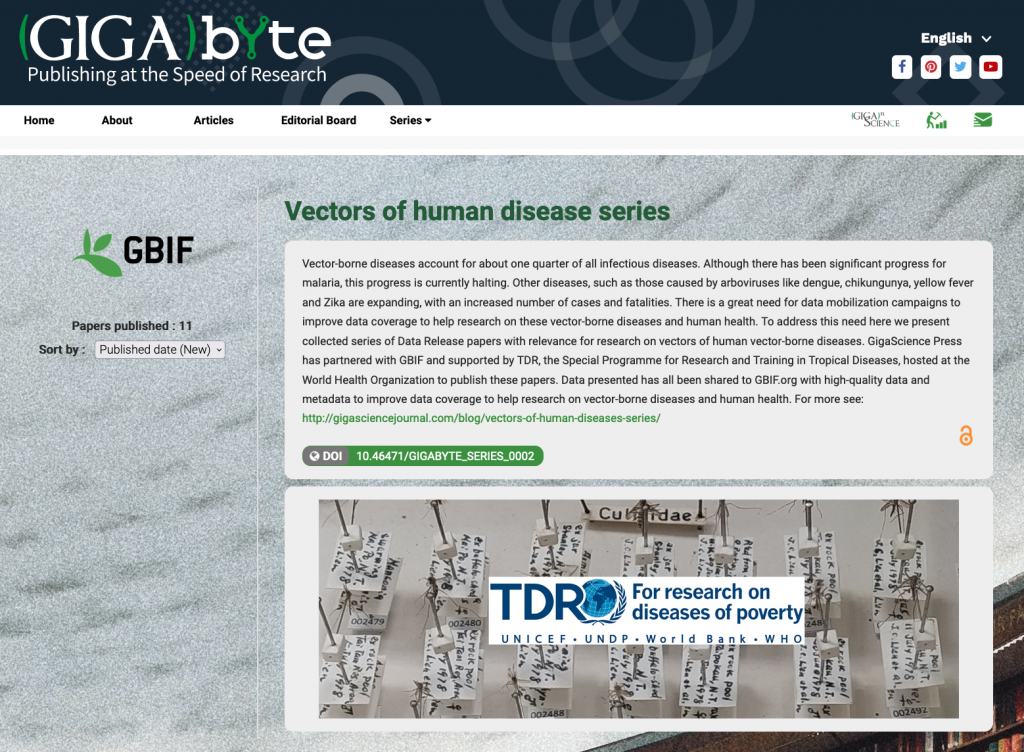
Our [WHO-sponsored
series](http://gigasciencejournal.com/blog/vectors-of-human-diseases-series/)
of articles describing biodiversity data relevant to
vector-borne diseases has [now been published in
*GigaByte*](https://doi.org/10.46471/GIGABYTE_SERIES_0002). This special
issue presents a wide variety of data relating to the presence, spread,
and diversity of organisms that are transmitting viruses, bacteria and
parasites to humans. The biodiversity data described in these articles
provides researchers with information to aid in the battle against this
prevalent and growing burden on the health of millions of people
worldwide. Further, the work here incentivises data sharing through the
[GBIF.org](http://gbif.org/) platform to track and assess particular
species, most especially in geographic gaps where the presence and
expansion of these organisms are not well described. As the world
continues to see the spread of disease vector species and new
vector-borne diseases, the collection of monitoring data, coupled with
sharing of and open access to such data to enable analysis, are part of
the frontline to battle such scourges.
Vector-borne diseases are responsible for more than 17% of infectious
diseases. Debilitating and deadly diseases, such as malaria, dengue,
chikungunya, yellow fever and zika, can only be contained by having the
latest and most abundant amount of information on the presence,
diversity, ecology, bionomics and geographic spread of the organisms
that carry and transmit the infectious agents. There are, however, huge
gaps in the information related to these vectors, and data mobilisation
and sharing campaigns are essential to combat these scourges.
As part of these efforts, GigaScience Press partnered with the Global
Biodiversity Information Facility (GBIF) and were supported by the
Special Programme for Research and Training in Tropical Diseases (TDR),
hosted by the WHO. In total 11 Data Release papers on vectors of human
disease have now been [published in the thematic
series](https://doi.org/10.46471/GIGABYTE_SERIES_0002), providing open
access to the articles and the data collected in the efforts to promote
advance worldwide work in this arena. This effort has led to the release
of newly digitised location data for more than [500,000 occurrence
records](https://www.gbif.org/occurrence/search?2a629a9a_38d1_496b_afbf_b4ff3b8fae60=&dataset_key=a51b1fb9-6e67-42b9-879b-5f21e4d85642&dataset_key=1fef1ead-3d02-495e-8ff1-6aeb01123408&dataset_key=83ab030b-d243-469c-8947-1ed487e06a80&dataset_key=12315bb8-8ab3-446a-b5a4-2be93aade242&dataset_key=03269e13-84ae-430f-990e-f11069413e36&dataset_key=3331bcd4-f85e-4252-8e92-3aaa6fdc3eca&dataset_key=6679952f-649b-4888-bd97-00daca4b8cc1&dataset_key=9ee09033-8aab-4813-8c2b-db6d54d9817b&dataset_key=a178c443-d737-4938-b983-5fa8e50936fe&dataset_key=f5361e97-c8f1-4697-b209-8817e14ae780&dataset_key=f0ccf436-e2e8-4f61-af19-753cdb73ca00&dataset_key=d9f6d2bf-20d7-4b87-99ac-e902b34364e4&dataset_key=7140a42f-8ad6-43cd-b252-b5a791c8de4a&dataset_key=eae731a7-3e82-4295-b0b3-ec72d75a402d)
(and 675,000 specimens) observed across the Americas and Europe.
The difficulty of carrying out a global call for novel data of this type
is reduced by creating mechanisms to incentive data collection, sharing,
and discovery. Currently, one of the best ways to overcome these
difficulties is through the publication of data papers, which provide
much deserved credit for the researchers carrying out this vital work
who typically do not receive the appropriate recognition. Such papers
drive readers directly to the data in their associated public domain
database ([GBIF](http://gbif.org/) in this case), as well as improving
its findability through well-established mechanisms for article
discovery, providing the means to give details about the collection,
methodology, and validation of the data presented. Data collection is
essential; open data sharing respecting [FAIR
principles](https://www.go-fair.org/fair-principles/) moves
understanding forward. The data for this series has been audited by our
curation team, organised, and made freely available to the community via
the [GBIF.org](http://gbif.org/) platform (on top of examples with data
also in NCBI, the EBI bioimaging archive and GigaDB), and each
dataset\'s access information is documented in the published articles.
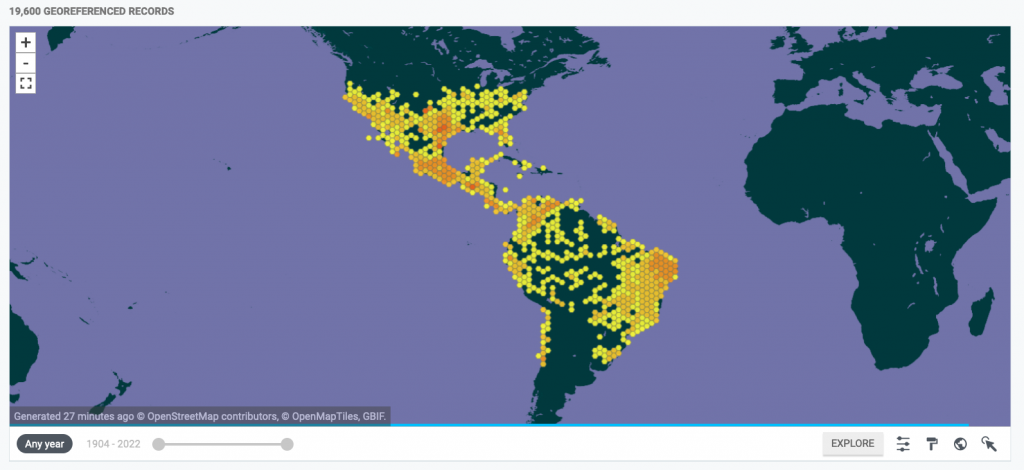
Data from the series in the GBIF.org repository showing the
geographic coverage of American triatomine
species.
GBIF\'s deputy director, Tim Hirsch, commented: \"The great response to
this data paper series shows the enormous potential for improved
availability of data on species connected with human diseases. Such data
often already exists but is disconnected and unavailable for re-use:
opening it up through sharing via platforms such as GBIF, and alerting
the scientific community via peer-reviewed descriptions, supports better
understanding and policies reflecting the inextricable connections
between biodiversity and human health.\"
The articles in [this
series](https://doi.org/10.46471/GIGABYTE_SERIES_0002) include a wide
sampling of vectors across Europe and the Americas. In the Americas,
there is a study presenting information and [data on 428,960
ticks](https://doi.org/10.46471/gigabyte.56) collected across the United
States and a [collection of 80,000 sand
flies](https://doi.org/10.46471/gigabyte.52) potential vectors of
leishmaniasis from 20 different countries. Additional work includes
digitising historical collections from several [Brazilian
states](https://doi.org/10.46471/gigabyte.61), and efforts to [work
directly with indigenous
communities](https://doi.org/10.46471/gigabyte.61) deep in the Amazon to
prevent leishmaniasis.
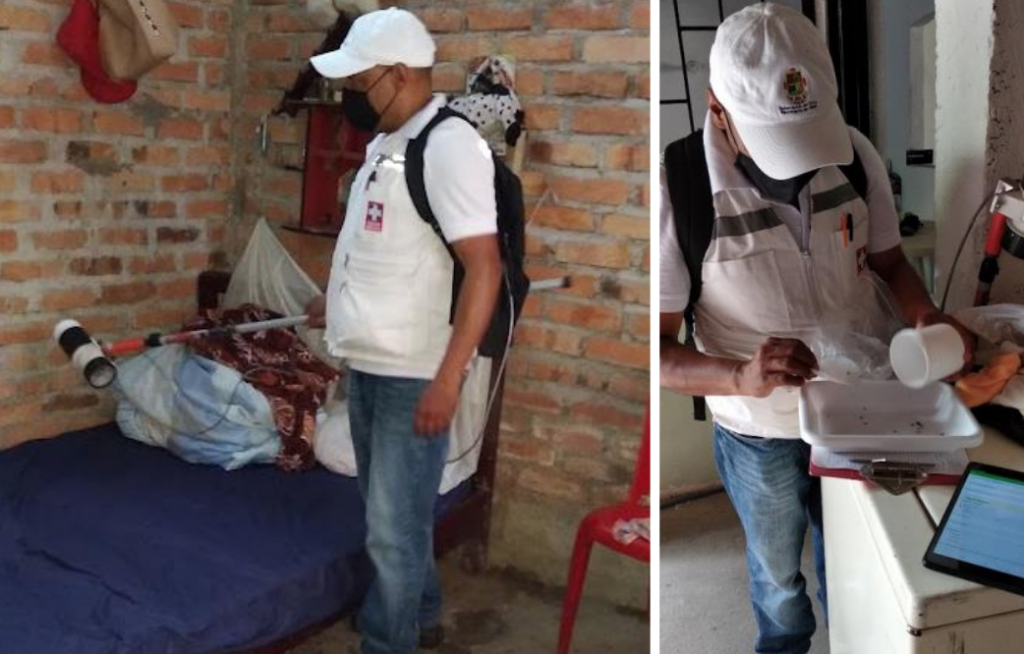
Urban mosquito surveillance programs in Columbia from Marceló-díaz C et
al..
In Europe, a [pan-continental consortium
project](https://doi.org/10.46471/gigabyte.57) implemented by 42
volunteer teams from 24 countries have systematically looked for
invasive *Aedes* mosquitoes across the continent. Discovery and
monitoring pests are typically handled by government vector screening
programs, but these require huge resources making it impossible to gain
information from all geographical corners of their countries. The
ubiquitous presence of citizens with mobile devices throughout the world
made them an excellent -and free- resource to include as a new regiment
in the battle against these infectious diseases. These citizen
scientists have been mobilised by the [Mosquito Alert
project](https://doi.org/10.46471/gigabyte.54) to use an app to identify
and monitor invasive mosquitoes., and this data is also shared here.
This process established the means to create an early warning system of
invasive species from a city-to-city scale for government managed
programs that have limited resources to continental scale (see [more in
Gigablog](http://gigasciencejournal.com/blog/publishing-mosquito-alert-data/)).
Further demonstration of the power of citizen scientists also includes
an [article presenting a database](https://doi.org/10.46471/gigabyte.62)
of triatomine kissing bug insects that spread Chagas disease in the
Americas, 90% of the data from the US (around 5000 data points) was
collected from the [](http://dx.doi.org/10.1371/journal.pntd.0004235)
[Kissing bugs and Chagas Disease in the United States community science
program](http://dx.doi.org/10.1371/journal.pntd.0004235). Demonstrating
that citizens can play a key role in contributing to the sum of
scientific knowledge and filling crucial data gaps in this extremely
important area of global public health. The use of citizen scientists
in these studies serves as an example for new inexpensive ways to carry
out myriad other such massive data collection projects.
All the articles in this series provide an enormous amount of
information that is central to the ongoing and growing fight against
infectious diseases that are carried by organisms throughout the world.
Open access, freely available, discoverable data are key to making rapid
advances in all areas of research. The contributors to this series, from
citizen scientists to independent researchers to consortium members,
have this goal in mind as they make these data available to the world
and continue this work. Dr Florence Fouque, Scientist and focal point
for vectors at TDR saying: \"This is an important effort for sharing
data on vectors which are essential in the fight against vector-borne
diseases and we do hope that it will encourage the sharing of those data
more largely\".
The papers from [this vector-borne diseases
series](https://doi.org/10.46471/GIGABYTE_SERIES_0002) include embedded
dynamics, such as interactive maps and embedded protocols. Additionally,
there are multilingual options for many papers that allow Portuguese and
Spanish speakers to better comprehend the implications of important work
relating to the public health of their communities.
See more in the [GBIF
webinar](http://gigasciencejournal.com/blog/gbif-webinar/) covering the
series.
:::: {.iframe}
[](https://player.vimeo.com/video/669798325)
::: {#crawler_player}
Play
{.logo}
:::
::::
Read the series here:
**Further Reading**\
Andrade-filho JD et al. Online catalogue of the Coleção de Flebotomíneos
(FIOCRUZ/COLFLEB), a biological collection of American sand flies
(Diptera: Psychodidae, Phlebotominae) held at Fiocruz Minas, Brazil,
*Gigabyte*, 2022
Marceló-díaz C et al. Arbovirus vectors in municipalities with a high
risk of dengue in Cauca, Southwestern Colombia, *Gigabyte*, 2022
[ https://doi.org/10.46471/gigabyte.53](https://doi.org/10.46471/gigabyte.53)
Južnič-zonta Ž et al. Mosquito alert: leveraging citizen science to
create a GBIF mosquito occurrence dataset, *Gigabyte*, 2022
[ https://doi.org/10.46471/gigabyte.54](https://doi.org/10.46471/gigabyte.54)
Dos Santos Conceição M et al. Culicidae (Diptera: Culicomorpha) in the
southern Brazilian \'Ana Leuch Lozovei\' collection, with notes on
distribution and diversity, *Gigabyte*, 2022
Paull SH et al. Tick abundance, diversity and pathogen data collected by
the National Ecological Observatory Network, *Gigabyte*, 2022
[ https://doi.org/10.46471/gigabyte.56](https://doi.org/10.46471/gigabyte.56)
Miranda MA et al. AIMSurv: First pan-European harmonized surveillance of
Aedes invasive mosquito species of relevance for human vector-borne
diseases, *Gigabyte*, 2022
Van Bortel W et al. MODIRISK: Mosquito vectors of disease, collection,
monitoring and longitudinal data from Belgium, *Gigabyte*, 2022
Deblauwe I et al. MEMO: Monitoring of exotic mosquitoes in Belgium,
*Gigabyte*, 2022
[ https://doi.org/10.46471/gigabyte.59](https://doi.org/10.46471/gigabyte.59)
Godoy RE et al. Sand fly (Diptera: Psychodidae: Phlebotominae) records
in Acre, Brazil: a dataset, *Gigabyte*, 2022
Shimabukuro PHF et al. Occurrence records and metadata for sand flies
(Diptera, Psychodidae, Phlebotominae) collected in the lands of
indigenous people in the Brazilian Amazon, *Gigabyte*, 2022
[ https://doi.org/10.46471/gigabyte.61](https://doi.org/10.46471/gigabyte.61)
Ceccarelli S et al. American triatomine species occurrences: updates and
novelties in the DataTri database, *Gigabyte*, 2022
The post [GigaByte helping the fight against Vector-Borne diseases with
data](http://gigasciencejournal.com/blog/vector-borne-diseases-series/){rel="nofollow"}
appeared first on
[GigaBlog](http://gigasciencejournal.com/blog){rel="nofollow"}.