---
author:
- contributor_roles: []
family: Edmunds
given: Scott
url: https://orcid.org/0000-0001-6444-1436
blog:
authors: null
community_id: 52db0518-e228-4260-8c54-c4e323b2569d
created: 1675555200
current_feed_url: null
description: Data driven blogging from the GigaScience editors
doi: https://doi.org/10.59350/gigablog
favicon: https://rogue-scholar.org/api/communities/52db0518-e228-4260-8c54-c4e323b2569d/logo
feed_format: application/atom+xml
feed_url: http://gigasciencejournal.com/blog/feed/atom/
filter: null
generator: Other
home_page_url: https://gigasciencejournal.com/blog
issn: null
language: eng
license: https://creativecommons.org/licenses/by/4.0/legalcode
prefix: '10.59350'
relative_url: null
secure: false
slug: gigablog
status: archived
subfield: '1311'
title: GigaBlog
updated: null
use_api: null
container: GigaBlog
date: '2024-02-20T00:00:00+00:00'
date_updated: '2025-12-06T10:06:58+00:00'
guid: http://gigasciencejournal.com/blog/?p=5635
identifier: https://doi.org/10.59350/f07m6-3h227
image: http://gigasciencejournal.com/blog/wp-content/uploads/2024/02/GigaScience-Banner-300x82.jpeg
images:
- height: '195'
sizes: '(max-width: 713px) 100vw, 713px'
src: http://gigasciencejournal.com/blog/wp-content/uploads/2024/02/GigaScience-Banner-300x82.jpeg
srcset: http://gigasciencejournal.com/blog/wp-content/uploads/2024/02/GigaScience-Banner-300x82.jpeg,
http://gigasciencejournal.com/blog/wp-content/uploads/2024/02/GigaScience-Banner-1024x280.jpeg,
http://gigasciencejournal.com/blog/wp-content/uploads/2024/02/GigaScience-Banner-768x210.jpeg,
http://gigasciencejournal.com/blog/wp-content/uploads/2024/02/GigaScience-Banner-1536x419.jpeg,
http://gigasciencejournal.com/blog/wp-content/uploads/2024/02/GigaScience-Banner.jpeg
width: '713'
- alt: Spatial Omics gif
height: '327'
src: http://gigasciencejournal.com/blog/wp-content/uploads/2024/02/ezgif-Stomics-300x169.gif
width: '580'
- alt: Spatial Omics series example
height: '192'
sizes: '(max-width: 703px) 100vw, 703px'
src: http://gigasciencejournal.com/blog/wp-content/uploads/2024/02/giae003fig2-300x82.png
srcset: http://gigasciencejournal.com/blog/wp-content/uploads/2024/02/giae003fig2-300x82.png,
http://gigasciencejournal.com/blog/wp-content/uploads/2024/02/giae003fig2-768x211.png,
http://gigasciencejournal.com/blog/wp-content/uploads/2024/02/giae003fig2-1536x422.png,
http://gigasciencejournal.com/blog/wp-content/uploads/2024/02/giae003fig2-2048x563.png
width: '703'
- alt: SAW Spatial Omics workflow
height: '614'
sizes: '(max-width: 614px) 100vw, 614px'
src: http://gigasciencejournal.com/blog/wp-content/uploads/2024/02/gigabyte-2024-111-g004-300x300.jpg
srcset: http://gigasciencejournal.com/blog/wp-content/uploads/2024/02/gigabyte-2024-111-g004-300x300.jpg,
http://gigasciencejournal.com/blog/wp-content/uploads/2024/02/gigabyte-2024-111-g004-150x150.jpg,
http://gigasciencejournal.com/blog/wp-content/uploads/2024/02/gigabyte-2024-111-g004.jpg
width: '614'
issn: null
keywords:
- Biology
- 3D Spatial Mapping
- Genomics
- Spatial Omics
- Thematic Series
lang: en
license: https://creativecommons.org/licenses/by/4.0/legalcode
reference:
- id: https://doi.org/10.1093/gigascience/giae003
unstructured: Cao, L., Yang, C., Hu, L., Jiang, W., Ren, Y., Xia, T., Xu, M., Ji,
Y., Li, M., Xu, X., Li, Y., Zhang, Y., & Fang, S. (2024). Deciphering spatial
domains from spatially resolved transcriptomics with Siamese graph autoencoder.
GigaScience, 13.
- id: https://doi.org/10.1093/gigascience/giad097
unstructured: 'Lv, T., Zhang, Y., Li, M., Kang, Q., Fang, S., Zhang, Y., Brix, S.,
& Xu, X. (2024). EAGS: efficient and adaptive Gaussian smoothing applied to
high-resolved spatial transcriptomics. GigaScience, 13.'
- id: https://doi.org/10.46471/gigabyte111
unstructured: Unknown title
- id: https://doi.org/10.46471/gigabyte108
unstructured: Unknown title
- id: https://doi.org/10.46471/gigabyte109
unstructured: Unknown title
- id: https://doi.org/10.46471/gigabyte110
unstructured: Unknown title
- id: http://gigasciencejournal.com/blog/spatial-omics-series/
unstructured: Unknown title
- id: http://gigasciencejournal.com/blog
unstructured: Unknown title
rid: 084hc-p9n31
rights: https://creativecommons.org/licenses/by/4.0/legalcode
summary: '*A multitude of papers on novel methods for Spatial Omics are published
in a cross-journal series launching today in GigaScience and GigaByte Journals.
* Spatial Omics is a new field that is taking large-scale data-rich biological and
biomedical research into new dimensions. Which is having a significant impact on
the fundamental fields of biology and biomedicine.'
title: Taking Spatial Omics into the Next Dimension
url: https://wayback.archive-it.org/22098/2025-05-01T17:13:42Z/http://gigasciencejournal.com/blog/spatial-omics-series
version: v1
---
{.wp-image-5641
.aligncenter loading="lazy" decoding="async"
srcset="http://gigasciencejournal.com/blog/wp-content/uploads/2024/02/GigaScience-Banner-300x82.jpeg 300w, http://gigasciencejournal.com/blog/wp-content/uploads/2024/02/GigaScience-Banner-1024x280.jpeg 1024w, http://gigasciencejournal.com/blog/wp-content/uploads/2024/02/GigaScience-Banner-768x210.jpeg 768w, http://gigasciencejournal.com/blog/wp-content/uploads/2024/02/GigaScience-Banner-1536x419.jpeg 1536w, http://gigasciencejournal.com/blog/wp-content/uploads/2024/02/GigaScience-Banner.jpeg 2000w"
sizes="(max-width: 713px) 100vw, 713px" width="713" height="195"}
\*A multitude of papers on novel methods for Spatial Omics are published
in a cross-journal series launching today in GigaScience and GigaByte
Journals.\
\*
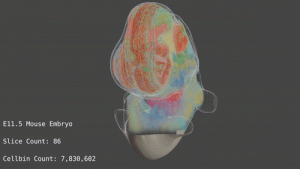
Spatial Omics is a new field that is taking large-scale data-rich
biological and biomedical research into new dimensions. Which is having
a significant impact on the fundamental fields of biology and
biomedicine. Spatial omics technologies are high-throughput methods for
analyzing biological data-based spatial information. It allows
researchers to uncover the spatial distribution characteristics in
cells, tissues, and organs, which provides a fresh perspective for
studying the structure and function of biological systems. This
groundbreaking new field has originally centred on spatial
transcriptomics, which was [named \'Method of the Year\' by *Nature
Methods*](https://doi.org/10.1038/s41592-020-01033-y) in 2021. For
research in this field to continue to progress, new algorithms, methods
and tools for spatial omics technology are essential. As well as new
data standards and models of sharing this data (see this
[new](https://doi.org/10.1016/j.xgen.2023.100374)
[commentary](https://doi.org/10.1016/j.xgen.2023.100374) covering these
challenges). To address these needs, the first articles in a new
Spacial Omics thematic series have just been published in GigaScience
Press\' open-science journals *GigaScience* and *GigaByte*.
{.wp-image-5648
.aligncenter loading="lazy" decoding="async" width="580" height="327"}
The huge potential of Spatial Omics technology is being held back due to
the challenges in handling enormous multi-dimensional datasets.
Scientists currently lack available techniques and computational tools
for using this novel spatial information even with the ability to re-use
existing single-cell data-analysis algorithms. It is therefore crucial
to have new customized algorithms and tools specifically created to
analyze and interpret spatial omics data. To allow the community to take
full advantage of these tools, they must be open-source, easy-to-use,
and designed to handle the enormous data volumes produced in these
experiments.
To help to establish a place for the community to find multiple new
spatial omics analysis methods, GigaScience Press has just published the
first batch of articles in a new cross-journal thematic series in our
[*GigaScience*](https://academic.oup.com/gigascience/pages/spatial-omics-methods-and-applications)
and [*GigaByte*](https://doi.org/10.46471/GIGABYTE_SERIES_0005)
journals. These series provide a home for novel spatial omics
algorithms, tools, and applications. The openly available pipelines and
tools include data preprocessing methods, data quality assessment and
improvement, basic analyses, downstream analysis mining, and more.
Together, these articles in this ongoing series will help the roll-out
and democratize use of this technology by streamlining analyses and
providing a toolkit of adaptable open-source tools for others to use and
build on. And using our in-house curation experience and data-hosting in
GigaDB we can also assist authors to get these complicated works out in
an easy and reproducible manner.
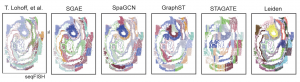
One of these just released articles is published in our lead journal,
*GigaScience*, describes a [new analysis tool called Siamese Graph
Autoencoder (SGAE)](https://doi.org/10.1093/gigascience/giae003), an
algorithm for detecting spatial domains. SGAE outperforms other methods
in terms of capturing spatial patterns and generating high-quality
clusters. This enables researchers to resolve anatomical structures such
as cortex structures of the brain or gastrulation during mouse embryonic
development, with better clarity than other current methods. This
groundbreaking new technology pushes the boundaries of what can be
studied and discovered. Another *GigaScience* paper present the
imputation algorithm [Efficient and Adaptive Gaussian smoothing (EAGS)
tool](https://doi.org/10.1093/gigascience/giad097), which improves data
quality in highly resolved spatial transcriptomics.
::: {#attachment_5638 .wp-caption .aligncenter style="width: 713px"}
{.wp-image-5638
loading="lazy" decoding="async"
aria-describedby="caption-attachment-5638"
srcset="http://gigasciencejournal.com/blog/wp-content/uploads/2024/02/giae003fig2-300x82.png 300w, http://gigasciencejournal.com/blog/wp-content/uploads/2024/02/giae003fig2-768x211.png 768w, http://gigasciencejournal.com/blog/wp-content/uploads/2024/02/giae003fig2-1536x422.png 1536w, http://gigasciencejournal.com/blog/wp-content/uploads/2024/02/giae003fig2-2048x563.png 2048w"
sizes="(max-width: 703px) 100vw, 703px" width="703" height="192"}
Mouse gastrulation dataset resolved with SGAE and other spatial omics
analysis tools.
:::
Articles published in our *GigaByte* journal address major limiting
factors in the adoption of spatial omics research: the availability of
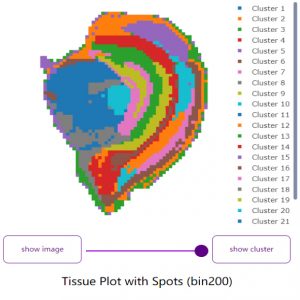
workflow systems for data preprocessing. One of articles [presents
SAW](https://doi.org/10.46471/gigabyte111), an already popular (nearly
100 stars on GitHub) tool that processes Stereo-seq data, and which
allows better data quality assessment of large spatial transcriptomics
datasets. Another paper presents the [BatchEval
tool](https://doi.org/10.46471/gigabyte108), which helps researchers
identify and remove batch effects, ensuring reliable and meaningful
insights from integrated datasets. In addition to tools for improving
data processing, a number of new analysis tool articles are also
released in the launch of this new series. These include articles that
present the [Variable Neighborhood Search (VNS)
method](https://doi.org/10.46471/gigabyte109), which serves to better
cluster cells based on both gene expression and spatial coordinates; and
[the STCellbin tool,](https://doi.org/10.46471/gigabyte110) which uses
cell nuclei staining images as a bridge to align cell membrane/wall
staining images with spatial gene expression maps.
::: {#attachment_5646 .wp-caption .aligncenter style="width: 624px"}
{.wp-image-5646
loading="lazy" decoding="async"
aria-describedby="caption-attachment-5646"
srcset="http://gigasciencejournal.com/blog/wp-content/uploads/2024/02/gigabyte-2024-111-g004-300x300.jpg 300w, http://gigasciencejournal.com/blog/wp-content/uploads/2024/02/gigabyte-2024-111-g004-150x150.jpg 150w, http://gigasciencejournal.com/blog/wp-content/uploads/2024/02/gigabyte-2024-111-g004.jpg 621w"
sizes="(max-width: 614px) 100vw, 614px" width="614" height="614"}
SAW Spatial Omics Analysis workflow, demonstrating spatial clustering
for a mouse brain dataset.
:::
This cross-journal thematic series will continue to publish a host of
other papers in the coming months, and remains open for submissions of
similar open-source, reproducible algorithms, tools and applications.
Both *GigaScience* and *Gigabyte* aid authors to share due to having
in-house data hosting and curation support to provide open-science
articles. This encourages others to complement the development of the
spatial omics data tool community and continue to promote rapid
scientific research progress in this new and growing field.
For more information or pre-submission inquiries, please contact us at
editorial@gigasciencejournal.com.
You can read the papers as they continue to be added to the series pages
here
G*igaByte* Journal series page:
*GigaScience* Journal Series page:
### **References**
Cao L et al. Deciphering spatial domains from spatially resolved
transcriptomics with Siamese Graph Autoencoder. *GigaScience* 2024
doi:[10.1093/gigascience/giae003](http://dx.doi.org/10.1093/gigascience/giae003)
Lv T et al. EAGS: efficient and adaptive Gaussian smoothing applied to
high-resolved spatial transcriptomics. *GigaScience* 2024.
doi:[10.1093/gigascience/giad097](https://doi.org/10.1093/gigascience/giad097)
Gong C et al. SAW: An efficient and accurate data analysis workflow for
Stereo-seq spatial transcriptomics. *GigaByte* 2024
doi:[10.46471/gigabyte111](https://doi.org/10.46471/gigabyte111)
Zhang C. et al. BatchEval Pipeline: Batch Effects Evaluation Workflow
for Multi-batch Dataset Joint Analysis. *GigaByte* 2024
doi:[10.46471/gigabyte108](https://doi.org/10.46471/gigabyte108)
Ivanovic M et al. A Novel Variable Neighborhood Search Approach for Cell
Clustering for Spatial Transcriptomics. *GigaByte* 2024
doi:[10.46471/gigabyte109](https://doi.org/10.46471/gigabyte109)
Kang Q et al. Generating single-cell gene expression profiles for
high-resolution spatial transcriptomics based on cell boundary images.
*GigaByte* 2024
doi:[10.46471/gigabyte110](https://doi.org/10.46471/gigabyte110)
The post [Taking Spatial Omics into the Next
Dimension](http://gigasciencejournal.com/blog/spatial-omics-series/){rel="nofollow"}
appeared first on
[GigaBlog](http://gigasciencejournal.com/blog){rel="nofollow"}.