---
author:
- contributor_roles: []
family: Edmunds
given: Scott
url: https://orcid.org/0000-0001-6444-1436
blog:
authors: null
community_id: 52db0518-e228-4260-8c54-c4e323b2569d
created: 1675555200
current_feed_url: null
description: Data driven blogging from the GigaScience editors
doi: https://doi.org/10.59350/gigablog
favicon: https://rogue-scholar.org/api/communities/52db0518-e228-4260-8c54-c4e323b2569d/logo
feed_format: application/atom+xml
feed_url: http://gigasciencejournal.com/blog/feed/atom/
filter: null
generator: Other
home_page_url: https://gigasciencejournal.com/blog
issn: null
language: eng
license: https://creativecommons.org/licenses/by/4.0/legalcode
prefix: '10.59350'
relative_url: null
secure: false
slug: gigablog
status: archived
subfield: '1311'
title: GigaBlog
updated: null
use_api: null
container: GigaBlog
date: '2019-05-15T00:00:00+00:00'
date_updated: '2025-12-06T10:24:17+00:00'
guid: http://gigasciencejournal.com/blog/?p=2862
identifier: https://doi.org/10.59350/e8h7d-97c26
image: http://gigasciencejournal.com/blog/wp-content/uploads/2019/05/NickLoman-300x225.jpg
images:
- alt: mock metagenome
height: '225'
sizes: '(max-width: 300px) 100vw, 300px'
src: http://gigasciencejournal.com/blog/wp-content/uploads/2019/05/NickLoman-300x225.jpg
srcset: http://gigasciencejournal.com/blog/wp-content/uploads/2019/05/NickLoman-300x225.jpg,
http://gigasciencejournal.com/blog/wp-content/uploads/2019/05/NickLoman-768x576.jpg,
http://gigasciencejournal.com/blog/wp-content/uploads/2019/05/NickLoman-1024x768.jpg,
http://gigasciencejournal.com/blog/wp-content/uploads/2019/05/NickLoman.jpg
width: '300'
- alt: mock microbiome
height: '278'
sizes: '(max-width: 300px) 100vw, 300px'
src: http://gigasciencejournal.com/blog/wp-content/uploads/2019/05/giz043fig1-300x278.jpeg
srcset: http://gigasciencejournal.com/blog/wp-content/uploads/2019/05/giz043fig1-300x278.jpeg,
http://gigasciencejournal.com/blog/wp-content/uploads/2019/05/giz043fig1.jpeg
width: '300'
- alt: mock metagenome
height: '272'
sizes: '(max-width: 300px) 100vw, 300px'
src: http://gigasciencejournal.com/blog/wp-content/uploads/2019/05/longreadclub-300x272.jpg
srcset: http://gigasciencejournal.com/blog/wp-content/uploads/2019/05/longreadclub-300x272.jpg,
http://gigasciencejournal.com/blog/wp-content/uploads/2019/05/longreadclub.jpg
width: '300'
issn: null
keywords:
- Technology
- Genomics
- Metagenome
- Metagenomics
- Microbial Genomics
lang: en
license: https://creativecommons.org/licenses/by/4.0/legalcode
rid: 5645q-ebb10
rights: https://creativecommons.org/licenses/by/4.0/legalcode
summary: The mock metagenome, MAGs and breaking the first rule of Long Read
Club Nick showing us some of his experiments with an early antecedent
Short Read Club… Out today in GigaScience is a new "mock metagenome"
Data Note from the Nick Loman lab in Birmingham showcasing the latest long-read
sequencing technologies from Oxford Nanopore.
title: Mock the Metagenome. Author Q&A with Nick Loman & Sam Nicholls
url: https://wayback.archive-it.org/22098/2025-05-01T17:13:42Z/http://gigasciencejournal.com/blog/mock-metagenome
version: v1
---
**The mock metagenome, MAGs and breaking the first rule of Long Read
Club**
::: {#attachment_2866 .wp-caption .alignright style="width: 310px"}
{.size-medium
.wp-image-2866 loading="lazy" decoding="async"
aria-describedby="caption-attachment-2866"
srcset="http://gigasciencejournal.com/blog/wp-content/uploads/2019/05/NickLoman-300x225.jpg 300w, http://gigasciencejournal.com/blog/wp-content/uploads/2019/05/NickLoman-768x576.jpg 768w, http://gigasciencejournal.com/blog/wp-content/uploads/2019/05/NickLoman-1024x768.jpg 1024w, http://gigasciencejournal.com/blog/wp-content/uploads/2019/05/NickLoman.jpg 2048w"
sizes="(max-width: 300px) 100vw, 300px" width="300" height="225"}
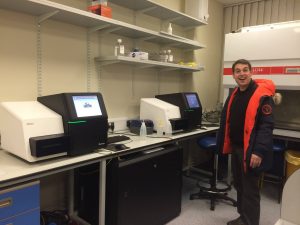
Nick showing us some of his experiments with an [early]{dobid="hdw"}
[antecedent]{dobid="hdw"} Short Read Club...
:::
Out [today in *GigaScience*](https://doi.org/10.1093/gigascience/giz043)
is a new \"mock metagenome\" Data Note from the Nick Loman lab in
Birmingham showcasing the latest long-read sequencing technologies from
Oxford Nanopore. Having published the first nanopore *E. coli* genome
[with us in 2014](https://doi.org/10.1186/2047-217X-3-22) showcasing the
then new MinION, this new benchmark presents long read metagenomics
datasets from Oxford Nanopore\'s new PromethION sequencer. In one of our
long running series of author Q&As Nick Loman and first author Sam
Nicholls give us the lowdown on the importance of the mock metagenome,
open science, MAGs, and how this work is part of a new Long Read Club.
**What does a mock metagenomics dataset give you that you can\'t get
from \"real-world\" datasets? Why are these community standards
important?**
Mock communities are really useful for both lab and bioinformatics
\"positive controls\".
Because the community has gram-negative, gram-positive and two types of
yeast cells, it can be used to check that DNA extractions have worked
properly. Some kits will fail to lyse some of the cells and they will
simply be missing from your experiment! Having a gold standard reference
for each genome is really useful for assessing how well bioinformatics
aligners and de novo assemblers are working. And the use of known taxa
and abundances in invaluable for assessing taxonomic assignment
pipelines.
In this case, to keep pace with such changes and to ensure robustness of
results, it is incredibly helpful to have validated, known \"gold
standard\" datasets. In this case we used a commercially-available
[\"mock community\" from
Zymo](https://www.zymoresearch.com/blogs/blog/zymobiomics-microbial-standards-optimize-your-microbiomics-workflow):
real cells, in known abundances, comprised of 10 different microbes.
As genomics is moving into real-world uses such as in the clinic, it is
even more vital that experiments are conducted correctly and sequencing
and bioinformatics pipelines can be validated. We are trying to help the
community design accepted best practices for long read metagenomics.
Our paper is a starting point for a longer-term goal to generate
reliable trusted data sets, and make them [freely
available](http://dx.doi.org/10.5524/100580) for the community.
**This example presents large amounts of long-read sequencing data, so
what does this technology bring to the field of metagenomics?**
Metagenomics is a very exciting technique, and the field has really
taken off in recent years, and has been used for diverse applications
including diagnosis for clinical microbiology, the discovery of new
genes and species with potentially industrial biotechnology
applications, and for studies of microbial diversity: for example, whole
new swathes of the Tree of Life, such as the Candidate Phyla Radiation
were [discovered using
metagenomics](http://dx.doi.org/10.1038/s41564-017-0083-5)!
The field is enthusiastic about being able to recover whole genome
information directly from samples without the need for culture, and
so-called metagenome-assembed genomes (MAGs) are being collected at an
increasing pace. MAGs are usually made by sorting sequence reads or
contigs with similar composition or coverage into genome \'bins\'.
However, these binned MAGs can be fragmented, miss important genes and
end up being contaminated with sequences from related species.
::: {#attachment_2867 .wp-caption .alignleft style="width: 310px"}
{.size-medium
.wp-image-2867 loading="lazy" decoding="async"
aria-describedby="caption-attachment-2867"
srcset="http://gigasciencejournal.com/blog/wp-content/uploads/2019/05/giz043fig1-300x278.jpeg 300w, http://gigasciencejournal.com/blog/wp-content/uploads/2019/05/giz043fig1.jpeg 549w"
sizes="(max-width: 300px) 100vw, 300px" width="300" height="278"}
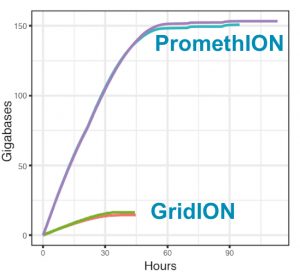
Output of the PromethION & GridION sequencers (source: Nicholls et al.).
:::
In comparison to short-read high-yield platforms where read lengths are
limited between 100 and 300 bp, single-molecule long-read platforms can
sequence much longer fragments of DNA: with read lengths averaging over
10 Kbp, with over 2 Mbp reported by the community. Long reads simply
hold much more information, making them a powerful tool for
metagenomics. For example, their increased information content offers
more evidence for sequencing mapping against references, or taxonomic
databases. Additionally, longer reads are key in bridging repetitive
structures within and between genomes.
We think long reads can help with this problem: particularly as the cost
of generating long reads has recently dropped dramatically (in our paper
we show outputs of \~15Gb from a single MinION flowcell, and \~150Gb
from the PromethION flowcells). However, there\'s not a clear view on
the best way to analyse long read metagenomic data as it\'s such a new
field.
**You gather Oxford Nanopore PromethION, GridION and Illumina data, so
what do you see from these comparisons, and what do you hope users will
get from this mock metagenome data?**
The goal of this work was to make available a really deep long read
dataset for the two [Zymo mock community
standards](https://www.zymoresearch.com/blogs/blog/zymobiomics-microbial-standards-optimize-your-microbiomics-workflow).
[These datasets](https://lomanlab.github.io/mockcommunity/) can be used
for a wealth of comparisons: between the evenly-distributed and
log-distributed samples, and between the Oxford Nanopore GridION and
PromethION platforms too. The Illumina short-read data demonstrates that
high-quality short-reads cannot adequately assemble the communities
alone, but are useful for polishing our long-read assemblies to a high
consensus accuracy (although we found that polishing long-read nanopore
data alone with Racon and Medaka does a very good job too).
Our work also benefits from the recent release of PacBio data for some
of the isolates in this community from Chris Mason and Alexa McIntyre.
These genomes now permit us to make a reliable estimate of the
correctness of the assemblies we generate, both in terms of base quality
and assembly structure.
We are really hoping that users will take parts (or all!) of our data
and use it to develop and validate new laboratory and software pipelines
for long-read metagenomics. We\'ve taken care to ensure we are up to
date with the latest ONT software including the newest \"flip-flop
model\" Guppy basecaller, the quite recent wtdbg2 assembler, and current
polishing strategies (Racon, Medaka, Pilon). This is a nice
demonstration of what can be achieved with long-read metagenomics, but
this is just the beginning and there will be plenty more to come!
**The Oxford Nanopore PromethION is a pretty new beast, so what does
this platform allow you to do that previous sequencing technologies were
not able to do? Especially for the field of metagenomics.**
PromethION data is quite sparse at the moment and to our knowledge this
is the first metagenomics PromethION dataset to be released. To make a
simple analogy, it\'s like having a more powerful microscope. Using the
PromethION, we see 10-fold increases in coverage for each of the genomes
in the community compared to exactly the same library when sequenced on
the GridION. This level of resolution permits us to assemble some of the
lower abundance organisms from the log-distributed community and to
detect organisms at extremely low abundance with more confidence. This
will be crucial for some applications where important community members
are not the highest abundance in the sample. We also are able to
demonstrate that the PromethION data are of similar quality to the
GridION when run on the same library, giving confidence that this beast
may be useful.
**Can you tell us about the [Long Read
Club](https://www.longreadclub.org/), and what does this work contribute
to it?**
{.alignright
.size-medium .wp-image-2863 loading="lazy" decoding="async"
srcset="http://gigasciencejournal.com/blog/wp-content/uploads/2019/05/longreadclub-300x272.jpg 300w, http://gigasciencejournal.com/blog/wp-content/uploads/2019/05/longreadclub.jpg 475w"
sizes="(max-width: 300px) 100vw, 300px" width="300" height="272"}The
first rule of Long Read Club is you don\'t talk about Long Read Club...!
If we were to break that rule, we\'d tell you that [Long Read
Club](https://www.longreadclub.org/) is part of a recently funded
Wellcome Trust Technology Development Award to Nick here in Birmingham,
and Matt Loose at the University of Nottingham. The goal is to help the
genomics community at large achieve finished-quality complete genomes
from long-reads, routinely and at scale. Our work here is a small
stepping stone contributing towards the future of long-read
metagenomics. We\'ve shown that long-read based assemblies are getting
close to the single-contig finished quality genomes that one would
expect to get from isolate sequencing directly, and we\'d like to think
that we\'re sharing the best extraction, sequencing and bioinformatics
protocols currently available.
Most importantly, Long Read Club is a Club, so the core idea is to share
our knowledge with each-other and the wider community. Our reads,
software and analyses are open access and open source, because we want
everybody to be able to achieve really very long reads indeed.
**All the [data](http://dx.doi.org/10.5524/100580), snakemake
[workflows](https://github.com/LomanLab/mockcommunity) and
[protocols](http://dx.doi.org/10.17504/protocols.io.x9tfr6n.) are
provided openly without restriction, and your lab have been big
advocates of open source approaches to science (e.g., [the
Tweenome](http://gigasciencejournal.com/blog/tweenome-on-film-excellent-video-on-crowdsourcing-killer-outbreaks/)).
Have you seen the benefits of this first hand?**
We have! [The paper itself](https://doi.org/10.1093/gigascience/giz043)
features recently published data from Alexa McIntyre et al\'s [recent
*Nature Communications*
paper](http://dx.doi.org/10.1038/s41467-019-08289-9) that included
PacBio isolate sequencing of eight of the ten organisms in the two
ZymoBIOMICS community standards, which was generously shared with us
ahead of publication; allowing us to perform robust comparisons of our
long-read nanopore assemblies against orthogonal long-read PacBio
assemblies. We are very grateful for their early data sharing, not least
because it allowed us to respond to a request from the reviewers to
include assembly comparisons in this manuscript.
Last month, Mikhail Kolmogorov and Jeffrey Yuan (et al.) [published the
Flye assembler in *Nature
Biotechnology*](https://www.nature.com/articles/s41587-019-0072-8). Over
the past year, Mikhail and Jeffrey have been developing a metagenomic
assembly mode for Flye (\'metaFlye\') -- [a preprint has just been made
available](https://doi.org/10.1101/637637) -- and have shown it works
really well using the Zymo mock community data. We actually made the
first version of this dataset available only a few weeks after
generating it and released it at last September\'s Genome Science
meeting. It\'s gratifying to know that there are developers taking our
data and working to develop and validate new methods for long-read
metagenomics. If you\'re interested, you can hear more about Flye from
Mikhail and Jeffrey in their recent [Long Read Club
episode](https://www.youtube.com/watch?v=It5KXnPBnbg).
We want to make everything we do available for everyone to use and
improve. The MinION has helped to democratise sequencing and in the past
couple of years we\'ve seen huge improvement in long-read technology,
but it is natural that it takes time for a new field to figure out the
best way to analyse data. Making our ideas,
[protocols](https://www.protocols.io/groups/long-read-club) and software
open means we can accelerate science and work with the genomics
community to make long-read metagenomics robust, scalable and
scientifically-accurate for everyone.
\*\*Further Reading\
\*\*Nicholls SM, Quick JC, T Shuiquan, Loman NJ. Ultra-deep, long-read
nanopore sequencing of mock microbial community standards.
*GigaScience*. 2019
doi:[10.1093/gigascience/giz043](https://doi.org/10.1093/gigascience/giz043)
**Further Watching**\
Watch the latest updates for the Long Read Club on their youtube
channel:
The post [Mock the Metagenome. Author Q&A with Nick Loman & Sam
Nicholls](http://gigasciencejournal.com/blog/mock-metagenome/){rel="nofollow"}
appeared first on
[GigaBlog](http://gigasciencejournal.com/blog){rel="nofollow"}.