---
author:
- contributor_roles: []
family: Edmunds
given: Scott
url: https://orcid.org/0000-0001-6444-1436
blog:
authors: null
community_id: 52db0518-e228-4260-8c54-c4e323b2569d
created: 1675555200
current_feed_url: null
description: Data driven blogging from the GigaScience editors
doi: https://doi.org/10.59350/gigablog
favicon: https://rogue-scholar.org/api/communities/52db0518-e228-4260-8c54-c4e323b2569d/logo
feed_format: application/atom+xml
feed_url: http://gigasciencejournal.com/blog/feed/atom/
filter: null
generator: Other
home_page_url: https://gigasciencejournal.com/blog
issn: null
language: eng
license: https://creativecommons.org/licenses/by/4.0/legalcode
prefix: '10.59350'
relative_url: null
secure: false
slug: gigablog
status: archived
subfield: '1311'
title: GigaBlog
updated: null
use_api: null
container: GigaBlog
date: '2019-01-14T00:00:00+00:00'
date_updated: '2025-12-06T10:24:45+00:00'
guid: http://gigasciencejournal.com/blog/?p=2663
identifier: https://doi.org/10.59350/cmngq-mz362
image: http://gigasciencejournal.com/blog/wp-content/uploads/2019/01/Dickens_by_Watkins_1858-297x300.png
images:
- alt: Appropriate authorship
height: '300'
sizes: '(max-width: 297px) 100vw, 297px'
src: http://gigasciencejournal.com/blog/wp-content/uploads/2019/01/Dickens_by_Watkins_1858-297x300.png
srcset: http://gigasciencejournal.com/blog/wp-content/uploads/2019/01/Dickens_by_Watkins_1858-297x300.png,
http://gigasciencejournal.com/blog/wp-content/uploads/2019/01/Dickens_by_Watkins_1858.png
width: '297'
- alt: Appropriate authorship guidelines from ICJME
height: '225'
sizes: '(max-width: 565px) 100vw, 565px'
src: http://gigasciencejournal.com/blog/wp-content/uploads/2019/01/giy122fig1-1024x408.jpeg
srcset: http://gigasciencejournal.com/blog/wp-content/uploads/2019/01/giy122fig1-1024x408.jpeg,
http://gigasciencejournal.com/blog/wp-content/uploads/2019/01/giy122fig1-300x120.jpeg,
http://gigasciencejournal.com/blog/wp-content/uploads/2019/01/giy122fig1-768x306.jpeg
width: '565'
- alt: Educating on authorship in China
height: '392'
sizes: '(max-width: 277px) 100vw, 277px'
src: http://gigasciencejournal.com/blog/wp-content/uploads/2019/01/ZKJJ201806.jpg
srcset: http://gigasciencejournal.com/blog/wp-content/uploads/2019/01/ZKJJ201806.jpg,
http://gigasciencejournal.com/blog/wp-content/uploads/2019/01/ZKJJ201806-212x300.jpg
width: '277'
issn: null
keywords:
- Publishing
- Authorship
- CASRAI
- China
- DOI
lang: en
license: https://creativecommons.org/licenses/by/4.0/legalcode
rid: 02mv0-qmq27
rights: https://creativecommons.org/licenses/by/4.0/legalcode
summary: Assuring Appropriate Authorship. In our day-to-day work
at GigaScience many of the most common and reoccurring problems we keep
encountering relate to appropriate authorship. In this "publish or perish" world
of science, getting authorship right is of course important.
title: Authorship Down. Tackling Misguided Incentives.
url: https://wayback.archive-it.org/22098/2025-05-01T17:13:42Z/http://gigasciencejournal.com/blog/appropriate-authorship
version: v1
---
**Assuring Appropriate Authorship.**\
{.alignleft
.size-medium .wp-image-2665 loading="lazy" decoding="async"
srcset="http://gigasciencejournal.com/blog/wp-content/uploads/2019/01/Dickens_by_Watkins_1858-297x300.png 297w, http://gigasciencejournal.com/blog/wp-content/uploads/2019/01/Dickens_by_Watkins_1858.png 622w"
sizes="(max-width: 297px) 100vw, 297px" width="297" height="300"}In our
day-to-day work at *GigaScience* many of the most common and reoccurring
problems we keep encountering relate to appropriate authorship. In this
\"publish or perish\" world of science, getting authorship right is of
course important. There are many issues that underlie the
appropriateness of authorship, but fortunately there are internationally
recognised norms and guidelines to help determine these. To pre-empt and
reduce the problems we\'ve been seeing we have recently made some
efforts to better explain these issues. Investigating why some
misunderstandings may occur, we\'ve noticed some of our authors from
China come to us with preconceptions and expectations that may differ
from these international guidelines. To try to tackle this we\'ve
recently expanded our author instructions and published an Editorial on
the topic in both [English](https://doi.org/10.1093/gigascience/giy122)
and
[Chinese](https://academic.oup.com/gigascience/pages/authorship_guidelines).
We\'ve also attempted to educate and lobby further by publishing
[Comment in the Chinese policy
space](http://www.cnki.net/kcms/doi/10.16262/j.cnki.1000-8217.2018.06.001.html)
and [OpEds in the Hong Kong
press](http://www.scmp.com/comment/insight-opinion/article/1758662/china-must-restructure-its-academic-incentives-curb-research).
In this blog we summarise and link to these materials, and give some
insight into why we think this miscommunication may have arisen.
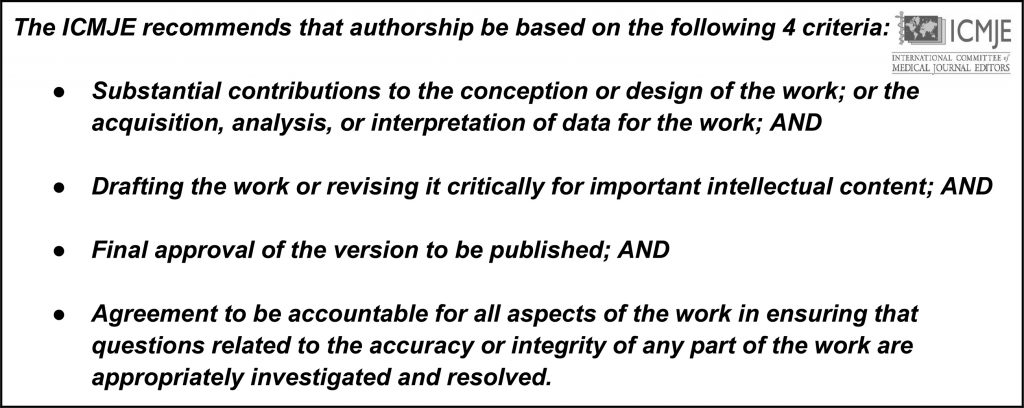
Because there is no reason to reinvent the wheel concerning the details
of authorship roles, *GigaScience* wholeheartedly embraces the excellent
authorship guidelines issued by the [ICMJE (AKA the Vancouver
guidelines)](http://www.icmje.org/recommendations/browse/roles-and-responsibilities/defining-the-role-of-authors-and-contributors.html).
These are quoted and expanded upon in our editorial policies and
[detailed authorship guidelines
page](https://academic.oup.com/gigascience/pages/authorship_guidelines),
but as we all know from skipping so many online terms and condition
documents its may be hard for most readers to take this detail in.
{.aligncenter
.wp-image-2668 loading="lazy" decoding="async"
srcset="http://gigasciencejournal.com/blog/wp-content/uploads/2019/01/giy122fig1-1024x408.jpeg 1024w, http://gigasciencejournal.com/blog/wp-content/uploads/2019/01/giy122fig1-300x120.jpeg 300w, http://gigasciencejournal.com/blog/wp-content/uploads/2019/01/giy122fig1-768x306.jpeg 768w"
sizes="(max-width: 565px) 100vw, 565px" width="565" height="225"}With
large consortia becoming increasing ubiquitous it is becoming
increasingly difficult to determine order or capture useful information
from unwieldy author lists. In medicine there has been [talk of
moving](http://jim.bmj.com/content/55/4/174) from co-authorship to
contributorship, which allows readers to more accurately assess credit
and accountability. We strongly agree with this, and we now capture
contributorship details in the authors contribution sections, as well as
[CASRAI contributorship](https://casrai.org/credit/) taxonomy
information in the submission process. [With BioMed Central we
experimented](http://gigasciencejournal.com/blog/putting-credit-hands-researchers/)
presenting this via Mozilla badges, and we are now collecting this
information on submission and working with Oxford University Press to
better display this on our our papers. You can see in the [\"Authors\'
Contributions\"
section](https://academic.oup.com/gigascience/article/7/12/giy122/5114264#126554571)
of our Editorial how this information can be displayed in a tabular
form.
While the increase in transparency and detail helps, unfortunately until
contributorship becomes a more accepted practice there are are a few
authorship positions that get most of the attention. Most biological and
biomedical journals list authors according to an author-rated level of
contribution: the first author is considered the individual who
contributed more than the second author, and so forth until reaching the
author in the last position. Generally the first authors and
corresponding authors are the ones most prominently listed on the paper,
and to a lesser extent the \'\'senior\" author or \"principal
investigator\" can be highlighted at the end of the paper (which we\'ve
attempted to highlight with a [‡]{.st} -- double-dagger symbol).
Given the special significance of the first author, it is understandable
that for some authors it is tricky to decide who should go first,
especially for projects that require distinctly different areas of
expertise to complete the work. It can be appropriate to indicate that
multiple authors contributed in equal measure to a manuscript. However,
generally speaking, the likelihood that shared first authorship is
warranted seems to decrease with the number of joint first authors. In
light of all this *we* now allow a maximum of three joint first authors,
and their roles must be made clear and justification must be given as to
how they have carried out equivalent amounts of intellectual
contribution.
The other prominent role highlighted on scientific papers is the
corresponding author. But being a corresponding author is not
necessarily the most senior author or project lead, as they for the most
part act as a secretary. Being primary contact for the journal and
respond to all manuscript queries, both before and after publication.
Therefore we suggest choosing the most suitable author or authors who
has the time to contact all the other authors, can explain the vast
majority of the research in detail, and---can respond in a timely
manner. Sometimes it is reasonable that two authors share the role of
\"corresponding author\", but we do not allow more than that.
To balance limiting the number of first and corresponding authors we are
encouraging better use of citation for more granular contributions. This
is why we credit data producers through [Data
Note](https://academic.oup.com/gigascience/pages/data_note) articles,
and software producers through Technical Note articles. Furthermore, we
also go more granular by individually citing and crediting (as first
class objects of research) the different Research Objects contributing
to the paper. Even including the peer reviews (see
[blog](http://gigasciencejournal.com/blog/peerrevwk15-news-crediting-amazing-reviewers-dois/)).
Giving these DOIs in our GigaDB database or other platforms means we can
credit different combinations of people through data citations, software
citations and method citations.
The [ICJME/Vancouver
guidelines](http://www.icmje.org/recommendations/browse/roles-and-responsibilities/defining-the-role-of-authors-and-contributors.html)
explain these issues in some detail, but we have increasingly seen
misunderstanding of what the role of first and corresponding author is,
particularly from authors from China. This lack of context and
understanding from funders and policy makers is likely a driver on their
funded authors to inflate the number of first and corresponding authors,
seeming to directly counter [ICJME/Vancouver
guidelines](http://www.icmje.org/recommendations/browse/roles-and-responsibilities/defining-the-role-of-authors-and-contributors.html).
Doing some research into this we\'ve seen that one of the big factors
has been the increasing [commoditisation]{.ILfuVd} of authorship. An
issue that needs addressing to reduce systematic fraud and ultimately a
loss of trust in science itself.
\*\*Why we think these problems have arisen? Authorship as a commodity.\
\*\*Gift and [ghost
authorship](https://en.wikipedia.org/wiki/Medical_ghostwriter) are long
running phenomena, but a more industrialised version of this has cropped
up in recent years: [\"paper
mills\"](https://www.scientificamerican.com/article/for-sale-your-name-here-in-a-prestigious-science-journal/).
On top of the [\"academic bazaar\"
system](http://science.sciencemag.org/content/342/6162/1035) where
authorship can be bought, a wider and more systematic network of Chinese
companies that produce ghostwritten papers to order has been exposed.
The recent mass-retractions of papers from a number of publishers
[linked to the
hacking](https://www.scientificamerican.com/article/for-sale-your-name-here-in-a-prestigious-science-journal/)
of the peer-review system is a direct side effect of this. This
large-scale gaming of the system has been driven by skewed incentive
systems, where authorship of papers in SCI-indexed (Science Citation
Index, the commercial database responsible for the dreaded impact
factor) journals is worth huge amounts of money. Chinese universities
offer [cash rewards](https://arxiv.org/abs/1707.01162) of up to
\$165,000 USD for papers published in the top SCI indexed journals, and
medics are required to publish in impact factor journals for promotion.
This is particularly a problem in mainland China, where companies have
been [openly
offering](http://blog.thegrandlocus.com/2014/10/a-flurry-of-copycats-on-pubmed)
ghostwritten publications in impact factor 1-2 journals for \$10,000
USD.
It doesn\'t help that in China (and other countries bitten by the
SCI-bug) this misunderstanding has spread to higher levels, and the role
of corresponding author is awarded with financial and other benefits.
Like with the inflationary designation of shared first authorship,
adding another asterisk above a name on the title page can have
disproportionate benefits. Placing this weight on the correspondent\'s
secretarial role is an abuse, and it makes the already conflicted
discussions about authorship more cumbersome.
The pressures to do this are a likely confusion of the senior author
role, and the guidance and pressure authors are under in China to be a
corresponding author is an example that directly contradicts [ICMJE
guidelines](http://www.icmje.org/recommendations/browse/roles-and-responsibilities/defining-the-role-of-authors-and-contributors.html).
There is a lack of guidance on what constitutes authorship in China, and
the only instruction that authors are given is that first and
corresponding authors are the ones that can get SCI-related cash
rewards. Even the scientist with the best intentions can be seriously
tempted by these. Looking at examples of internal documents from Chinese
Academy of Sciences institutes at how cash rewards are divided, we have
seen them stating that first authors receive 40% of the cash,
corresponding authors 30%, and subsequent co-authors 10%. In Shenzhen,
for example, in 2014 the updated \"National leading talent\" and
[\"Peacock\"
scheme](http://www.szhrss.gov.cn/xxgk/zcfgjjd/gcjzyrcgl/201708/t20170831_8317284.htm)
for recruiting overseas high-level talent offered 3M RMB (about
\$500,000 USD) to the first and corresponding authors of papers
published in *Nature* or *Science*. The notorious He Jiankui of
CRISPRbabies fame being a [notable
recipient](https://blogs.bmj.com/medical-ethics/2018/12/06/he-jiankuis-genetic-misadventure-why-him-why-china/)
of one of these one of these \"few questions asked\" grants. As
*GigaScience* ranks as a \"JCR Q1\" journal under the scheme, authors
can still receive cash rewards about half of this, which is obviously
leading to a lot of the \"joint-authorship inflation\" pressure we and
other journals are seeing.
We have written [Op-Eds in the Hong Kong
press](http://www.scmp.com/comment/insight-opinion/article/1758662/china-must-restructure-its-academic-incentives-curb-research)
stating the skewed incentive systems that led to corrupt practices on
the mainland could lead to the same problems in Hong Kong. Shortly after
writing this OpEd we, discovered a Hong Kong registered company
(thankfully now disappeared) that, when pretending to be a researcher,
offered us \"guaranteed impact factor 2\" publications for approximately
\$8,000 USD. While the mass-fraud is hopefully only the rare extreme end
of the spectrum, the \"publish or perish\" demands placed on all
academics are increasing the pressure to be counted, and the pressures
on how you are ranked as authors. All of which may not be compatible
with the ICMJE guidelines.
\*\*The Fightback Starts Now.\
\*\*Journals are one of the only players with any leverage in changing
these messed up practices in science. With great power comes great
responsibility, and through these efforts we have tried our best to
promote best practice. On top of our strict policies limiting first and
corresponding authors we have been promoting this move towards
contributorship rather than co-authorship. We ask authors to provide as
much detail as possible when completing the [CASRAI authors
roles](https://casrai.org/credit/) upon submission. This information and
as much context as possible is encouraged in the \'Authors\'
contributions\" and optional \"Authors\' information\" sections in the
paper. We also encourage and provide more granular and precise credit
via data, software, and method/protocol citations. Like us, [we
encourage people](http://gigasciencejournal.com/blog/jif_problems/) to
sign DORA (Declaration on Research Assessment: )
and to stop using journal-based metrics as a surrogate measure of the
quality of research articles, or authorship in them to assess an
individual scientist\'s contributions.
{.size-full
.wp-image-2664 .alignright loading="lazy" decoding="async"
srcset="http://gigasciencejournal.com/blog/wp-content/uploads/2019/01/ZKJJ201806.jpg 277w, http://gigasciencejournal.com/blog/wp-content/uploads/2019/01/ZKJJ201806-212x300.jpg 212w"
sizes="(max-width: 277px) 100vw, 277px" width="277" height="392"}On top
of these technical approaches we\'ve also been carrying out as much
outreach and education as we can. Especially in mainland China and Hong
Kong where we\'ve carried a number of presentations discussing these
matters at conferences and research institutions across the country. To
get the word out even further we\'ve now been publishing articles in
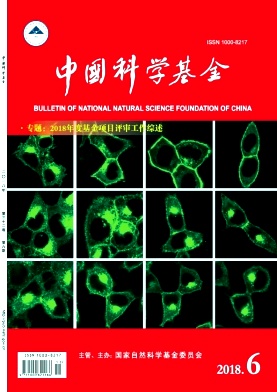
both English and Chinese language. Starting with our [recent
Editorial](https://doi.org/10.1093/gigascience/giy122) that has a more
detailed supplementary version [in
Chinese](https://oup.silverchair-cdn.com/oup/backfile/Content_public/Journal/gigascience/7/12/10.1093_gigascience_giy122/2/giy122_supplemental_file.docx?Expires=1547540284&Signature=h6e42W~9N4o45aj5Q6tta3Th2JA2FNoU2CrHFdG4Fui-OlSdCL0PVd4y9JI8XerCsWpMET5Go6dqBIJI37tqDC0FPTmNqP~K7uJa6NLb411PBXVgpNo6PmxGqLvoxusZqXQJH-JPD3DuLhSOCFxsY6uvqgLZiqURm66T04vLnJ1TO3WVHBipHmuJfGZWIX5OCdtokOHaGJVVjQp2Ka-S2wA0rdF1cPjUO9BrA1Ly~nE3D6nncaIO9LQ9kMpHEt1L4M~5t34w8kW3DSSBgnO89fyFiMiYHn-w18ZlDQeC~VxvCPVa5hXIW4ZliOz8We4gqJULrQkv9dxDnmK7x0D1fQ__&Key-Pair-Id=APKAIE5G5CRDK6RD3PGA).
And culminating in an [adapted
version](http://www.cnki.net/kcms/doi/10.16262/j.cnki.1000-8217.2018.06.001.html)
of this in the *Bulletin of National Natural Science Foundation of
China*. This journal being a particularly useful venue to make these
arguments, being published by one of the major funders in China, and
targeting policy makers, research managers and their fund applicants.
These efforts are hopefully very timely, as it is encouraging to see the
[announcement from the Ministry of Science and
Technology](http://most.gov.cn/mostinfo/xinxifenlei/fgzc/gfxwj/gfxwj2018/201805/t20180531_139731.htm)
last year of new upcoming reforms to address the issues of research
misconduct in China. As they state there will be a focus on deepening
the reform of scientific research evaluation systems, we hope this will
prohibit bad practices such as SCI-related cash rewards. A deeper system
needs to move the evaluation process beyond just measuring co-authorship
and a gameable impact factor, to promote international best practices
that are compliant with the [ICMJE
guidelines](http://www.icmje.org/recommendations/browse/roles-and-responsibilities/defining-the-role-of-authors-and-contributors.html).
We look forward to seeing how these new rules will be implemented in
China, and on top of assisting with education and providing our views on
this matter, we welcome feedback on how this affects authors and how we
can continue to promote appropriate authorship and improve the process.
\*\*Further Reading\
\*\*Zauner H, Nogoy NA, Edmunds SC, Zhou H, Goodman L. Editorial: We
need to talk about authorship. *Gigascience*. 2018 Dec 1;7(12). doi:
10.1093/gigascience/giy122.
([English](https://doi.org/10.1093/gigascience/giy122)/[Chinese](https://oup.silverchair-cdn.com/oup/backfile/Content_public/Journal/gigascience/7/12/10.1093_gigascience_giy122/2/giy122_supplemental_file.docx?Expires=1547540284&Signature=h6e42W~9N4o45aj5Q6tta3Th2JA2FNoU2CrHFdG4Fui-OlSdCL0PVd4y9JI8XerCsWpMET5Go6dqBIJI37tqDC0FPTmNqP~K7uJa6NLb411PBXVgpNo6PmxGqLvoxusZqXQJH-JPD3DuLhSOCFxsY6uvqgLZiqURm66T04vLnJ1TO3WVHBipHmuJfGZWIX5OCdtokOHaGJVVjQp2Ka-S2wA0rdF1cPjUO9BrA1Ly~nE3D6nncaIO9LQ9kMpHEt1L4M~5t34w8kW3DSSBgnO89fyFiMiYHn-w18ZlDQeC~VxvCPVa5hXIW4ZliOz8We4gqJULrQkv9dxDnmK7x0D1fQ__&Key-Pair-Id=APKAIE5G5CRDK6RD3PGA)).
Zauner H, Nogoy NA, Edmunds SC, 周红玲, Goodman L. 作者署名的最佳实践
(Best practices for determining authorship). *Bull. Ntnl. Nat. Sci
Foundation China*. 2018 (6) p560-61.
doi:[10.16262/j.cnki.1000-8217.2018.06.001](http://www.cnki.net/kcms/doi/10.16262/j.cnki.1000-8217.2018.06.001.html)
The post [Authorship Down. Tackling Misguided
Incentives.](http://gigasciencejournal.com/blog/appropriate-authorship/){rel="nofollow"}
appeared first on
[GigaBlog](http://gigasciencejournal.com/blog){rel="nofollow"}.