---
author:
- contributor_roles: []
family: Waaijers
given: Leo
- affiliation:
- id: https://ror.org/027bh9e22
name: Leiden University
contributor_roles: []
family: Waltman
given: Ludo
url: https://orcid.org/0000-0001-8249-1752
- contributor_roles: []
family: de Vries
given: Saskia
- contributor_roles: []
family: van Leeuwen
given: Thed
- affiliation:
- id: https://ror.org/027bh9e22
name: Leiden University
contributor_roles: []
family: van Eck
given: Nees Jan
url: https://orcid.org/0000-0001-8448-4521
blog:
authors:
- name: Leiden Madtrics
community_id: d8304840-75c2-4164-bc37-ec879c4f065b
created: 1780876800
current_feed_url: null
description: Leiden Madtrics
doi: https://doi.org/10.59350/leidenmadtrics
favicon: https://rogue-scholar.org/api/communities/d8304840-75c2-4164-bc37-ec879c4f065b/logo
feed_format: application/atom+xml
feed_url: https://www.leidenmadtrics.nl/atom/
filter: null
generator: Other
home_page_url: https://www.leidenmadtrics.nl/
issn: null
language: eng
license: https://creativecommons.org/licenses/by/4.0/legalcode
prefix: '10.59350'
relative_url: null
secure: null
slug: leidenmadtrics
status: active
subfield: '1804'
title: Leiden Madtrics
updated: 1784193807
use_api: null
container: Leiden Madtrics
date: '2021-03-02T00:00:00+00:00'
date_updated: '2025-12-05T08:37:20+00:00'
guid: https://www.leidenmadtrics.nl/articles/bona-fide-journals-creating-a-predatory-free-academic-publishing-environment
identifier: https://doi.org/10.59350/cbyyp-jpt74
images:
- src: https://leidenmadtrics.nl/images/uploads/BonaFideJournalsFig1.jpg
- alt: 'Figure 1. Schematic overview of the selection process for Bona Fide Journals.
Colours in the flowchart mark the level of trustworthiness: blue sufficient, light
blue partial, grey no.'
src: https://leidenmadtrics.nl/images/uploads/BonaFideJournalsFig1.jpg
issn: null
lang: en
license: https://creativecommons.org/licenses/by/4.0/legalcode
rid: 7efqm-s7991
rights: https://creativecommons.org/licenses/by/4.0/legalcode
summary: A recent item in Nature News reports "Hundreds of 'predatory' journals
indexed on leading scholarly database" , sub-headed "[…] the analysis
highlights how poor-quality science is infiltrating literature." A year before,
a group of leading scholars and publishers already warned in a comment in Nature,
"So far, disparate attempts to address predatory publishing have been unable
to control this ever-multiplying problem.
title: Bona Fide Journals - Creating a predatory-free academic publishing environment
url: https://www.leidenmadtrics.nl/articles/bona-fide-journals-creating-a-predatory-free-academic-publishing-environment
version: v1
---
[A recent item in Nature
News](https://doi.org/10.1038/d41586-021-00239-0){target="_blank"}
reports *\"Hundreds of \'predatory\' journals indexed on leading
scholarly database\"*, sub-headed *\"\[...\] the analysis highlights how
poor-quality science is infiltrating literature.\"*
A year before, a group of leading scholars and publishers already
[warned in a comment in
Nature](https://doi.org/10.1038/d41586-019-03759-y){target="_blank"},
*\"So far, disparate attempts to address predatory publishing have been
unable to control this ever-multiplying problem. The need will be
greater as authors adjust to Plan S and other similar mandates, which
will require researchers to publish their work in open-access journals
or platforms if they are funded by most European agencies, the World
Health Organization, the Bill & Melinda Gates Foundation and others.\"*
Given the significance of the problem of predatory publishing, [QOAM
(Quality Open Access Market)](http://www.qoam.eu){target="_blank"}, in
cooperation with CWTS, has started a new initiative to create a
predatory-free academic publishing environment: [Bona Fide
Journals](http://www.qoam.org/bfj){target="_blank"}.\
### The harm
The [fine of
\$50](https://www.sciencemag.org/news/2019/04/us-judge-rules-deceptive-publisher-should-pay-501-million-damages){target="_blank"}
million imposed by a U.S. federal judge to OMICS reflects the material
damage this publisher caused over the years 2011 to 2017. Given the
[long list of predatory
publishers](https://predatoryjournals.com/publishers/){target="_blank"},
it seems only a modest guess to multiply this \$7 million per year by 3
to have an indication of the harm caused by all of them together, making
it roughly \$20 million annually. This figure might be growing under the
current publication pressure, while, at the same time, predatory
journals simply pass the compliance test of the newly launched [Plan S
Journal Checker Tool](https://journalcheckertool.org/){target="_blank"}.
On top of that is the immaterial, hard to quantify damage to the
reputation of misled authors and falsely advertised editors and
reviewers. This affects the authority of the whole fabric of science.
\"*Publications using such practices may call into question the
credibility of the research they report,*\" [according to the US
National Institutes of Health
(NIH)](https://grants.nih.gov/grants/guide/notice-files/NOT-OD-18-011.html){target="_blank"}.
Predatory journals contaminate the scientific and scholarly domain with
fake news in a period in which the integrity of science may be more
important than ever.
Also, niche journals outside the mainstream of the highly branded
portfolios of the big publishing houses are at risk. Jan Erik Frantsvåg
conducted a thorough analysis of [journals removed from the Directory of
Open Access Journals
(DOAJ)](https://doi.org/10.18710/KCL56N){target="_blank"} in their 2016
grand cleansing operation. His resonating conclusion is that \"*there is
nothing \[...\] that indicates that the journals that were removed were
of inferior scholarly quality compared to those remaining.*\" In such a
banished mix the good suffer from the evil and a differentiating service
is urgently needed. Till today, this problem continues. See
[here](https://www.liberquarterly.eu/article/10.18352/lq.10339/){target="_blank"}
and
[here](https://doi.org/10.1016/j.acalib.2020.102271){target="_blank"}
and
[here](https://onlinelibrary.wiley.com/doi/10.1002/leap.1299){target="_blank"}.
### The remedy
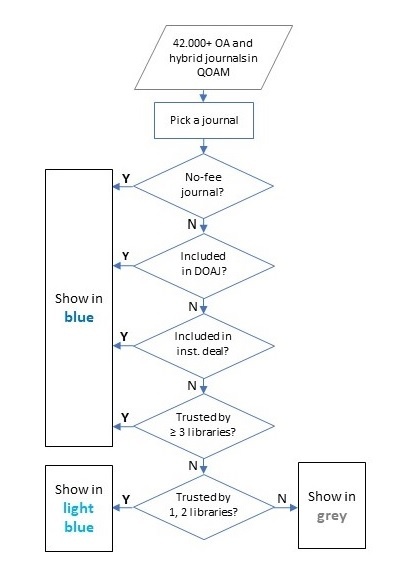
Figure 1. Schematic overview of the
selection process for
Bona Fide Journals. Colours in the flowchart mark the level
of trustworthiness: blue sufficient, light blue partial, grey no.
Setting up a list of predatory journals has proven problematic (see
[here](https://www.nature.com/news/backlash-after-frontiers-journals-added-to-list-of-questionable-publishers-1.18639){target="_blank"}
and [here](http://kscien.org/predatory.php){target="_blank"}).
Conversely, creating a list of trustworthy journals outcasts honest
journals that did not make it to the list. Other attempts concern lists
of criteria for \'predatory-ness\', leaving it to individual researchers
to check a specific journal (see
[here](https://doi.org/10.1080/02763869.2020.1693205){target="_blank"}
(paywalled) and
[here](https://app.lib.uliege.be/compass-to-publish/){target="_blank"}).
Recently, QOAM in cooperation with CWTS, launched a new initiative:
[Bona Fide Journals](http://www.qoam.org/bfj){target="_blank"}. Starting
with all 42,000 journals in QOAM, the idea is to indicate the journals
in the list which are deemed non-predatory, either because they are
no-fee journals or because they are approved by library professionals.
Examples of the second category are journals in
[DOAJ](https://doaj.org/){target="_blank"} and [journals included in
institutional
deals](https://journalcheckertool.org/transformative-agreements){target="_blank"}.
However, this still leaves thousands of journals unaddressed. Bona Fide
Journals will enable institutional libraries to express their trust in
these journals. The expectation is that most libraries are familiar with
a number of niche journals from institutions, societies or charities in
their own discipline, region, or language.
The only thing libraries have to ascertain is that a journal is not mala
fide. In case of doubt, the [Compass to
Publish](https://app.lib.uliege.be/compass-to-publish/){target="_blank"}
may offer practical guidance. If a journal has gained expressions of
trust from three different libraries, it will be included in the list of
trustworthy journals. Thus, libraries may resume their role as quality
guardians of the academic publishing domain.
Next to DOAJ, other sources may be included in the second diamond of the
flowchart (see Figure 1), such as high-profile indexing services or
recognized platforms like
[Redalyc](https://www.redalyc.org/){target="_blank"},
[SciELO](https://scielo.org/){target="_blank"},
[OpenEdition](https://www.openedition.org/){target="_blank"}, or
[African Journals Online](https://www.ajol.info/){target="_blank"}.\
### What is available now?
Today, [Bona Fide Journals](https://www.qoam.eu/bfj){target="_blank"} is
operational as a minimal viable product, soliciting user comments to
guide further development. Potential current use cases are:
- A (spammed) researcher checking the trustworthiness of a journal which
solicits their article.
- A library suggesting a specific collection of trustworthy journals for
a project or an institute.
- An open access publishing service using the list of Bona Fide Journals
to filter out predatory journals that may have infiltrated into their
journal base.
### What is next?
Bona Fide Journals offers basic evidence of the honesty of journals, but
journals may still differ a lot when it comes to peer review, editing,
data transparency, speed of publication, author evaluation, or
publication fee. There are several websites that provide useful
information on these aspects, but authors who wish to select a journal
in which to publish their article may easily get lost when trying to
find the most relevant information. Therefore, a next step that we hope
to take is [to develop an
infrastructure](https://leidenmadtrics.nl/articles/systematize-information-on-journal-policies-and-practices-a-call-to-action){target="_blank"}
that brings together the diversity of such services in a more systematic
way. Instead of reducing the selection of a journal to a simplistic
dichotomy (mainstream vs. unfamiliar) or a questionable one-dimensional
ranking (journal impact factor), such an infrastructure offers
researchers an informative variety of publishing options and enables the
scientific community to optimally benefit from these options.