---
author:
- contributor_roles: []
family: Edmunds
given: Scott
url: https://orcid.org/0000-0001-6444-1436
blog:
authors: null
community_id: 52db0518-e228-4260-8c54-c4e323b2569d
created: 1675555200
current_feed_url: null
description: Data driven blogging from the GigaScience editors
doi: https://doi.org/10.59350/gigablog
favicon: https://rogue-scholar.org/api/communities/52db0518-e228-4260-8c54-c4e323b2569d/logo
feed_format: application/atom+xml
feed_url: http://gigasciencejournal.com/blog/feed/atom/
filter: null
generator: Other
home_page_url: https://gigasciencejournal.com/blog
issn: null
language: eng
license: https://creativecommons.org/licenses/by/4.0/legalcode
prefix: '10.59350'
relative_url: null
secure: false
slug: gigablog
status: archived
subfield: '1311'
title: GigaBlog
updated: null
use_api: null
container: GigaBlog
date: '2017-09-12T00:00:00+00:00'
date_updated: '2025-12-06T10:32:33+00:00'
guid: http://gigasciencejournal.com/blog/?p=2115
identifier: https://doi.org/10.59350/9m982-bzw90
image: http://gigasciencejournal.com/blog/wp-content/uploads/2017/09/Screen-Shot-2017-09-12-at-19.27.14-1024x409.png
images:
- height: '262'
sizes: '(max-width: 656px) 100vw, 656px'
src: http://gigasciencejournal.com/blog/wp-content/uploads/2017/09/Screen-Shot-2017-09-12-at-19.27.14-1024x409.png
srcset: http://gigasciencejournal.com/blog/wp-content/uploads/2017/09/Screen-Shot-2017-09-12-at-19.27.14-1024x409.png,
http://gigasciencejournal.com/blog/wp-content/uploads/2017/09/Screen-Shot-2017-09-12-at-19.27.14-300x120.png,
http://gigasciencejournal.com/blog/wp-content/uploads/2017/09/Screen-Shot-2017-09-12-at-19.27.14-768x307.png,
http://gigasciencejournal.com/blog/wp-content/uploads/2017/09/Screen-Shot-2017-09-12-at-19.27.14.png
width: '656'
- height: '300'
sizes: '(max-width: 294px) 100vw, 294px'
src: http://gigasciencejournal.com/blog/wp-content/uploads/2017/09/MitoGenomes_gix053fig1-294x300.jpeg
srcset: http://gigasciencejournal.com/blog/wp-content/uploads/2017/09/MitoGenomes_gix053fig1-294x300.jpeg,
http://gigasciencejournal.com/blog/wp-content/uploads/2017/09/MitoGenomes_gix053fig1-768x784.jpeg,
http://gigasciencejournal.com/blog/wp-content/uploads/2017/09/MitoGenomes_gix053fig1-1003x1024.jpeg,
http://gigasciencejournal.com/blog/wp-content/uploads/2017/09/MitoGenomes_gix053fig1.jpeg
width: '294'
- height: '176'
sizes: '(max-width: 300px) 100vw, 300px'
src: http://gigasciencejournal.com/blog/wp-content/uploads/2017/09/Snow_Leopard_Skin_and_Photo_5610725305-300x176.jpg
srcset: http://gigasciencejournal.com/blog/wp-content/uploads/2017/09/Snow_Leopard_Skin_and_Photo_5610725305-300x176.jpg,
http://gigasciencejournal.com/blog/wp-content/uploads/2017/09/Snow_Leopard_Skin_and_Photo_5610725305-768x449.jpg,
http://gigasciencejournal.com/blog/wp-content/uploads/2017/09/Snow_Leopard_Skin_and_Photo_5610725305-1024x599.jpg,
http://gigasciencejournal.com/blog/wp-content/uploads/2017/09/Snow_Leopard_Skin_and_Photo_5610725305.jpg
width: '300'
issn: null
keywords:
- Biology
- Bioinformatics
- Conservation
- Data Intensive Ecology
- DNA Barcoding
lang: en
license: https://creativecommons.org/licenses/by/4.0/legalcode
reference:
- id: https://doi.org/10.1093/gigascience/gix052
unstructured: Modave, E., MacDonald, A. J., & Sarre, S. D. (2017). A single
mini-barcode test to screen for Australian mammalian predators from environmental
samples. GigaScience, 6(8).
- id: https://doi.org/10.1093/gigascience/gix053
unstructured: Mohd Salleh, F., Ramos-Madrigal, J., Peñaloza, F., Liu, S., Mikkel-Holger,
S. S., Riddhi, P. P., Martins, R., Lenz, D., Fickel, J., Roos, C., Shamsir, M.
S., Azman, M. S., Burton, K. L., Stephen, J. R., Wilting, A., & Gilbert, M.
T. P. (2017). An expanded mammal mitogenome dataset from Southeast Asia. GigaScience,
6(8).
- id: https://doi.org/10.1093/gigascience/gix080
unstructured: Arulandhu, A. J., Staats, M., Hagelaar, R., Voorhuijzen, M. M., Prins,
T. W., Scholtens, I., Costessi, A., Duijsings, D., Rechenmann, F., Gaspar, F.
B., Barreto Crespo, M. T., Holst-Jensen, A., Birck, M., Burns, M., Haynes, E.,
Hochegger, R., Klingl, A., Lundberg, L., Natale, C., … Kok, E. (2017). Development
and validation of a multi-locus DNA metabarcoding method to identify endangered
species in complex samples. GigaScience, 6(10).
- id: http://gigasciencejournal.com/blog/bringing-wildlife-forensics-into-the-omics-era-qa-with-alfred-arulandhu-and-martijn-staats/
unstructured: Unknown title
- id: http://gigasciencejournal.com/blog
unstructured: Unknown title
rid: e2z7f-4v320
rights: https://creativecommons.org/licenses/by/4.0/legalcode
summary: Sequencers versus the smugglers. CITES (the
Convention on International Trade in Endangered Species of Wild Fauna and Flora),
is one of the largest and oldest conservation and sustainable use agreements in
existence, and provides a legal framework for protecting endangered plants and animals
around the world.
title: Bringing Wildlife Forensics into the Omics Era. Q&A with Alfred Arulandhu and
Martijn Staats
url: https://wayback.archive-it.org/22098/2025-05-01T17:13:42Z/http://gigasciencejournal.com/blog/bringing-wildlife-forensics-into-the-omics-era-qa-with-alfred-arulandhu-and-martijn-staats
version: v1
---
***{.aligncenter
.wp-image-2116 loading="lazy" decoding="async"
srcset="http://gigasciencejournal.com/blog/wp-content/uploads/2017/09/Screen-Shot-2017-09-12-at-19.27.14-1024x409.png 1024w, http://gigasciencejournal.com/blog/wp-content/uploads/2017/09/Screen-Shot-2017-09-12-at-19.27.14-300x120.png 300w, http://gigasciencejournal.com/blog/wp-content/uploads/2017/09/Screen-Shot-2017-09-12-at-19.27.14-768x307.png 768w, http://gigasciencejournal.com/blog/wp-content/uploads/2017/09/Screen-Shot-2017-09-12-at-19.27.14.png 1516w"
sizes="(max-width: 656px) 100vw, 656px" width="656"
height="262"}Sequencers versus the smugglers.***
[CITES](https://www.cites.org/) (the Convention on International Trade
in Endangered Species of Wild Fauna and Flora), is one of the largest
and oldest conservation and sustainable use agreements in existence, and
provides a legal framework for protecting endangered plants and animals
around the world. There are roughly 35,000 species listed on the [three
CITES appendices](https://www.cites.org/eng/app/appendices.php), and
with increasing pressures on global biodiversity there are huge
challenges detecting, tracking and protecting species on this list from
the illegal wildlife trade. DNA barcoding techniques can leverage the
revolution in DNA sequencing technology to provide a high-throughput,
quantitative and low cost alternative to traditional morphological-based
approaches, although there are challenges with \"dark taxa\" (see [our
editorial on the topic](https://doi.org/10.1186/2047-217X-2-14)) and the
big gaps in many branches of the tree of life. Much of this is being
addressed by attempts to systematically fill in many of these gaps, and
we\'ve recently published papers targeting South East Asian mammalian
species (see [Mohd Salleh et
al.](https://doi.org/10.1093/gigascience/gix053)) and Australasian
carnivore species (see [Modave et
al.](https://doi.org/10.1093/gigascience/gix052)).
To truly unleash the genomics revolution in the battle against wildlife
smuggling and roll out these new techniques to the frontline forensic
labs they need to be cheap, reproducible, standardized and easy to use
by non-research scientists. Attempting to fill that niche, new worked
published in *GigaScience* [presents a new
pipeline](https://doi.org/10.1093/gigascience/gix080) for next-gen
wildlife forensics combining the cheap and ubiquitous benchtop MISEQ
sequencer, and an easy-to-use web based bioinformatics pipeline to
detect CITES-based species called
[CITEsspeciesDetect](http://decathlon-fp7.citespipe-wur.surf-hosted.nl:8080/).
Carrying on from our many [Q&A
blogs](http://gigasciencejournal.com/blog/tag/qa/) we quiz two of the
authors, Alfred Arulandhu and Martijn Staats about their work taking
genomics into the wildlife protection world.
**You both work at the** **RIKILT food safety institute at Wageningen
University in the Netherlands, so why are you interested in endangered
mostly tropical species?**
The research was conducted in the EU-funded [FP7 DECATHLON
project](http://www.decathlon-project.eu/), of which one of the goals
was to develop a DNA metabarcoding approach that can be used by customs
agencies in a routine setup to identify materials derived from
endangered species in complex samples. For this, we strongly
collaborated with the Dutch and Bulgarian Customs Laboratory, with input
from other European customs laboratories, that are tasked with
implementing CITES regulations related to nearly 36,000 species during
border controls. The Customs agencies often seize batches of, for
instance, traditional medicines and food supplements that are suspected
of containing endangered species. Due to the highly processed nature of
such products it is often difficult to make positive identifications
based on visual inspection. Having a standardized and reliable DNA-based
method that allows positive identification of CITES-protected species in
such complex products is very important in this respect and this issue
was at the basis of our research.
**This work is about looking for CITES listed species in complex
samples, so what kind of samples are we talking about?**
This research mainly focused on traditional medicines, consisting of
mixed materials derived from plant and animal species. Such products are
often sold as e.g. powders, pills, capsules and tablets. Due to their
highly processed nature the ingredients cannot be identified
morphologically.
**We\'ve previously [written](https://doi.org/10.1186/2047-217X-2-14),
published ([and
blogged](http://gigasciencejournal.com/blog/qa-with-xin-zhou-author-of-our-insect-squishome-paper/))
about metabarcoding techniques, and their potential in bringing
biodiversity and taxonomy research into the \"big-data\" era. What do
you think is its advantages in conservation?**
DNA metabarcoding is now part of the rich tool-box of forensic DNA
analysis methods, and it will certainly contribute to enhancing
investigations into crimes against protected natural resources. The
major advantage of the work that is presented here is that it combines
12 informative biomarkers and a very strict NGS data analysis pipeline
to identify species, including CITES species, even more solidly than was
achievable so far.
**There are** **\~35,000 species that are classified and listed by
CITES, so how many species do you think will be able to be detected by
your method? What needs to be done to increase the number of species
detected, and what are the ultimate limitations?**
{.alignleft
.size-medium .wp-image-2117 loading="lazy" decoding="async"
srcset="http://gigasciencejournal.com/blog/wp-content/uploads/2017/09/MitoGenomes_gix053fig1-294x300.jpeg 294w, http://gigasciencejournal.com/blog/wp-content/uploads/2017/09/MitoGenomes_gix053fig1-768x784.jpeg 768w, http://gigasciencejournal.com/blog/wp-content/uploads/2017/09/MitoGenomes_gix053fig1-1003x1024.jpeg 1003w, http://gigasciencejournal.com/blog/wp-content/uploads/2017/09/MitoGenomes_gix053fig1.jpeg 1828w"
sizes="(max-width: 294px) 100vw, 294px" width="294" height="300"}The
method was designed to make use of a panel of 12 DNA barcodes markers
that have demonstrated universal applicability across a wide range of
plant and animal taxa. However, accurate DNA barcoding depends on the
use of a reference database that provides good taxonomic coverage.
Unfortunately, the current under-representation of DNA barcodes from
species protected by CITES and closely related species still critically
hampers their identification in many cases. Based on available
databases, we estimated that only 18.8% of species on the CITES list
contain one or more DNA barcodes. This will improve as DNA barcoding
campaigns continue, in particular through initiatives such as the
[Barcodes of Wildlife Project](http://www.barcodeofwildlife.org)
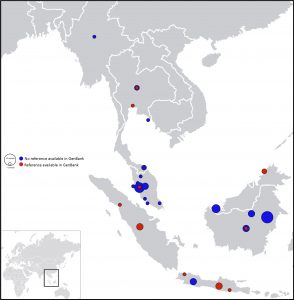
\[*GigaScience*: related to this see the [new work also just
publishe](https://doi.org/10.1093/gigascience/gix053)d adding 30 novel
SE Asian mammalian sequence to the database, and pictured here\]. The
continued efforts that are being put into building reference sequence
databases such as the [Barcode of Life Data
Systems](http://www.boldsystems.org), where millions of barcode
sequences are linked to voucher specimens, remain therefore essential.
The presented method will automatically improve with the gradually
improving databases, the data analysis pipeline will make use of this
growing dataset.
**You validated this technique in 16 labs across the world. Were there
any challenges in transferring these techniques and skills?**
{.alignright
.size-medium .wp-image-2118 loading="lazy" decoding="async"
srcset="http://gigasciencejournal.com/blog/wp-content/uploads/2017/09/Snow_Leopard_Skin_and_Photo_5610725305-300x176.jpg 300w, http://gigasciencejournal.com/blog/wp-content/uploads/2017/09/Snow_Leopard_Skin_and_Photo_5610725305-768x449.jpg 768w, http://gigasciencejournal.com/blog/wp-content/uploads/2017/09/Snow_Leopard_Skin_and_Photo_5610725305-1024x599.jpg 1024w, http://gigasciencejournal.com/blog/wp-content/uploads/2017/09/Snow_Leopard_Skin_and_Photo_5610725305.jpg 1912w"
sizes="(max-width: 300px) 100vw, 300px" width="300" height="176"}The
participating enforcement agencies and laboratories were all highly
experienced and proficient in advanced molecular analysis work, so
performing DNA extraction and PCR according to instructions in the SOP
was not too much to ask. Difficulties, however, were experienced with
interpreting the NGS results. Inconsistencies were observed among
laboratories when interpreting the raw BLAST output that is used for
identifying species. Individual participants were later given the
opportunity to reanalyze their data using the on-line platform, called
[CITEsspeciesDetect](http://decathlon-fp7.citespipe-wur.surf-hosted.nl:8080/).
The web interface enables a clear and structured presentation of the
analysis results, and it automatically highlights any matches with CITES
species, which helps tremendously with correctly interpreting the
results.
**On top of openly sharing all the [code from your
pipelines](https://github.com/RIKILT/CITESspeciesDetect) and the
validation data and results (see the [GigaDB
entry](http://dx.doi.org/10.5524/100330)) you went to the effort to put
your SOPs into protocols.io (see
[here](https://dx.doi.org/10.17504/protocols.io.ixbcfin)). How difficult
and how much extra time was needed to be able to do this, and do you
think these efforts will be worth it? Have you seen any examples yet of
this helping other labs use this tool, and can you talk about any
successes of this in detection and enforcement?**
Uploading the SOP into protocols.io is simple and straightforward.
Publishing protocols this way is relevant, because it allows
disseminating our publicly funded work in an efficient way to a wider
audience.
**This used MISEQ data, but is it applicable to other sequencing
platforms? What do you think of the potential of portable sequences such
as Oxford nanopore MinIONs to be able to combine with web-based
pipelines to enable this sort of work right into the field?**
While the [CITESspeciesDetect
pipeline](http://decathlon-fp7.citespipe-wur.surf-hosted.nl:8080/) was
specifically designed for use with Illumina data, the general work flow
can theoretically be applied irrespective of the sequencing technology
used. Yet, we selected Illumina technology for its ability to generate
high-quality data, and the use of
[CITESspeciesDetect](http://decathlon-fp7.citespipe-wur.surf-hosted.nl:8080/)
in combination with data from other sequencing platforms needs to be
evaluated. The prospect of having hand-held portable sequencers that
will enable Customs agencies to assess the presence of endangered
species in complex products directly on-location is very exciting.
However, the current sample-to-answer procedure provided by Oxford
Nanopore technology involves various separate sample preparation steps
that make current application of this technology in the field for the
moment still impractical.
### **References**
Modave E, MacDonald AJ, Sarre SD. A single mini-barcode test to screen
for Australian mammalian predators from environmental samples.
*Gigascience*. 2017 Aug 1;6(8):1-13. doi:
[10.1093/gigascience/gix052.](https://doi.org/10.1093/gigascience/gix052)
Mohd Salleh F, Ramos-Madrigal J, Peñaloza F, Liu S, Mikkel-Holger SS,
Riddhi PP, Martins R, Lenz D, Fickel J, Roos C, Shamsir MS, Azman MS,
Burton KL, Stephen JR, Wilting A, Gilbert MTP. An expanded mammal
mitogenome dataset from Southeast Asia. *Gigascience*. 2017 Aug
1;6(8):1-8. doi:
[10.1093/gigascience/gix053](https://doi.org/10.1093/gigascience/gix053).
Arulandhu, A, J; Hagelaar, R; Staats, M; Voorhuijzen, M, M; Prins, T, W;
Scholtens, I, M; Costessi, A; Duijsings, D; Rechenmann, F; Gaspar, F, B;
Barreto Crespo, M, T; Holst-Jensen, A; Birck, M; Burns, M; Haynes, E;
Hochegger, R; Klingl, A; Lundberg, L; Natale, C; Niekamp, H; Perri, E;
Barbante, A; Rosec, J; Seyfarth, R; Sovova, T; Moorleghem, C, V; Ruth,
S, V; Peelen, T; Kok, E. Development and validation of a multi-locus DNA
metabarcoding method to identify endangered species in complex samples.
*GigaScience* 2017. Sept 1;6(9):1-8.
doi:[10.1093/gigascience/gix080](https://doi.org/10.1093/gigascience/gix080)
[Save]{style="border-radius: 2px; text-indent: 20px; width: auto; padding: 0px 4px 0px 0px; text-align: center; font: bold 11px/20px 'Helvetica Neue',Helvetica,sans-serif; color: #ffffff; background: #bd081c no-repeat scroll 3px 50% / 14px 14px; position: absolute; opacity: 1; z-index: 8675309; display: none; cursor: pointer; top: 36px; left: 70px;"}
[Save]{style="border-radius: 2px; text-indent: 20px; width: auto; padding: 0px 4px 0px 0px; text-align: center; font: bold 11px/20px 'Helvetica Neue',Helvetica,sans-serif; color: #ffffff; background: #bd081c no-repeat scroll 3px 50% / 14px 14px; position: absolute; opacity: 1; z-index: 8675309; display: none; cursor: pointer;"}
[Save]{style="border-radius: 2px; text-indent: 20px; width: auto; padding: 0px 4px 0px 0px; text-align: center; font: bold 11px/20px 'Helvetica Neue',Helvetica,sans-serif; color: #ffffff; background: #bd081c no-repeat scroll 3px 50% / 14px 14px; position: absolute; opacity: 1; z-index: 8675309; display: none; cursor: pointer; top: 36px; left: 70px;"}
[Save]{style="border-radius: 2px; text-indent: 20px; width: auto; padding: 0px 4px 0px 0px; text-align: center; font: bold 11px/20px 'Helvetica Neue',Helvetica,sans-serif; color: #ffffff; background: #bd081c no-repeat scroll 3px 50% / 14px 14px; position: absolute; opacity: 1; z-index: 8675309; display: none; cursor: pointer; top: 36px; left: 70px;"}
The post [Bringing Wildlife Forensics into the Omics Era. Q&A with
Alfred Arulandhu and Martijn
Staats](http://gigasciencejournal.com/blog/bringing-wildlife-forensics-into-the-omics-era-qa-with-alfred-arulandhu-and-martijn-staats/){rel="nofollow"}
appeared first on
[GigaBlog](http://gigasciencejournal.com/blog){rel="nofollow"}.