---
author:
- affiliation:
- id: https://ror.org/027bh9e22
name: Leiden University
contributor_roles: []
family: Waltman
given: Ludo
url: https://orcid.org/0000-0001-8249-1752
- affiliation:
- id: https://ror.org/027bh9e22
name: Leiden University
contributor_roles: []
family: van Eck
given: Nees Jan
url: https://orcid.org/0000-0001-8448-4521
- contributor_roles: []
family: Visser
given: Martijn
- contributor_roles: []
family: Neijssel
given: Mark
url: https://orcid.org/0000-0001-6252-8503
- contributor_roles: []
family: Montgomery
given: Lucy
- affiliation:
- id: https://ror.org/02n415q13
name: Curtin University
contributor_roles: []
family: Neylon
given: Cameron
url: https://orcid.org/0000-0002-0068-716X
- contributor_roles: []
family: Kramer
given: Bianca
- contributor_roles: []
family: Demes
given: Kyle
- contributor_roles: []
family: Priem
given: Jason
blog:
authors:
- name: Leiden Madtrics
community_id: d8304840-75c2-4164-bc37-ec879c4f065b
created: 1780876800
current_feed_url: null
description: Leiden Madtrics
doi: https://doi.org/10.59350/leidenmadtrics
favicon: https://rogue-scholar.org/api/communities/d8304840-75c2-4164-bc37-ec879c4f065b/logo
feed_format: application/atom+xml
feed_url: https://www.leidenmadtrics.nl/atom/
filter: null
generator: Other
home_page_url: https://www.leidenmadtrics.nl/
issn: null
language: eng
license: https://creativecommons.org/licenses/by/4.0/legalcode
prefix: '10.59350'
relative_url: null
secure: null
slug: leidenmadtrics
status: active
subfield: '1804'
title: Leiden Madtrics
updated: 1784193807
use_api: null
container: Leiden Madtrics
date: '2024-01-30T00:00:00+00:00'
date_updated: '2026-01-25T05:39:52+00:00'
guid: https://www.leidenmadtrics.nl/articles/introducing-the-leiden-ranking-open-edition
identifier: https://doi.org/10.59350/89wpz-hpz32
images:
- height: '351'
src: https://lh7-us.googleusercontent.com/tHy1PdjuQuLYS4xgQBtRL_vGkbfkfjP4MJxc8PDR3Ji_uHkaxSIWvR7okJ4aaxcoJnhj37sf_6OHphInlgRJfO7JhR57zNxHKxcAFA7Kx0ccdCupskFQSIHakH1Yqga5rMfwUGxn3retA5GrROG_PZQ
width: '624'
- height: '239'
src: https://lh7-us.googleusercontent.com/VjpSp7dpbdBJKP1aRBdINJ4IzoRdB0W9i1Nyb8ZTbyiT_avm6-892DopQpVUKpwoInEXPBI-NVW7rrW9y-5yKLSlIpv7S68l6xfrYUn87rwcPpM0oHcsi8IeWgyjFEUO5H8UqirPzjgMqpbF4Pcec9A
width: '624'
- height: '445'
src: https://lh7-us.googleusercontent.com/GNdAIHrl957GDdRDrD6fzTA8W-MHOBg_HeLyxOv9KpzoXVTVH0BuYhlkOWefvSzX038JqIOoOe9f_qy4WI-BUWTCXt5D0Ji7XzriBYYKWCjLz0CNxZuj_oeIJwWPtW6NHveE8SlaW2Zg8PgGB4rZOF8
width: '624'
- height: '448'
src: https://lh7-us.googleusercontent.com/HNyLmI0XobkmgZQ_p5JsZqeGVOanxWxUpDeNJ0oMCwX6o2FXx9hgsOKbSpU4k-YRAWn_XSX0fyW7mxiT4smZeTxgpTCY8dmCGK1yoteJz50vB8Ylk8x54_uuxCQcdVXJcPHpWGhE6I3RgBglND9-hAM
width: '624'
issn: null
lang: en
license: https://creativecommons.org/licenses/by/4.0/legalcode
rid: 0kjpv-99945
rights: https://creativecommons.org/licenses/by/4.0/legalcode
summary: When the Shanghai Ranking, also known as the Academic Ranking of World Universities
(ARWU), was launched in 2003, Ton van Raan, director of CWTS at the time, sounded
the alarm about the problematic way in which the ranking uses bibliometric data,
for instance in attributing publications to universities.
title: Introducing the Leiden Ranking Open Edition
url: https://www.leidenmadtrics.nl/articles/introducing-the-leiden-ranking-open-edition
version: v1
---
When the Shanghai Ranking, also known as the Academic Ranking of World
Universities (ARWU), was launched in 2003, Ton van Raan, director of
CWTS at the time, sounded the alarm about the [problematic way in which
the ranking uses bibliometric
data](https://doi.org/10.1007/s11192-005-0008-6){target="_blank"}, for
instance in attributing publications to universities. In response to the
Shanghai Ranking, CWTS decided to launch the [Leiden
Ranking](https://www.leidenranking.com/){target="_blank"}, aiming to
demonstrate more appropriate ways to use bibliometric data for comparing
universities. While the Leiden Ranking did not gain the same visibility
as the Shanghai, THE, and QS rankings, it developed a strong reputation
for offering a robust, high-quality approach for comparing universities
in terms of bibliometric parameters.
Today, after almost two decades, the Leiden Ranking is going to take an
ambitious next step in improving bibliometric approaches for comparing
universities. The [Open Edition of the Leiden
Ranking](https://open.leidenranking.com/){target="_blank"}, launched
today by CWTS, addresses one of the most challenging problems of
bibliometric indicators: the lack of transparency of these indicators
due to their dependence on proprietary data. Together with the [Curtin
Open Knowledge Initiative
(COKI)](https://openknowledge.community/){target="_blank"}, [Sesame Open
Science](https://bmkramer.github.io/SesameOpenScience_site/){target="_blank"},
and [OurResearch](https://ourresearch.org/){target="_blank"}, CWTS has
rebuilt the Leiden Ranking, making it fully transparent by working
exclusively with open data and open source algorithms. Until now, the
Leiden Ranking has always been based on data from [Web of
Science](https://webofscience.com/){target="_blank"}, a proprietary data
source owned by Clarivate. The Leiden Ranking Open Edition uses data
from [OpenAlex](https://openalex.org/){target="_blank"}, a fully open
data source created by OurResearch. To the best of our knowledge, the
Leiden Ranking Open Edition is the first fully transparent university
ranking.
The importance of transparency of university rankings is widely
recognized. CWTS emphasizes the need to be transparent in [its ten rules
for ranking
universities](https://www.researchresearch.com/news/article/?articleId=1368350){target="_blank"}.
Transparency also features prominently in the [criteria for fair and
responsible university
rankings](https://inorms.net/wp-content/uploads/2022/07/principles-for-fair-and-responsible-university-assessment-v5.pdf){target="_blank"}
developed by the International Network of Research Management Societies
(INORMS). These criteria were used in the [rethinking the rankings
initiative](https://arma.ac.uk/rethinking-the-rankings/){target="_blank"}.
Likewise, transparency and openness are key elements in the [strategy
for culture change regarding university
rankings](https://www.universiteitenvannederland.nl/en/ranking-the-university){target="_blank"}
that is currently being implemented in the Netherlands. More in general,
the [UNESCO Recommendation on Open
Science](https://doi.org/10.54677/MNMH8546){target="_blank"} highlights
the need for \"open bibliometrics and scientometrics systems\". In a
similar vein, the [Agreement on Reforming Research
Assessment](https://coara.eu/agreement/the-agreement-full-text/){target="_blank"}
stresses the importance of \"independence and transparency of the data,
infrastructure and criteria necessary for research assessment\".
### **How did we create the Leiden Ranking Open Edition?**
The Leiden Ranking Open Edition aims to reproduce the traditional Leiden
Ranking as closely as possible, focusing on the [Leiden Ranking
2023](https://www.leidenmadtrics.nl/articles/the-cwts-leiden-ranking-2023){target="_blank"}
that was published in June last year. The Open Edition includes the same
1411 universities that are also included in the Leiden Ranking 2023.
Instead of proprietary data from Web of Science, the Open Edition uses
open data from OpenAlex. This data is harvested by OpenAlex from a
[variety of
sources](https://help.openalex.org/how-it-works/entities-overview){target="_blank"},
including [Crossref](https://www.crossref.org/){target="_blank"},
[PubMed](https://pubmed.ncbi.nlm.nih.gov/){target="_blank"}, and the
websites of publishers. The Open Edition is based on the [OpenAlex
snapshot](https://docs.openalex.org/download-all-data/openalex-snapshot){target="_blank"}
released on November 21, 2023.
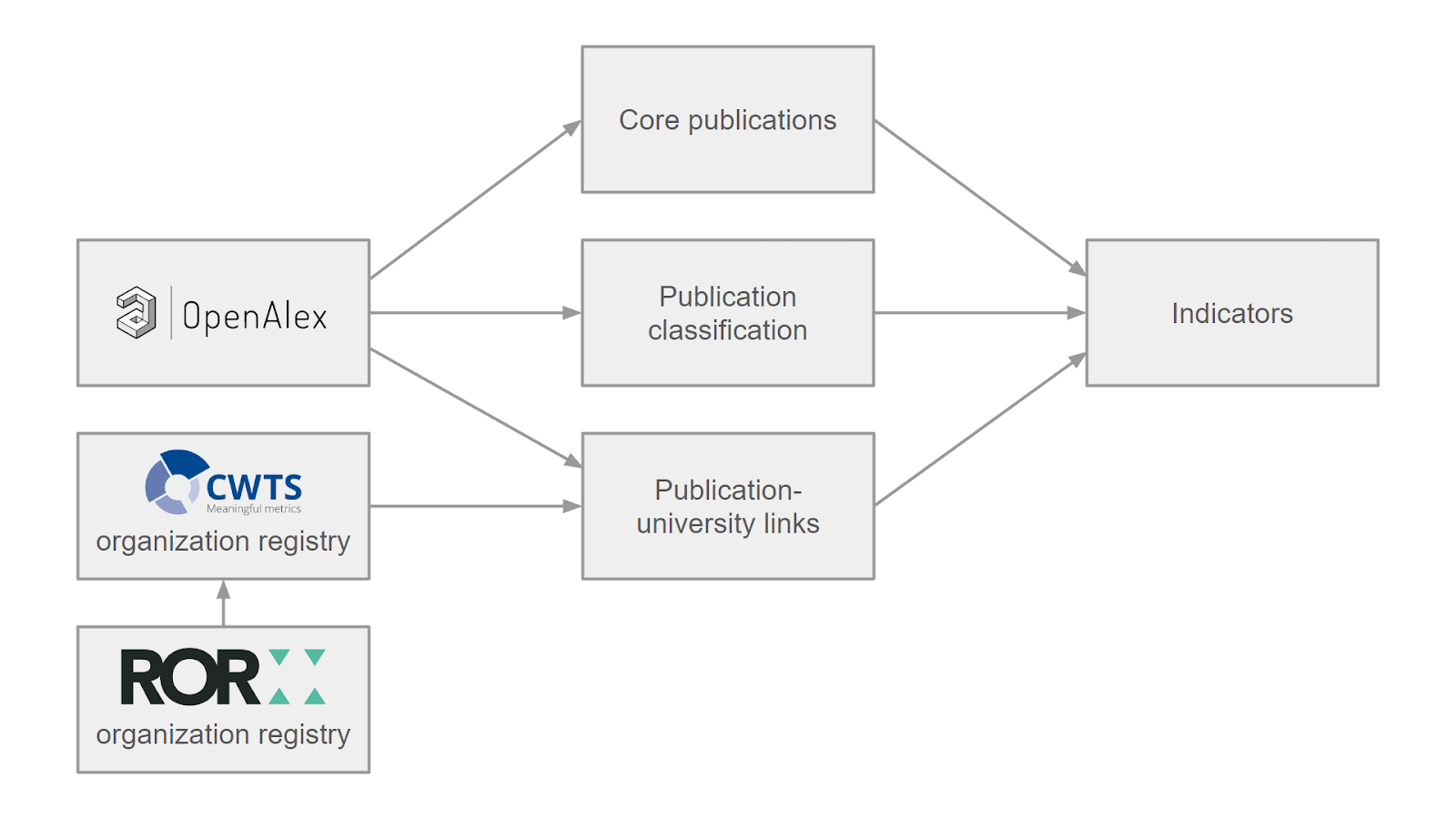
Figure 1 summarizes the process of creating the Leiden Ranking Open
Edition. We now discuss the different steps in this process.
Figure 1. Summary of the process of creating the Leiden
Ranking Open Edition.
\
**Core publications**
Web of Science and OpenAlex differ in their coverage of the scientific
literature. Most publications covered by Web of Science are also covered
by OpenAlex, but OpenAlex covers many publications that Web of Science
does not cover. The traditional Leiden Ranking focuses on so-called core
publications, which are identified based on a [number of
criteria](https://www.leidenranking.com/information/indicators#publications){target="_blank"}.
The Open Edition also has a focus on core publications, identified based
on [similar
criteria](https://open.leidenranking.com/information/indicators#publications){target="_blank"}.
However, because of coverage differences between Web of Science and
OpenAlex, the set of core publications considered in the Open Edition
differs from the set of core publications considered in the traditional
Leiden Ranking. This is discussed in more detail in [this blog
post](https://www.leidenmadtrics.nl/articles/opening-up-the-cwts-leiden-ranking-toward-a-decentralized-and-open-model-for-data-curation){target="_blank"}.
**Publication classification**
The Leiden Ranking relies on a detailed algorithmic classification of
publications into research areas. This classification is used to assign
publications to main fields and to calculate normalized citation impact
indicators. For the Open Edition, CWTS created a new classification of
publications based on OpenAlex data. [This blog
post](https://www.leidenmadtrics.nl/articles/an-open-approach-for-classifying-research-publications){target="_blank"}
provides more details.
**CWTS organization registry**
OpenAlex uses [ROR (Research Organization Registry)
identifiers](https://ror.org/){target="_blank"} for organizations, while
the Leiden Ranking has traditionally used internal CWTS organization
identifiers. For the Open Edition, CWTS created a new organization
registry by matching CWTS organization identifiers to ROR identifiers.
This was done for the 1411 universities included in the Open Edition and
for the [affiliated organizations linked to these
universities](https://www.leidenmadtrics.nl/articles/a-team-a-stands-for-very-challenging-job){target="_blank"}.
Additional links between universities and affiliated organizations were
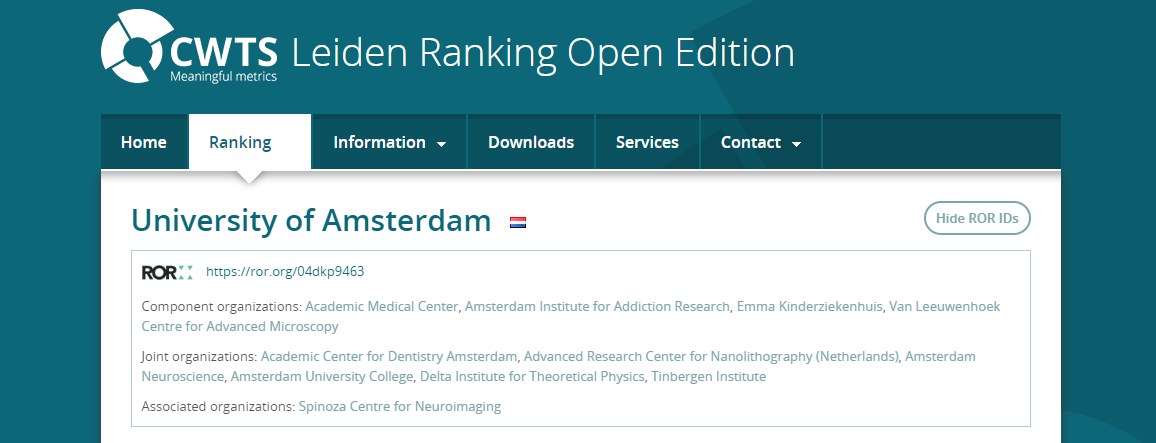
obtained from the ROR organization registry. Links between universities
and their affiliated organizations are presented in a transparent way on
the website of the Open Edition (see Figure 2).\
Figure 2. Screenshot of the website of the Leiden Ranking
Open Edition showing the links between University of Amsterdam and its
affiliated organisations.
**\
Publication-university links**
OpenAlex provides ROR identifiers for the affiliations of authors of
publications. We linked publications to universities by connecting ROR
identifiers obtained from OpenAlex to the ROR identifiers of
universities and their affiliated organizations in the CWTS organization
registry. In [this blog
post](https://www.leidenmadtrics.nl/articles/opening-up-the-cwts-leiden-ranking-toward-a-decentralized-and-open-model-for-data-curation){target="_blank"}
the CWTS team presents a comparison between the approach for linking
publications to universities used in the traditional Leiden Ranking and
the approach used in the Open Edition.
**Indicators**
The Open Edition includes the same bibliometric indicators as the
traditional Leiden Ranking, except for [indicators of gender
diversity](https://www.leidenranking.com/information/indicators#gender-indicators){target="_blank"}.
These indicators are somewhat more challenging to produce using OpenAlex
data because OpenAlex does not make a distinction between first and last
names of authors. This distinction is important for algorithmic gender
inference. At the moment gender diversity indicators are therefore not
included in the Open Edition. We may add them in the future.
### **How to access the data and software**
The data used to create the Leiden Ranking Open Edition is [openly
available in
Zenodo](https://doi.org/10.5281/zenodo.10579113){target="_blank"} under
a [CC0 public domain
dedication](https://creativecommons.org/public-domain/cc0/){target="_blank"}.
The data can also be [accessed through Google
BigQuery](https://console.cloud.google.com/bigquery?ws=!1m4!1m3!3m2!1scwts-leiden!2sleiden_ranking_open_edition_2023){target="_blank"}
(to run queries you need to have a BigQuery account and your own
project). Universities may for instance use the data to check whether
publications have been correctly attributed to them. Performing such
checks is not possible in the case of the traditional Leiden Ranking,
since this ranking is based on proprietary data that cannot be shared
openly.
The source code of the software used to create the Leiden Ranking Open
Edition is [openly available in
GitHub](https://github.com/CWTSLeiden/CWTS-Leiden-Ranking-Open-Edition){target="_blank"}
under an MIT license. A Microsoft SQL Server database system was used to
perform the data processing and the calculations. The source code
therefore consists mostly of SQL scripts.**\**
### **How to compare the Open Edition with the traditional Leiden Ranking**
To what extent does the Open Edition provide results that are similar to
those provided by the traditional Leiden Ranking? To address this
question, we have created an [interactive
dashboard](https://app.powerbi.com/view?r=eyJrIjoiODg0YWM2MzEtMmVlNS00NzEyLWE2YjMtMTIxM2Y3ZjMxYTJkIiwidCI6ImNhMmE3Zjc2LWRiZDctNGVjMC05MTA4LTZiM2Q1MjRmYjdjOCIsImMiOjh9){target="_blank"}
in which the values of the indicators in the two editions of the Leiden
Ranking can be easily compared.
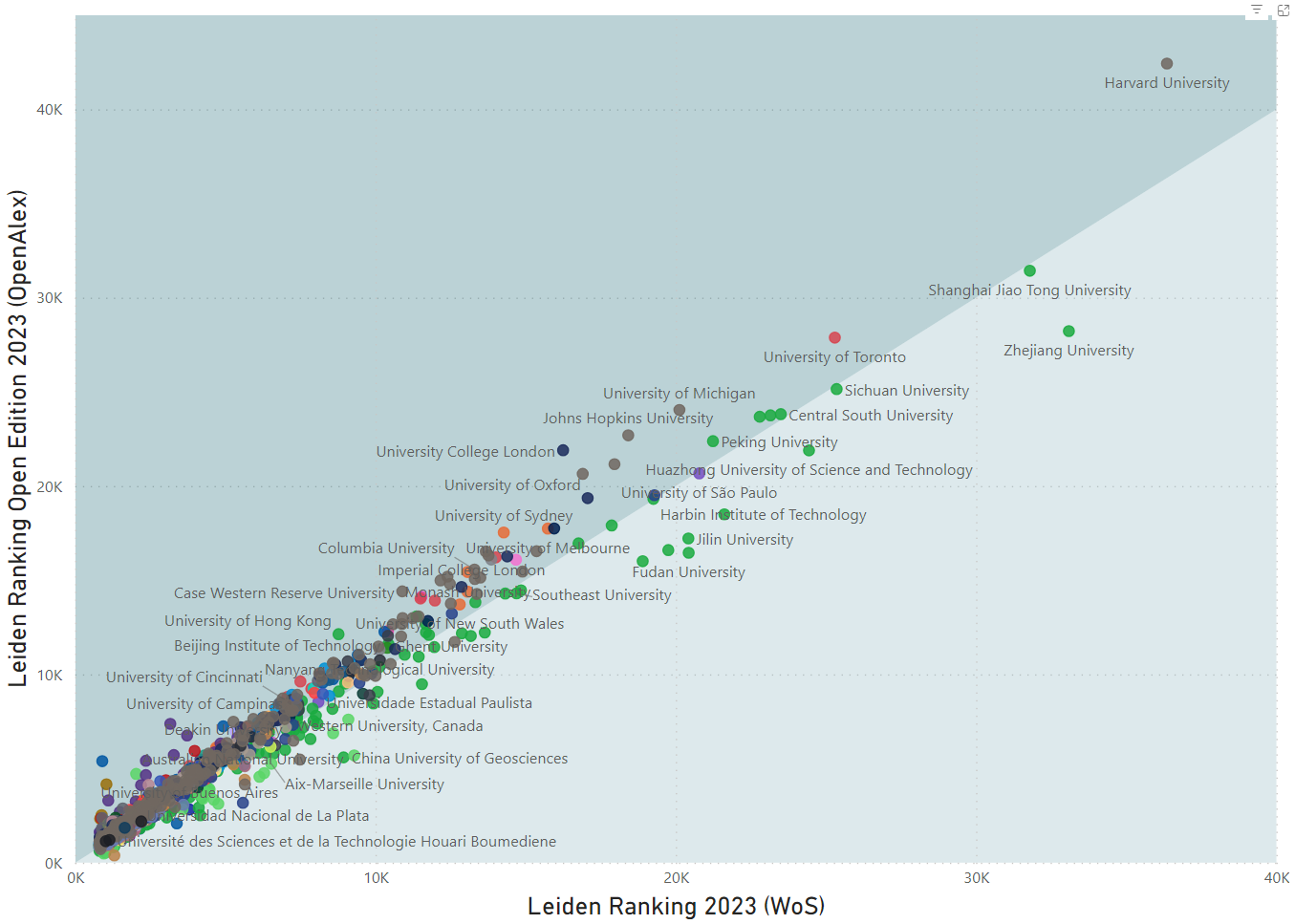
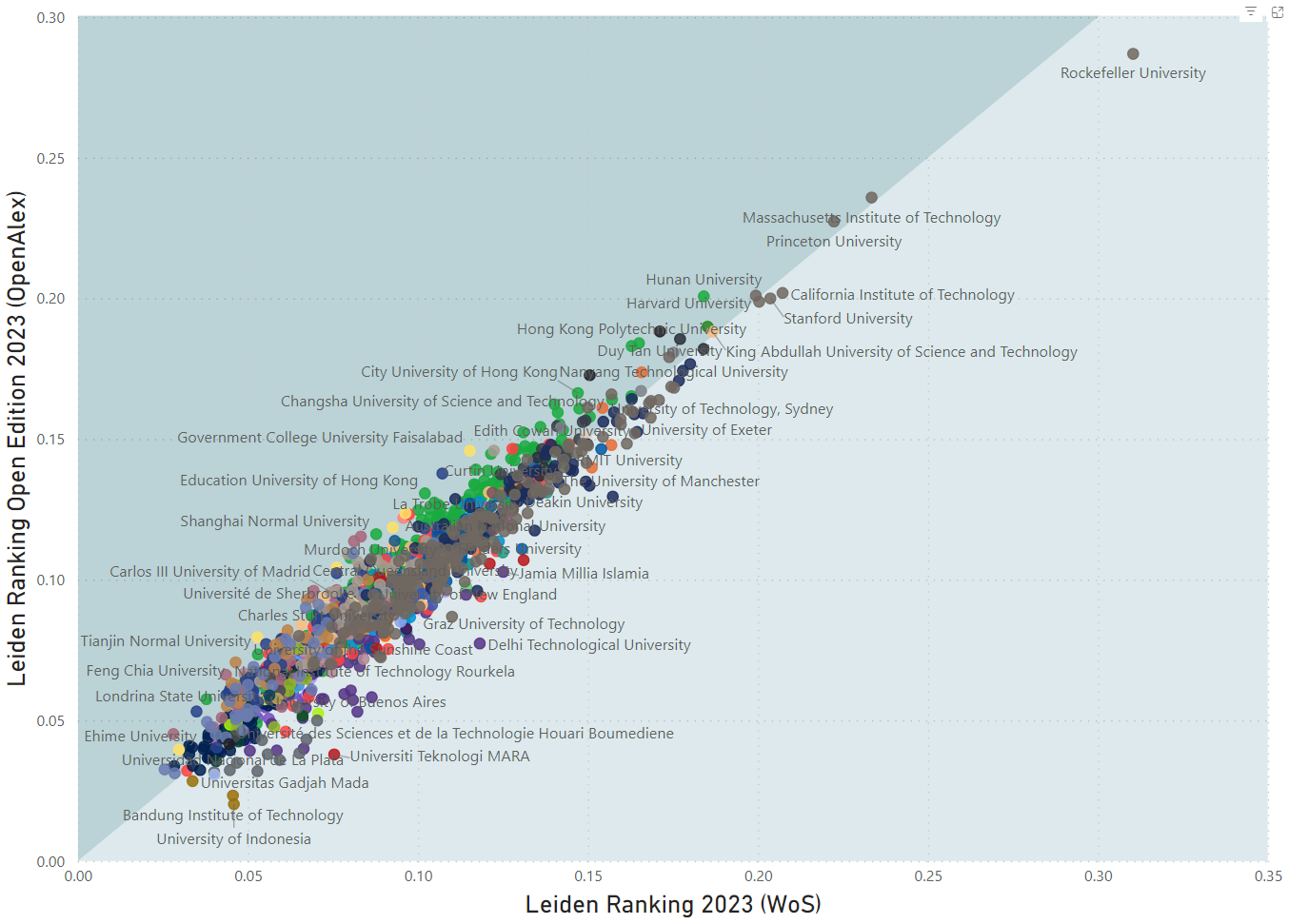
The interactive dashboard can for instance be used to explore the
correlation between the number of publications of a university in the
traditional Leiden Ranking and in the Open Edition (see Figure 3), or
the correlation between a university\'s proportion of highly cited
publications in the two editions of the Leiden Ranking (see Figure 4).\
\
Figure 3. Correlation between the number of publications of
a university in the traditional Leiden Ranking and in the Open Edition
(fractional counting).
\
Figure 4. Correlation between the proportion of highly cited
(top 10%) publications of a university in the traditional Leiden Ranking
and in the Open Edition (fractional counting).
\
In general, we consider the correlations between indicator values in the
two editions of the Leiden Ranking to be quite strong. However, for some
universities there are large differences between the two editions of the
Leiden Ranking. In many cases this is probably due to differences in the
publications attributed to a university. This issue is analyzed in more
detail in [this blog
post](https://www.leidenmadtrics.nl/articles/opening-up-the-cwts-leiden-ranking-toward-a-decentralized-and-open-model-for-data-curation){target="_blank"}.
### **What is next?**
At the moment the Leiden Ranking Open Edition is still of an
experimental nature. Building the ranking was an incredibly useful
exercise for our organizations (CWTS, COKI, Sesame Open Science, and
OurResearch). We also expect to learn a lot from the feedback we hope to
receive from users of the Open Edition. Based on the lessons learned, we
will make further improvements to the Open Edition. Within one or two
years, we expect the Open Edition to be fully mature and to offer a full
replacement for the traditional Leiden Ranking.
While our organisations are making further improvements to the Leiden
Ranking Open Edition, CWTS will continue to release annual updates of
the traditional Leiden Ranking based on Web of Science data. In the next
one or two years, we expect the traditional Leiden Ranking and the Open
Edition to co-exist. In the somewhat longer term, CWTS will make a [full
transition to open research
information](https://www.leidenmadtrics.nl/articles/toward-open-research-information-introducing-the-information-openness-focal-area-at-cwts){target="_blank"}.
Within the next few years, all bibliometric indicators produced by CWTS,
including those in the Leiden Ranking, will be based on open data.
The transition of the Leiden Ranking toward open data fits into broader
discussions about openness of research information, responsible use of
bibliometric indicators, and reform of research assessment. Critical
reflection on the value of university rankings should be part of these
important discussions.\
### **How to get in touch**\
{#how-to-get-in-touch}
Would you like to know more about the Leiden Ranking Open Edition? CWTS
is organizing two webinars about the Open Edition, providing an
opportunity to discuss the ranking with members of the CWTS team. The
[first
webinar](https://universiteitleiden.zoom.us/meeting/register/u5cuce-vrD0iGNZUZREryhJ0Ogvh7zaZOILs#/registration){target="_blank"}
takes place on February 6 at 10h CET, and the [second
webinar](https://universiteitleiden.zoom.us/meeting/register/u50ode-sqDgrHd2RGWtphvap5qPoZ5bB2ord#/registration){target="_blank"}
on February 9 at 15h CET. COKI, in collaboration with Future Campus, is
offering a [webinar with an Australian
focus](https://futurecampus.com.au/event/your-university-ranked/){target="_blank"}
on January 31 at 11h AEDT. OpenAlex is organising a [webinar about
institutional profiles and affiliation
curation](https://us02web.zoom.us/webinar/register/WN_ggI4M2mwQF-Ce-pp947nUA){target="_blank"}
on February 8 at 12h EST.
We also invite you to reach out to us using the [contact
form](https://open.leidenranking.com/contact){target="_blank"} on the
website of the Leiden Ranking Open Edition. We appreciate your comments
and feedback on the Open Edition.
Do you want to start working yourself with open bibliometric data
sources such as OpenAlex? You may then consider signing up for the
[course *Scientometrics Using Open
Data*](https://www.cwts.nl/education/cwts-course-program/scientometrics-using-open-data){target="_blank"}
organised by CWTS, COKI, and Sesame Open Science. The next edition of
this online course takes place from March 25 to March 28.\
[Header image from ]{.caption dir="ltr"}