---
author:
- contributor_roles: []
family: Edmunds
given: Scott
url: https://orcid.org/0000-0001-6444-1436
blog:
authors: null
community_id: 52db0518-e228-4260-8c54-c4e323b2569d
created: 1675555200
current_feed_url: null
description: Data driven blogging from the GigaScience editors
doi: https://doi.org/10.59350/gigablog
favicon: https://rogue-scholar.org/api/communities/52db0518-e228-4260-8c54-c4e323b2569d/logo
feed_format: application/atom+xml
feed_url: http://gigasciencejournal.com/blog/feed/atom/
filter: null
generator: Other
home_page_url: https://gigasciencejournal.com/blog
issn: null
language: eng
license: https://creativecommons.org/licenses/by/4.0/legalcode
prefix: '10.59350'
relative_url: null
secure: false
slug: gigablog
status: archived
subfield: '1311'
title: GigaBlog
updated: null
use_api: null
container: GigaBlog
date: '2023-08-03T00:00:00+00:00'
date_updated: '2025-12-06T10:10:42+00:00'
guid: http://gigasciencejournal.com/blog/?p=5165
identifier: https://doi.org/10.59350/59yfe-63e94
image: http://gigasciencejournal.com/blog/wp-content/uploads/2023/08/Top.jpg
images:
- alt: The conference centre in Lyon, for a conference covering subjects including
Large Language Models
height: '466'
sizes: '(max-width: 720px) 100vw, 720px'
src: http://gigasciencejournal.com/blog/wp-content/uploads/2023/08/Top.jpg
srcset: http://gigasciencejournal.com/blog/wp-content/uploads/2023/08/Top.jpg, http://gigasciencejournal.com/blog/wp-content/uploads/2023/08/Top-300x194.jpg
width: '720'
- alt: GigaScience Macarons
height: '788'
sizes: '(max-width: 720px) 100vw, 720px'
src: http://gigasciencejournal.com/blog/wp-content/uploads/2023/08/GigaMacarons.jpg
srcset: http://gigasciencejournal.com/blog/wp-content/uploads/2023/08/GigaMacarons.jpg,
http://gigasciencejournal.com/blog/wp-content/uploads/2023/08/GigaMacarons-274x300.jpg
width: '720'
- alt: At the GigaScience party.
height: '800'
sizes: '(max-width: 720px) 100vw, 720px'
src: http://gigasciencejournal.com/blog/wp-content/uploads/2023/08/GigaPooch.jpg
srcset: http://gigasciencejournal.com/blog/wp-content/uploads/2023/08/GigaPooch.jpg,
http://gigasciencejournal.com/blog/wp-content/uploads/2023/08/GigaPooch-270x300.jpg
width: '720'
- height: '741'
sizes: '(max-width: 720px) 100vw, 720px'
src: http://gigasciencejournal.com/blog/wp-content/uploads/2023/08/BOSC-Image.png
srcset: http://gigasciencejournal.com/blog/wp-content/uploads/2023/08/BOSC-Image.png,
http://gigasciencejournal.com/blog/wp-content/uploads/2023/08/BOSC-Image-291x300.png
width: '720'
- src: http://gigasciencejournal.com/blog/wp-content/uploads/2023/08/Top.jpg
- src: http://gigasciencejournal.com/blog/wp-content/uploads/2023/08/GigaMacarons.jpg
- src: http://gigasciencejournal.com/blog/wp-content/uploads/2023/08/GigaPooch.jpg
- src: http://gigasciencejournal.com/blog/wp-content/uploads/2023/08/BOSC-Image.png
issn: null
keywords:
- Biology
- AI
- Bioinformatics
- BOSC
- Conferences
lang: en
license: https://creativecommons.org/licenses/by/4.0/legalcode
rid: vbc2e-5w007
rights: https://creativecommons.org/licenses/by/4.0/legalcode
summary: Once again the GigaScience Press team has gathered at
the yearly ISMB (Intelligent Systems for Molecular Biology) meeting to find out
about the state of the art of computational biology, as well as celebrate our birthday
. Hosted this year in the beautiful city of Lyon, and this year collocated
with ISMB's European sibling ECCB, it's now been 11 years since GigaScience
journals launch at ISMB 2012 in Long
title: Going Large (Language Models) at ISMB2023
url: https://wayback.archive-it.org/22098/2025-05-01T17:13:42Z/http://gigasciencejournal.com/blog/going-large-language-models-at-ismb2023
version: v1
---
**Once again the *GigaScience Press* team has gathered at the yearly
[ISMB (Intelligent Systems for Molecular
Biology)](https://www.iscb.org/ismbeccb2023) meeting to find out about
the state of the art of computational biology, as well as celebrate our
birthday**.
::: {.wp-block-image}
:::
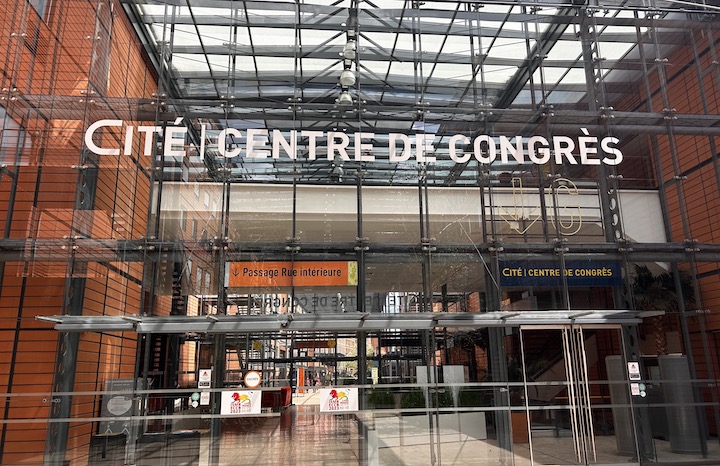
Hosted this year in the beautiful city of Lyon, and this year collocated
with ISMB\'s European sibling ECCB, it\'s now been 11 years since
*GigaScience* journals launch at [ISMB 2012 in Long
Beach](http://gigasciencejournal.com/blog/searching-for-the-open-source-at-long-beach/),
and we have [attended every in-person
meeting](http://gigasciencejournal.com/blog/tag/ismb/) since Vienna in
2011. After skipping two years because of COVID, [last year in
Madison](http://gigasciencejournal.com/blog/birthday-at-ismb2022/) was
relatively successful at dipping ISMB\'s toes into offering a hybrid
format while still having a reasonable in-person turnout.
**The return of the conference**
But this year proved that conferences are properly back, with the
highest turnout for the meeting to date: 2100 in-person attendees and
400 watching online. It was great to see lots of familiar faces that
hadn\'t been back for many years, and also to see the society regain
some of their economic losses from COVID, although if anything the
meeting might have been a bit of a victim of its own success as at times
the organisational infrastructure was a little stretched from too many
people going up the escalators, challenges fitting into some of the
sessions (especially at the keynotes), and long queues for coffee and
lunch. With many PhD students having missed out on the important
experience of attending conferences because of COVID many PI\'s were
generous in bringing large entourages of them along this year. Talking
to attendees it seems this is a recurring theme this summer, the [SMBE
(Society for Molecular Biology and Evolution) meeting in
Ferrara](https://www.smbe2023.org/) also on this week fully booked and
there were some attendees who came to Lyon because they missed booking a
place for the meeting in Italy. But all-in-all it was good to see people
back in-person again and have the important experience of interacting
and socialising with your scientific friends and peers.
#### **Large Lyon Mischief** {#large-lyon-mischief .wp-block-heading}
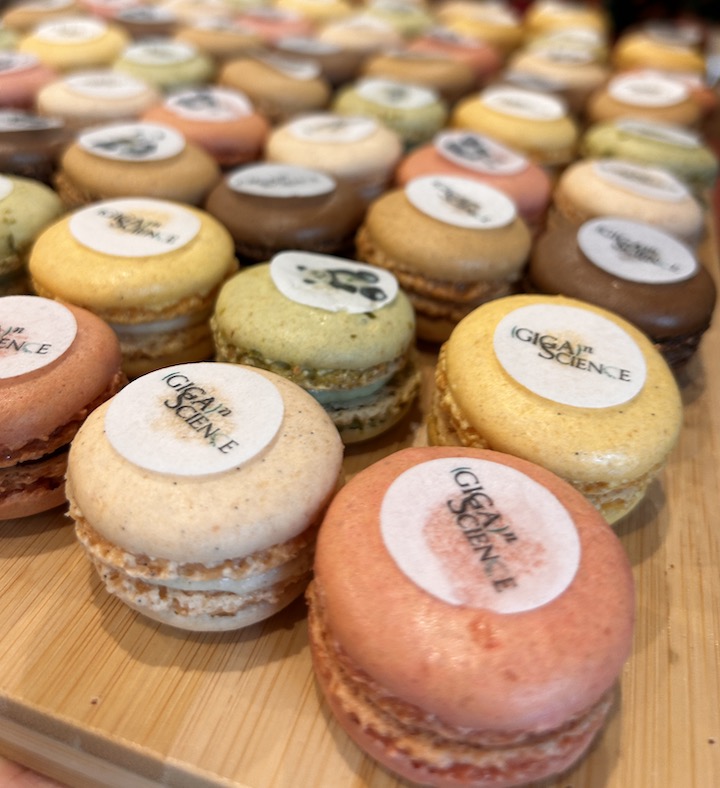
Our birthday celebrations were equally larger than expected, the
Lyon-inspired GigaPanda macarons at the booth helping spread the word of
the event at the Ninkasi microbrewery the other side of the LyonTech-la
Doua University campus. Despite it being a bit of the walk, a public bus
ran directly from the conference centre and at its peak these were being
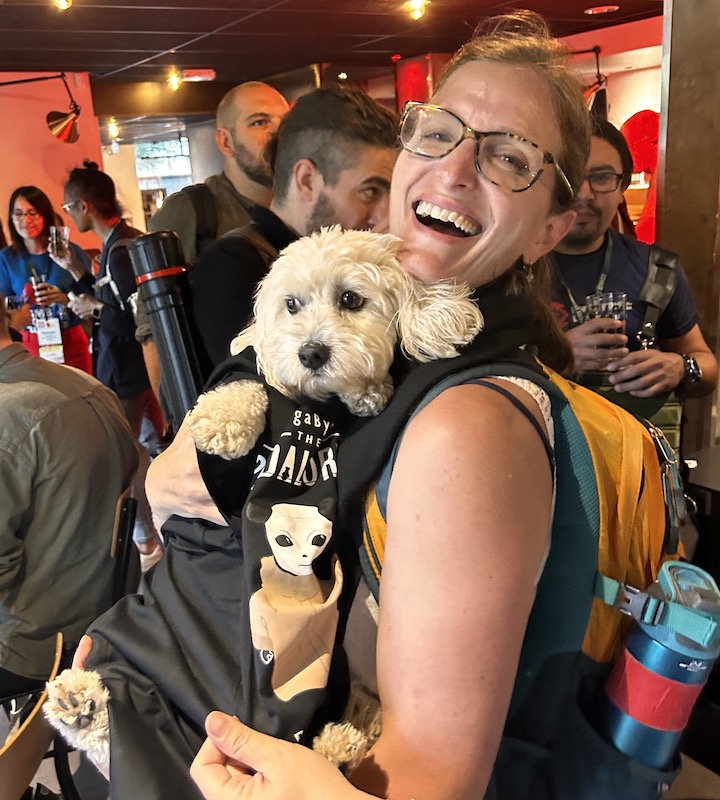
filled with party goers who arrived in bus-sized waves. The new
*GigaByte* baby-GigaPanda (Pandalorian) t-shirts we handed out were
popular with (human and non-human) attendees, but the 60 shirts we
brought quickly ran out and we had over 100 attendees at the end of the
night, even outnumbering our [legendary Prague 5^th^-birthday
celebrations](http://gigasciencejournal.com/blog/bohemian-bashfully-baroque-birthdays-and-bingo-in-prague/).
You can see photos via our [facebook photo
album](https://www.facebook.com/media/set?vanity=GigaScience&set=a.680937507387097)
of the conference.
#### **I, for one, applaud our AI-overlords** {#i-for-one-applaud-our-ai-overlords .wp-block-heading}
The recurring theme of the conference this was the rise of Large
Language Models, and this topic infiltrated many of the COSI tracks and
there was even a [Special
Session](https://www.iscb.org/ismbeccb2023-programme/special-sessions/llm)
organized jointly by the ISCB Publication Committee and the ISCB Science
in Society Committee on \"Large Language Models -- Are these the next
pocket calculators?\" that specifically covered the subject. This
session included talks on the impact of LLMs on education, teaching and
learning from Patricia Palagi; the ethical implications for science as a
community of practice from David Leslie; and interestingly for us Alex
Bateman giving an Editor\'s perspective of the challenges for journals
having to deal with LLM-generated \"plausible nonsense\". Alex\'s talk
presented [the latest guidance and
policies](https://www.iscb.org/iscb-policy-statements/iscb-policy-for-acceptable-use-of-large-language-models)
on the use of LLMs the ISCB has drafted in association with Editors from
the ISCB journals *Bioinformatics* and Bioinformatics Advances. This
policy outlines the permitted uses of LLMs in the publication process
and highlights what is not permitted (with the caveat that in such a
rapidly moving area these policies is likely to evolve as the tools
improve and peoples level of acceptance changes). At GigaScience Press
we are following the [COPE
guidelines](https://publicationethics.org/news/artificial-intelligence-and-authorship)
on Authorship and AI tools, and are drafting similar detailed guidance
for our authors and reviewers on this important and challenging area.
Watch this space for further news and updates on this.
Looking at the other tracks, the [FUNCTION
COSI](https://www.iscb.org/ismbeccb2023-programme/tracks/function) had
talks on using **LLMs to** improve annotation, and the Text mining COSI
having some talks on its use there as well. The panel with Larry Hunter,
J. Harry Caufield and Chris Dallago (nvidea) on \"Applications of
ChatGPT and large language models in biology and medicine\" being
particularly popular and discussing wide variety of topics including
trustworthiness and the need for better testing, assessment and training
data.. It was not all negative, as Aurélie Névéol was in her Text Mining
track talk on reproducibility noted that its increasingly important to
show ChatGPT\'s limitations and this potentially increases the
importance of sharing negative results and bringing them back in the
game.
#### **Back to BOSC** {#back-to-bosc .wp-block-heading}
LLM\'s were even in our favourite [BOSC (Bioinformatics Open Source
Conference) COSI](https://www.open-bio.org/events/bosc-2023/), on top of
AI-generated art prefacing the sessions, J. Harry Caufield presented an
overview of transforming unstructured biomedical texts using this
approach. Trying to fix \"hallucinations\" by grounding them in
ontologies with the [OntoGPT
tool](/github.com/monarch-initiative/ontogpt). The two keynotes this
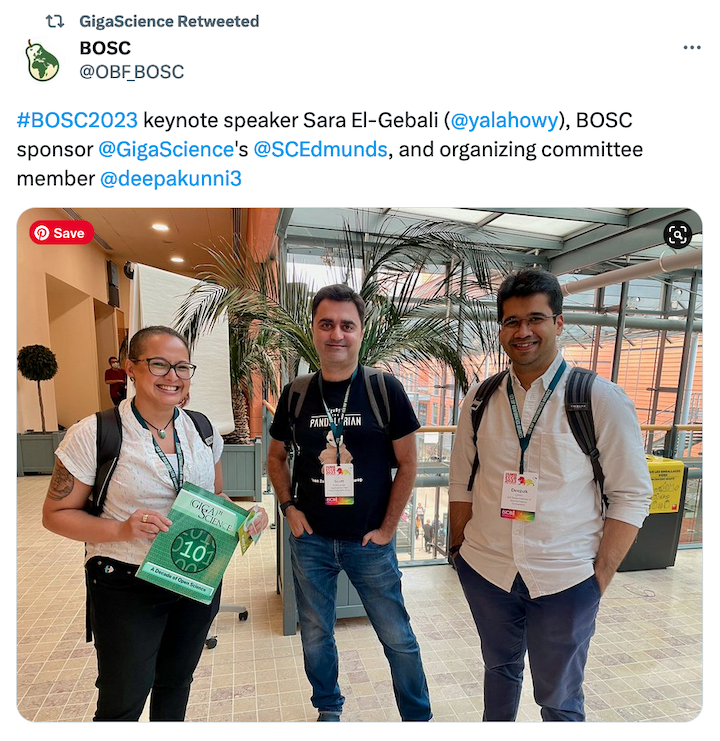
year both covered very important subjects in Open Science. [Sara
El-Gebali](https://selgebali.netlify.app/) opened the meeting presenting
on the future of scientific progress through open collaboration. Busting
the myths of scientific meritocracy, and telling us what we personally
can do to address these issues. Includding acknowledging bias, learn
from mistakes, embrace diversity, recognise your role and privilege, and
finally leveraging all of these to make better decision and change
Joseph Yracheta covered the dissonance between scientific altruism and
capitalist extraction, and how indigenous communities need to look at
federated data structures to better track the source and reuse of
indigenous knowledge for benefit sharing and defining community
expectations. His [Native BioData Consortium](https://nativebio.org/)
being an example of this approach as the only research institute and
data repository hosted on indigenous land (domestic dependent nation)
and led and run by indigenous scientists and tribal members in the US.
As always BOSC included talks from many of our long time collaborators,
friends and authors. *GigaByte* Board Member Monica Munoz-Torres
presented on the standards to connect biomedical data to AI in the [NIH
Bridge2AI Program](https://commonfund.nih.gov/bridge2ai). There was also
a talk from Tazro Ohta on [his recently published
work](https://doi.org/10.1093/gigascience/giad031) in *GigaScience* on a
workflow reproducibility scale for automatic validation of biological
interpretation results.
::: {.wp-block-image}
:::
It was great to see many of our previous authors presenting. Amber
Scholz in [the Human Frontier Science Program (HFSP)
Symposium](https://www.iscb.org/ismbeccb2023-programme/special-sessions/sshfsp)
presenting data from her [\"myth busting\" paper in
*GigaScience*](https://doi.org/10.1093/gigascience/giab085) on the
current negotiations and potential effects of UN Convention on
Biological Diversity on biological data management. It was standing room
only for Matthieu Foll from IARC\'s Rare Cancer Genomics initiative
keynote in VarI COSI on Multi-omics characterization of rare
heterogeneous tumours. As an Open Science advocate using best practice
in sharing workflows and interactive notebooks, the data underlying the
mesothelioma research he presented here has all been described and
shared and gathered together for reuse via a recent [GigaScience Data
Note](https://doi.org/10.1093/gigascience/giac128). We [previously
published a
Q&A](http://gigasciencejournal.com/blog/controlled-access-data/) with
Matthieu on his experience
[sharing](https://doi.org/10.1093/gigascience/giaa112), accessing and
reviewing controlled access data of rare cancers.
As in-person conferences are well and truly back we look forward to ISMB
and BOSC 2024 in Montreal next year, and will make sure we book in
sufficient enough advance to get a place as all the predictions are is
it will be a large one.
The post [Going Large (Language Models) at
ISMB2023](http://gigasciencejournal.com/blog/going-large-language-models-at-ismb2023/){rel="nofollow"}
appeared first on
[GigaBlog](http://gigasciencejournal.com/blog){rel="nofollow"}.