---
author:
- contributor_roles: []
family: Edmunds
given: Scott
url: https://orcid.org/0000-0001-6444-1436
blog:
authors: null
community_id: 52db0518-e228-4260-8c54-c4e323b2569d
created: 1675555200
current_feed_url: null
description: Data driven blogging from the GigaScience editors
doi: https://doi.org/10.59350/gigablog
favicon: https://rogue-scholar.org/api/communities/52db0518-e228-4260-8c54-c4e323b2569d/logo
feed_format: application/atom+xml
feed_url: http://gigasciencejournal.com/blog/feed/atom/
filter: null
generator: Other
home_page_url: https://gigasciencejournal.com/blog
issn: null
language: eng
license: https://creativecommons.org/licenses/by/4.0/legalcode
prefix: '10.59350'
relative_url: null
secure: false
slug: gigablog
status: archived
subfield: '1311'
title: GigaBlog
updated: null
use_api: null
container: GigaBlog
date: '2023-03-06T00:00:00+00:00'
date_updated: '2025-12-06T10:11:07+00:00'
guid: http://gigasciencejournal.com/blog/?p=4838
identifier: https://doi.org/10.59350/279kt-vm986
image: http://gigasciencejournal.com/blog/wp-content/uploads/2023/03/Tazro_crop-1.jpeg
images:
- alt: Yevis author Tazro Ohta
height: '705'
sizes: '(max-width: 705px) 100vw, 705px'
src: http://gigasciencejournal.com/blog/wp-content/uploads/2023/03/Tazro_crop-1.jpeg
srcset: http://gigasciencejournal.com/blog/wp-content/uploads/2023/03/Tazro_crop-1.jpeg,
http://gigasciencejournal.com/blog/wp-content/uploads/2023/03/Tazro_crop-1-300x300.jpeg,
http://gigasciencejournal.com/blog/wp-content/uploads/2023/03/Tazro_crop-1-150x150.jpeg
width: '705'
- alt: Yevis screenshot
height: '313'
sizes: '(max-width: 768px) 100vw, 768px'
src: http://gigasciencejournal.com/blog/wp-content/uploads/2023/03/giad006fig7-1024x417.jpeg
srcset: http://gigasciencejournal.com/blog/wp-content/uploads/2023/03/giad006fig7-1024x417.jpeg,
http://gigasciencejournal.com/blog/wp-content/uploads/2023/03/giad006fig7-300x122.jpeg,
http://gigasciencejournal.com/blog/wp-content/uploads/2023/03/giad006fig7-768x313.jpeg,
http://gigasciencejournal.com/blog/wp-content/uploads/2023/03/giad006fig7.jpeg
width: '768'
- alt: 'Dr Tazro Ohta from the Database Center for Life Science in
Shizuoka Japan'
src: http://gigasciencejournal.com/blog/wp-content/uploads/2023/03/Tazro_crop-1.jpeg
- alt: 'Screenshot of Yevis-web, a browser-based application showing
both published and under-review workflows to help maintainers in
organizing the registry.'
src: http://gigasciencejournal.com/blog/wp-content/uploads/2023/03/giad006fig7-1024x417.jpeg
issn: null
keywords:
- Technology
- Q&A
- Reproducibility
- Reproducible Research
- Workflows
lang: en
license: https://creativecommons.org/licenses/by/4.0/legalcode
rid: 9txwz-88496
rights: https://creativecommons.org/licenses/by/4.0/legalcode
summary: At GigaScience we see more and more of our published papers use
computational workflows, as they provides researchers easy access to high-quality
analysis methods without the requirement of computational expertise. However, systems
are needed to enable the sharing of these workflows in a reusable form.
title: Addressing the challenges of sharing computational workflows with Yevis. Q&A
with Tazro Ohta.
url: https://wayback.archive-it.org/22098/2025-05-01T17:13:42Z/http://gigasciencejournal.com/blog/yevis-qa-with-tazro-ohta
version: v1
---
At *GigaScience* we see more and more of our published papers use
computational workflows, as they provides researchers easy access to
high-quality analysis methods without the requirement of computational
expertise. However, systems are needed to enable the sharing of these
workflows in a reusable form. To fill that gap we have a [recently
published paper on Yevi](https://doi.org/10.1093/gigascience/giad006)s,
a system to build a workflow registry that automatically validates and
tests published workflows. This new system particularly useful to those
that want to share workflows but lack the specific technical expertise
to build and maintain a workflow registry from scratch. Yevis was
started by Hirotaka Suetake and Tazro Ohta at the Database Center for
Life Science in Shizuoka Japan, Hiro being the main developer of the
implementations and Tazro the lead of the project. Following our long
running series of [author
Q&A\'s](http://gigasciencejournal.com/blog/tag/qa/) (and
[videos](https://www.youtube.com/@GigaScienceJournal)) we present a Q&A
and [video abstract](https://youtu.be/Yr7UUw_lqGE) (see below) with
Tazro where he gives some insight into archiving workflows and his new
platform.
Dr Tazro Ohta from the Database Center for Life Science in
Shizuoka Japan
**What are the challenges in sharing computational workflows, and how
does Yevis help address these?**
If you want just to make your workflows public, it won\'t be a difficult
task. Many public web services like GitHub can help you to upload your
resources, and some are free of charge. Sharing your workflow has a huge
potential to help researchers who want to perform similar analyses.
However, published workflows may stop working for many reasons; for
example due to an update in dependent software or an unexpected change
to data it relies on. To keep your workflow usable, you need to maintain
it. But this takes valuable cost and time. Therefore, we wanted to help
researchers by providing a platform that automatically performs workflow
testing.
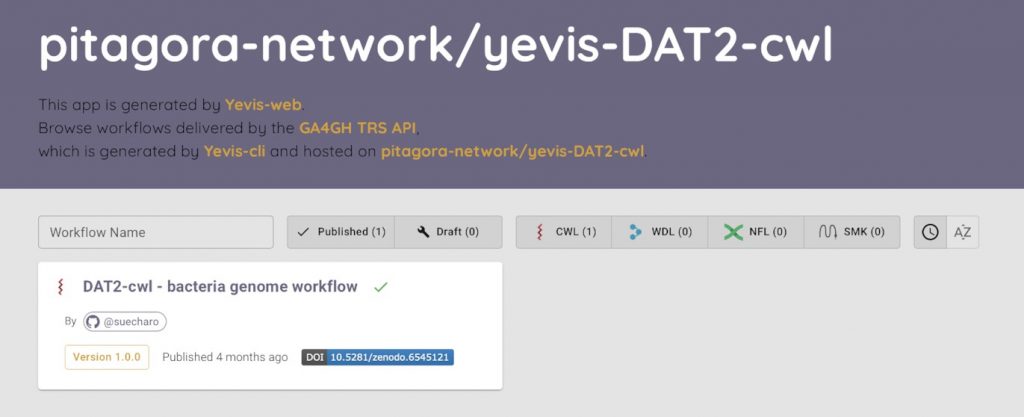
Screenshot of Yevis-web, a browser-based application showing
both published and under-review workflows to help maintainers in
organizing the registry.
**Why should people wanting to share workflows use this platform? What
are the advantages for users?**
With Yevis, you can create your own workflow registry. The platform runs
using GitHub and Zenodo, so you don\'t need to have your own server.
Yevis\'s most significant feature is to help you maintain the uploaded
workflows automatically. Once you register your workflow with your test
data, the platform takes care of the test execution.
It would sound great to you if you ever had an experience in that
someone told you that your published resources are not working anymore
and you need to fix it. And this is absolutely why we started to do
this.
**Can you tell us what is the backstory on the name \"Yevis\"?**
Naming a project or software has been the most time-consuming phase in
my research. I was always trying to think of a name that is meaningful
or full of humor as much as the other popular bioinformatics databases
or software. Then one day I realized that this is just a waste of time
-- at least for me. I realized that this is something I have to automate
to make my life easier. Then I invented a method to name a project, and
the name \'Yevis\' came from it. I hope I can publish the method one
day. But you may notice something in common with the names of our
projects.
**What are your future development plans?**
I believe the idea of automated workflow testing is beneficial to many,
and our implementation is ready to use. My team is already using it for
its own registry and it is working perfectly. However, I see some
limitations in testing. For example, if a workflow requires a large
volume of test data, it may fail because of the storage limit of GitHub.
Designing feasible workflow testing with small datasets may also not be
an easy task for users who don\'t usually think about testing, which we
want to help with by automation techniques. Therefore, I would like to
work on a method to automate the testing phase in workflow development,
which saves a lot of time to make researchers more productive. I believe
it can also contribute to improving the reproducibility of science.
*Workflows have been a long-running area of interest for the journal,
and since our launch we have tried to keep on top of the start of the
art in this area (e.g. see* [*the previous
workshops*](http://gigasciencejournal.com/blog/gigascience-special-session-at-iscb-asia-on-workflows-cloud-for-reproducible-bioinformatics/)
*we have organised on the topic and our* [*Galaxy
series*](https://academic.oup.com/gigascience/pages/galaxy_series_data_intensive_reproducible_research)*).
On top of promoting best practice the use of registries like Yevis and*
[*workflowhub.eu*](https://workflowhub.eu/)*, we encourage submissions
covering this important area of computational research.*
**Further Reading**\
Suetake H et al., Workflow sharing with automated metadata validation
and test execution to improve the reusability of published workflows,
*GigaScience*, Volume 12, 2023, giad006,
The post [Addressing the challenges of sharing computational workflows
with Yevis. Q&A with Tazro
Ohta.](http://gigasciencejournal.com/blog/yevis-qa-with-tazro-ohta/){rel="nofollow"}
appeared first on
[GigaBlog](http://gigasciencejournal.com/blog){rel="nofollow"}.