---
author:
- affiliation:
- id: https://ror.org/03yty8687
name: GigaScience Press
contributor_roles: []
family: Edmunds
given: Scott
url: https://orcid.org/0000-0001-6444-1436
blog:
authors: null
community_id: 52db0518-e228-4260-8c54-c4e323b2569d
created: 1675555200
current_feed_url: null
description: Data driven blogging from the GigaScience editors
doi: https://doi.org/10.59350/gigablog
favicon: https://rogue-scholar.org/api/communities/52db0518-e228-4260-8c54-c4e323b2569d/logo
feed_format: application/atom+xml
feed_url: http://gigasciencejournal.com/blog/feed/atom/
filter: null
generator: Other
home_page_url: https://gigasciencejournal.com/blog
issn: null
language: eng
license: https://creativecommons.org/licenses/by/4.0/legalcode
prefix: '10.59350'
relative_url: null
secure: false
slug: gigablog
status: archived
subfield: '1311'
title: GigaBlog
updated: null
use_api: null
container: GigaBlog
date: '2024-10-02T00:00:00+00:00'
date_updated: '2026-03-16T23:27:41+00:00'
guid: http://gigasciencejournal.com/blog/?p=5904
identifier: https://doi.org/10.59350/1hm40-3cg63
images:
- alt: Asia Nature Challenge logo
height: '359'
sizes: 'auto, (max-width: 749px) 100vw, 749px'
src: https://gigasciencejournal.com/blog/wp-content/uploads/2024/10/ANC-2024.png
srcset: https://gigasciencejournal.com/blog/wp-content/uploads/2024/10/ANC-2024.png,
https://gigasciencejournal.com/blog/wp-content/uploads/2024/10/ANC-2024-300x144.png,
https://gigasciencejournal.com/blog/wp-content/uploads/2024/10/ANC-2024-768x368.png
width: '749'
- alt: Asia Nature Challenge warmup
height: '458'
sizes: 'auto, (max-width: 750px) 100vw, 750px'
src: https://gigasciencejournal.com/blog/wp-content/uploads/2024/10/SCE-in-Beijing.jpg
srcset: https://gigasciencejournal.com/blog/wp-content/uploads/2024/10/SCE-in-Beijing.jpg,
https://gigasciencejournal.com/blog/wp-content/uploads/2024/10/SCE-in-Beijing-300x183.jpg
width: '750'
- alt: ANC infographic
height: '724'
sizes: 'auto, (max-width: 724px) 100vw, 724px'
src: https://gigasciencejournal.com/blog/wp-content/uploads/2024/10/9bb8460f-8ad8-44c2-bca8-98909097cc85-1024x1024.jpg
srcset: https://gigasciencejournal.com/blog/wp-content/uploads/2024/10/9bb8460f-8ad8-44c2-bca8-98909097cc85-1024x1024.jpg,
https://gigasciencejournal.com/blog/wp-content/uploads/2024/10/9bb8460f-8ad8-44c2-bca8-98909097cc85-300x300.jpg,
https://gigasciencejournal.com/blog/wp-content/uploads/2024/10/9bb8460f-8ad8-44c2-bca8-98909097cc85-150x150.jpg,
https://gigasciencejournal.com/blog/wp-content/uploads/2024/10/9bb8460f-8ad8-44c2-bca8-98909097cc85-768x768.jpg,
https://gigasciencejournal.com/blog/wp-content/uploads/2024/10/9bb8460f-8ad8-44c2-bca8-98909097cc85.jpg
width: '724'
issn: null
keywords:
- Biology
- Biodiversity
- Citizen Science
- GBIF
- Open Science
lang: en
license: https://creativecommons.org/licenses/by/4.0/legalcode
reference:
- unstructured: 'Edmunds, S. C., Zauner, H., Nogoy, N. A., Zhou, H., Zhang, H., &
Goodman, L. (2022). A Decade of GigaScience: Milestones in Open Science.
GigaScience, 11.'
- unstructured: Unknown title
- unstructured: 'Soares, F. M., Ferreira Pires, L., Garcia, M. C., Coradin, L., Ghilardi-Lopes,
N. P., Silva, R. R., de Carvalho, A. M., Gavai, A., Bouzembrak, Y., Maculan, B.
C. M. dos S., Koffler, S., Montedo, U. B., Drucker, D. P., Santiago, R., de Carvalho,
M. C. P., Lima, A. C. da S., Gabriel, H. D. E., de França, S. G. M., de Almeida,
K. R., … Saraiva, A. M. (2024). Citizen science data on urban forageable plants:
a case study in Brazil. Gigabyte, 2024, 1–16.'
- unstructured: Ondo, I., Dhanjal‐Adams, K. L., Pironon, S., Silvestro, D., Colli‐Silva,
M., Deklerck, V., Grace, O. M., Monro, A. K., Nicolson, N., Walker, B., &
Antonelli, A. (2024). Plant diversity darkspots for global collection priorities.
New Phytologist, 244(2), 719–733.
rid: p3h4q-q4405
rights: https://creativecommons.org/licenses/by/4.0/legalcode
summary: GigaScience Press is helping CitizenScience.Asia mobilise
Citizen Scientists Across Asia for a groundbreaking biodiversity initiative from
October 18 to 27 2024.
title: 'Filling the Biodiversity Dark Spots: Announcing the Asia Nature Challenge'
url: https://wayback.archive-it.org/22098/2025-05-01T17:13:42Z/https://gigasciencejournal.com/blog/biodiversity-announcing-asia-nature-challenge/
version: v1
---
{.aligncenter
.wp-image-5905 decoding="async" height="359" loading="lazy"
sizes="auto, (max-width: 749px) 100vw, 749px"
srcset="https://gigasciencejournal.com/blog/wp-content/uploads/2024/10/ANC-2024.png 1000w, https://gigasciencejournal.com/blog/wp-content/uploads/2024/10/ANC-2024-300x144.png 300w, https://gigasciencejournal.com/blog/wp-content/uploads/2024/10/ANC-2024-768x368.png 768w"
width="749"}
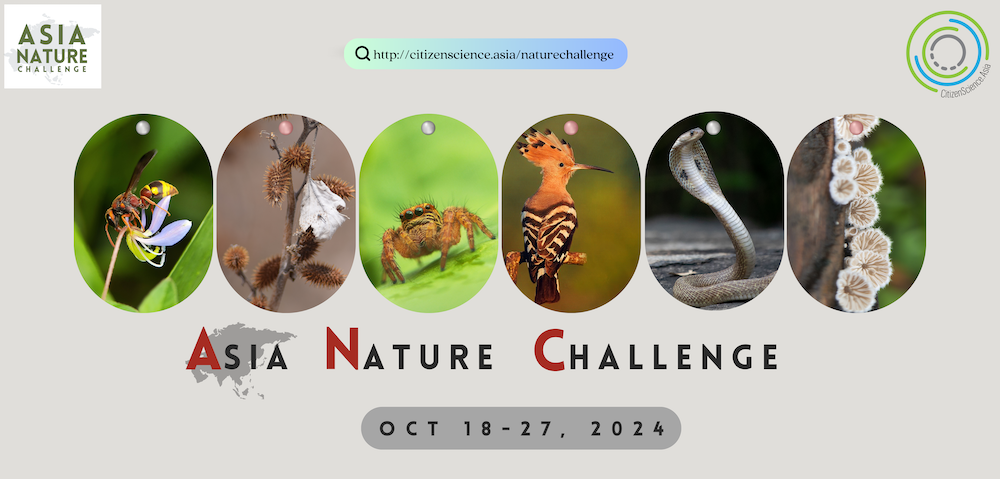
*GigaScience Press is* *helping CitizenScience.Asia mobilise Citizen
Scientists Across Asia for a groundbreaking biodiversity initiative from
October 18 to 27 2024.*
Regular readers will have seen our efforts to promote and amplify
[citizen science
projects](https://gigasciencejournal.com/blog/tag/citizen-science/),
citizen science being a key driver of \"Open Engagement of Societal
Actors\", which was [highlighted by
UNESCO](https://en.unesco.org/science-sustainable-future/open-science/recommendation)
as one of the four fundamental pillars of Open Science (and flagged in
our [10^th^ birthday
Editorial](https://doi.org/10.1093/gigascience/giac067) as an area we
needed to focus on for the next decade). Professional science alone
cannot provide information at the scales and resolutions necessary to
understand the challenges of environmental change, and problems with
scientific data collection are [hindering
efforts](https://sciencebusiness.net/news/data-biodiversity-loss-and-protection-lacking-cop15-conference-hears)
to halt mass extinction and biodiversity loss. The [GBIF (Global
Biodiversity Framework) platform](https://www.gbif.org/) has become the
go-to home for this type of data, recently crossing over 3 billion
records. Because it is scalable Citizen Science has become GBIF\'s
biggest source of data, particularly citizen science-derived data from
the massively popular smartphone app-driven
[eBird](https://ebird.org/home) and
[iNaturalist](https://www.inaturalist.org/) projects. These provide
large volumes of data to GBIF but there are known biases in data types
and geography, with some species more popular than others, and some
parts of the world having many more users. As Hong Kong based [GBIF
publishers](https://www.gbif.org/publisher/43f15a25-d37f-4e7c-bb58-4cc2a9c209b2)
in August we attended the GBIF Asia Nodes meeting in Beijing, and it was
highlighted in a number of talks that data was underrepresented from
what is the largest and most populous contentment.
::: {#attachment_5906 .wp-caption .aligncenter style="width: 760px"}
{.size-full
.wp-image-5906 aria-describedby="caption-attachment-5906"
decoding="async" height="458" loading="lazy"
sizes="auto, (max-width: 750px) 100vw, 750px"
srcset="https://gigasciencejournal.com/blog/wp-content/uploads/2024/10/SCE-in-Beijing.jpg 750w, https://gigasciencejournal.com/blog/wp-content/uploads/2024/10/SCE-in-Beijing-300x183.jpg 300w"
width="750"}
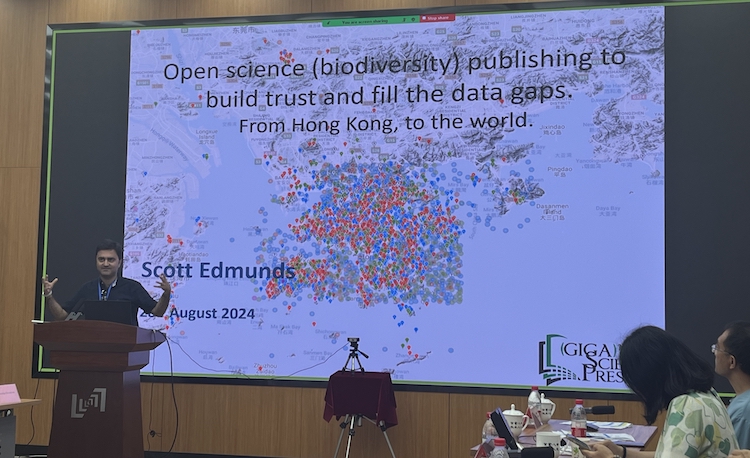
Our Editor in Chief Scott Edmunds resenting at the GBIF Asia Nodes
meeting in Beijing in August 2024.
:::
We have done efforts to drive data sharing from under-represented taxa
(see our GigaByte Data Release papers on the [Hong Kong
Jellyfish](https://doi.org/10.46471/gigabyte.125) and [iNaturalist
projects](https://gigasciencejournal.com/blog/citizen-scientists-can-see-the-wood-for-the-trees/)
on [Brazilian fruit tree
species),](https://doi.org/10.46471/gigabyte.107) but there is a need to
promote the filling in of geographic data gaps too.
With that in mind our [friends at
CitizenScience.Asia](https://gigasciencejournal.com/blog/citizen-smith-goes-to-nairobi-taking-citizen-science-to-the-un/)
are proud to announce this week the launch of the [Asia Nature Challenge
(ANC)](https://citizenscience.asia/naturechallenge), a continent-wide
citizen science event designed to significantly enhance biodiversity
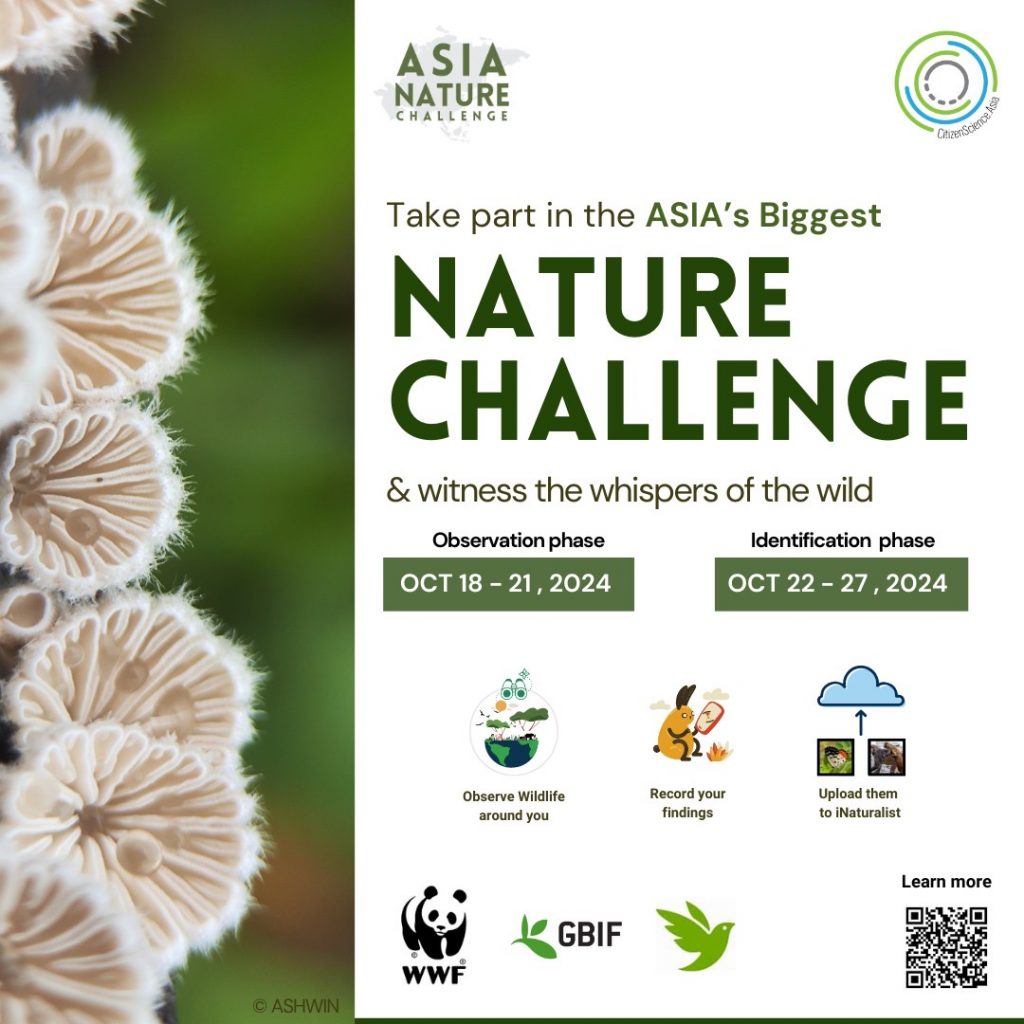
data collection across Asia. This two-part event will bring together
participants from across Asia to document the region\'s diverse flora
and fauna. Participants will be encouraged to get out and take
observations of their surrounding environments between October 18-21,
and then there will be a focus on teaming up with experts between
October 22-27 to do identifications on the observations collected.
Asia, home to some of the world\'s most unique ecosystems, ranks third
among continents in biodiversity observations on iNaturalist. However,
when measured by per capita observations, the region lags behind other
continents. With a population of over 4.7 billion, Asia has immense
potential for citizen science contributions. Statistics from July 2023
to June 2024 show that Asia accounts for a smaller share of biodiversity
observations per million people, despite being home to critical
ecosystems and species diversity. This lack of data is critical for such
a biodiverse region off the world, and in a [recent
study](https://doi.org/10.1111/nph.20024) looking at global biodiversity
\'dark spots\' where there are the most plant species waiting to be
discovered, most of these were in Asia. With 22 of the 33 \'dark spots\'
highlighted as needing further research being in Asia, including the
island of Sumatra, the eastern Himalayas, Assam in India, and Vietnam.
To address this disparity, the
[ANC](https://citizenscience.asia/naturechallenge) aims to increase
biodiversity records in Asia and encourage public involvement in nature
conservation through citizen science. This initiative comes at a crucial
time as more Asian nations recognize the importance of citizen
contribution to conservation efforts. The ANC will also seek to boost
involvement from areas that have been underrepresented in the past.
The [Asia Nature](https://citizenscience.asia/naturechallenge) Challenge
will strengthen communities by promoting collaboration among
environmental organisations, researchers, and citizen scientists. It
will increase capacity towards biodiversity research through general
public awareness and training. Furthermore, the initiative aims to
expand on international conversations to ensure that Asia\'s
biodiversity receives the attention it deserves.
**How to Participate**
For both budding and veteran citizen scientists, participating is easy
with a free account at iNaturalist. Visit
[inaturalist.org](http://inaturalist.org) from your browser, or download
iNaturalist app from the [Apple App
Store](https://itunes.apple.com/us/app/inaturalist/id421397028) or
[Google Play
Store](https://play.google.com/store/apps/details?id=org.inaturalist.android)
to create your account.
{.aligncenter
.wp-image-5907 decoding="async" height="724" loading="lazy"
sizes="auto, (max-width: 724px) 100vw, 724px"
srcset="https://gigasciencejournal.com/blog/wp-content/uploads/2024/10/9bb8460f-8ad8-44c2-bca8-98909097cc85-1024x1024.jpg 1024w, https://gigasciencejournal.com/blog/wp-content/uploads/2024/10/9bb8460f-8ad8-44c2-bca8-98909097cc85-300x300.jpg 300w, https://gigasciencejournal.com/blog/wp-content/uploads/2024/10/9bb8460f-8ad8-44c2-bca8-98909097cc85-150x150.jpg 150w, https://gigasciencejournal.com/blog/wp-content/uploads/2024/10/9bb8460f-8ad8-44c2-bca8-98909097cc85-768x768.jpg 768w, https://gigasciencejournal.com/blog/wp-content/uploads/2024/10/9bb8460f-8ad8-44c2-bca8-98909097cc85.jpg 1080w"
width="724"}
**Participants At Large:**
**Observation: *October 18-21, 2024***
1. **Find Biodiversity**: Look for any plant, animal, or signs of life
in your city / area.
2. **Take a Picture**: Capture a photo of your discovery and make note
of its location.
3. **Share Your Findings**: Upload your observations to iNaturalist.
**Identification: *October 22-27, 2024***
1. **Survey Observations**: See which observations have not been
identified in iNaturalist.
2. **Provide Identification or Categorisation**: Suggest at minimal a
high-level group like \"plants,\" \"insects,\" \"birds,\" or
\"fungi\" for unidentified observations.
3. **Review Suggestions**: Confirm or correct any identification
suggestions already made.
**Collaborating Organisations:**
Through this event, interested organisations will also be invited to
collaborate, coordinate, and lead local engagement efforts.
CitizenScience.Asia will facilitate necessary resources, including
training material and educational support, to ensure organisers and
participants have a seamless experience. This initiative promises to be
a pivotal moment for conservation efforts across Asia, generating
valuable data that will support biodiversity management and
policy-making for years to come.
If you are interested to participate as a collaborating organisation,
member, or just as a citizen on the ground, please visit
.
Further details about the Asia Nature Challenge will be provided on the
website, along with all necessary educational resources to ensure a
successful local event.
#### **References**
Edmunds SC et al. A Decade of *GigaScience*: Milestones in Open Science.
*GigaScience*. 2022;**11**:giac067. doi:
[10.1093/gigascience/giac067](https://doi.org/10.1093/gigascience/giac067).
Terenzini J et al. Jellyfish in Hong Kong: a citizen science dataset.
*GigaByte*. 2024.
[https://doi.org/10.46471/gigabyte.125](https://www.youtube.com/redirect?event=video_description&redir_token=QUFFLUhqbUtLUUZRQUh5Nk1fUG1xLWF0Y3NxYU9nY1pVd3xBQ3Jtc0tsOXkwV0hTQmZxMDVjQ3pjVTNaQW9ZQzZuakg4QU9vRUNIN0d5ZXJSMWd3bS1VT3BQNUtreFJQMl8wZVdHdG54bnZhamp4R2Y4Nk5kbW12MnhrOXNEQjNfRGlOaWFFZmxKR2hzLVpLd2luUFZ4eHM5RQ&q=https%3A%2F%2Fdoi.org%2F10.46471%2Fgigabyte.125&v=-4gH5fnO7WI)
Soares FM et al. Citizen science data on urban forageable plants: a case
study in Brazil, Gigabyte, 2024
doi:[10.46471/gigabyte.107](https://doi.org/10.46471/gigabyte.107)
Ondo I et al. Plant diversity darkspots for global collection
priorities. *New Phytol*. 2024 Aug 16.
doi:[10.1111/nph.20024](https://doi.org/10.1111/nph.20024).